How to Set Up an R&D Center in Poland?
21 min
· February 23, 2026
Last updated: August 28, 2026
Poland is quietly becoming Europe’s innovation playground. Talented engineers, competitive costs, and government incentives make it a magnet for R&D centers.
But “setting up an R&D center” sounds deceptively simple. In reality, it involves choosing the right city, navigating Polish employment law, structuring your legal entity, building a recruitment pipeline from scratch, and creating a culture that actually retains top engineers. Get any of these wrong, and you’re looking at months of delays and costly corrections.
This guide is based on over 100+ hours of dedicated research by our development team in Poland. It combines real-world case studies, local insights, and our hands-on experience building teams from scratch.
When you consider expanding the dedicated development team in Poland and research capabilities internationally, two models often come up: setting up a full R&D center or building a dedicated team.
While both serve the goal of accessing local talent, they differ significantly in structure, investment level, and strategic intent.
A dedicated team is a group of professionals, often sourced through an outsourcing or staff augmentation partner, who work exclusively on your project. This engagement model is particularly popular in the software and technology industry, where agility matters. You get access to pre-vetted specialists without the overhead of building an internal organization from scratch.
An R&D center is a more permanent, fully integrated part of your company. You open a legal entity in Poland, hire a team directly, establish office space, and build internal processes. This model suits organizations with long-term innovation roadmaps and the strategic intent to grow their country’s presence over years, not months. Read more about how to build your R&D center.
| Feature | Dedicated team | R&D center |
| Setup | No local legal entity required; operational setup handled by the partner | Requires opening a legal entity, setting up office space, and building internal processes |
| Time to launch | Fast, typically a couple of months | Slower, requires additional time for legal, hiring, and organizational setup |
| Control over operations | Shared with the outsourcing partner | Full control over team, processes, and decision-making |
| Employer brand | Limited local employer brand presence | Strong, recognizable local employer brand |
| Scalability | Suitable for moderate, short-to-mid-term scaling | Ideal for significant, long-term team growth |
| Best for | Fast launches, well-defined or time-limited projects, market or talent testing, budget flexibility | Long-term innovation roadmaps, deep institutional knowledge, strategic country presence |
At Newxel, we have hands-on experience launching both dedicated teams and full-scale R&D centers, so the choice ultimately depends on your business goals and technical requirements. Our experience shows building a dedicated team takes a couple of months, while setting up a fully operational R&D center typically requires 4–6 months, depending on team scaling complexity, and risk management.
Based on our experience, building a dedicated team typically takes a couple of months, while setting up a fully operational R&D center requires allocating more time for legal setup, hiring, and organizational maturity.
Once you decide that an R&D center is the right model for your business, the next critical question is where to establish it.
Poland has evolved into one of Central Europe’s major technology and R&D hubs. Its combination of engineering talent strategy, a mature technology ecosystem, EU market access, competitive operating conditions, and established legal and tax frameworks makes it a strong option for companies building long-term R&D operations.
Poland has one of the largest and most established technology markets in Central Europe. The country’s IT/ICT sector includes more than 100,000 ICT entities, supported by a strong base of engineering talent and an expanding ecosystem focused on areas such as AI, cloud computing, cybersecurity, IoT, and advanced software development.
Warsaw, Kraków, and Wrocław are among the country’s most important technology hubs, combining universities, established technology companies, startups, research organizations, and international R&D operations.
This ecosystem matters when you’re building an R&D center because you’re not hiring into an isolated market. You gain access to an existing technology community and a broader pool of specialists across software engineering, data, cloud, cybersecurity, and other technical disciplines.
Poland’s technology sector is also increasingly focused on innovation rather than purely outsourced delivery. According to the 2025 PARP report, Polish technology companies are expanding in areas including AI, cloud computing, IoT, and cybersecurity, while IT and ICT exports continue to grow in demanding international markets.
For an R&D center, this creates an environment where recruitment can scale beyond a small group of generalist developers toward specialized engineering and research capabilities.
Poland can offer a cost advantage compared with many Western European technology markets, while maintaining access to the same European talent and business environment.
However, the right comparison is not simply developer salary. When evaluating an R&D center location, companies should consider the total cost of employment and operations, including:
Poland also offers tax incentives that can make qualifying R&D activities more attractive.
The R&D tax relief (B+R) allows qualifying companies to deduct eligible R&D expenses from their tax base. Under current rules, the deduction can reach 200% for qualifying employee remuneration and associated social-security compliancecontributions for taxpayers that do not have R&D Centre status, subject to the applicable conditions. Companies with R&D Centre status can have different deduction limits for qualifying costs.
Poland also operates an IP Box regime, under which qualifying income from eligible intellectual property can be taxed at a 5% rate, provided the statutory requirements are met and the IP is connected to qualifying R&D activity.
These incentives should not be treated as automatic discounts. Eligibility depends on the structure and nature of the company’s R&D activities, the qualifying costs, and the relevant tax requirements. A local tax adviser should assess eligibility before an investment decision is made.
Poland’s geographic position gives R&D teams convenient access to European markets while maintaining strong connectivity with other regions.
The country operates in the CET/CEST time zone, making several hours of daily overlap with Western and Central European teams straightforward. For US-based companies, the time difference requires more deliberate scheduling, but it can also create a useful follow-the-sun workflow when teams are structured across continents.
Poland is an EU member and part of the EU Single Market, giving companies operating there access to a market of around 450 million people and 26 million businesses.
The country’s central European location also makes business travel practical. Major international airports, including Warsaw Chopin Airport, connect Polish cities with business centers across Europe and beyond.
For companies building an R&D center rather than simply outsourcing individual projects, this combination of EU market access, European time-zone alignment, and physical connectivity can make Poland particularly attractive.
For an R&D center, the legal environment matters as much as the talent market. The center will likely handle proprietary source code, product roadmaps, customer data, technical documentation, and potentially patentable technology.
As an EU member state, Poland operates within the European legal and regulatory framework, including EU data protection requirements. Companies establishing R&D operations should ensure that employment and contractor agreements clearly address IP assignment, confidentiality, data protection, and ownership of work product.
Poland’s integration into the EU Single Market also provides a familiar regulatory environment for companies already operating elsewhere in Europe.
The broader economic environment is another factor in long-term planning. The European Commission currently forecasts 3.5% GDP growth for Poland in 2026, following 3.6% growth in 2025, supported in part by investment and EU-funded spending.
For companies considering a multi-year R&D commitment, the combination of an established technology sector, EU regulatory framework, and relatively strong economic growth provides a more mature foundation than a purely cost-driven outsourcing location.
After exploring the key advantages of setting up an R&D center in Poland, it’s helpful to see how the country compares with other popular destinations for technology and R&D investments.
While Poland offers a unique combination of talent, legal protection, and innovation ecosystem, companies often consider alternatives like Germany, the UK, the USA, or India depending on their strategic goals.
The table below provides a clear comparison across key factors such as offshore software development countries, costs, legal protections, time to hire, and business environment, highlighting why Poland is often the preferred choice for establishing and scaling R&D operations.
| Feature | Poland | Germany | UK | USA | India |
| Talent pool | 100,000+ STEM graduates/year; strong in engineering, data science | Large talent pool, strong in engineering, smaller IT pool than Poland | High quality, smaller STEM graduate output | Very large, highly skilled, but expensive | Huge IT talent pool; less strong in software development |
| Cost of developer | 20–50% lower than Western Europe/US | High | High | Very high | 60–70% lower than US, but quality may vary |
| Time to hire | 2–4 weeks | 2–3 months | 2–3 months | 3–6 months | 3–6 weeks |
| Legal protection | Strong, EU-aligned | Strong, EU-aligned | Strong, EU-aligned | Very strong, US laws | Moderate; IP enforcement can be challenging |
| R&D tax incentives | R&D Tax Relief (200%), IP Box (5%) | Some R&D incentives | R&D tax credit (13–33%) | R&D tax credit varies by state | Some government incentives, but limited |
| Business environment | Stable economy, GDP ~5% | Stable, high cost of operations | Stable, moderate cost | Stable, very competitive | Growing economy, variable regulations |
| Innovation ecosystem | Thriving tech hubs in Warsaw, Kraków, Wrocław; strong startups | Strong industrial research hubs | London, Cambridge startups | Silicon Valley, Boston, strong research | Growing startup ecosystem |
| Time zone | CET/CEST, good overlap with Europe, limited with US | CET/CEST | GMT/BST | Multiple – US internal | IST – limited overlap with Europe/US |
With a clear understanding of how Poland compares to other R&D destinations, it’s easy to see why it stands out as a strategic choice. The next step is to explore how to successfully set up and scale an R&D centre in Poland, from hiring talent to establishing operations and leveraging the local ecosystem.
Setting up a legal entity, obtaining permits, and ensuring compliance with Polish employment law can be complex and time-consuming.
Solution:
You can delegate the legal and operational setup to a local partner with proven experience in Poland. Newxel supports clients by managing the full setup cycle, including entity registration, tax filings, bank account opening, and employment law compliance. This local expertise helps avoid costly mistakes and months of delays during launch.
Even with a highly skilled workforce, differences in business culture, communication styles, and language can slow down team integration and decision-making.
Solution:
You can assign dedicated Country Managers or R&D Center Directors who understand both the client’s corporate culture and the Polish market. This ensures clear communication, faster onboarding, and strong team cohesion from day one.
In practice, Newxel also embeds a dedicated HR partner within the Polish team, acting as a trusted local point of contact and day-to-day “buddy” who proactively resolves onboarding, workplace, and operational issues before they escalate.
More details about Staff Augmentation in Eastern Europe to get more about best practices for team growth.
Maintaining a competitive edge in R&D requires adapting quickly to new technologies, frameworks, and research trends.
Solution:
You can leverage partnerships with local universities and technology hubs to access engineers skilled in cutting-edge technologies. These collaborations help teams stay continuously updated on emerging trends. Newxel actively works with local ecosystems and talent networks, allowing R&D centers to remain competitive without the overhead of constantly scouting and validating new talent independently.
Finding professionals with highly specific skills for advanced R&D projects can be difficult, despite a large overall talent pool.
Solution:
Implement focused recruitment strategies built around role-specific pipelines and local market expertise. Newxel accelerates hiring by building tailored talent pipelines, sourcing from universities, niche communities, and specialized recruitment channels. For clients requiring rapid ramp-up, the first specialists can be hired in 2–4 weeks while maintaining high quality and retention.
Without clear objectives, R&D centers may pursue projects misaligned with business goals, reducing overall effectiveness.
Solution:
Define clear strategic roadmaps, ownership models, and growth plans before scaling the team. Newxel provides hands-on support in shaping R&D strategy, helping clients clarify technology domains, hiring horizons, and integration points with headquarters to keep execution aligned with long-term business goals.
R&D performance suffers when teams lack collaboration, motivation, or a strong sense of belonging.
Solution:
You can design culture intentionally from day one, rather than letting it evolve by accident. Newxel supports this by building structured onboarding, clear communication frameworks, and motivating work environments, including branded office setups, local leadership, and mentorship practices that foster collaboration and long-term engagement.
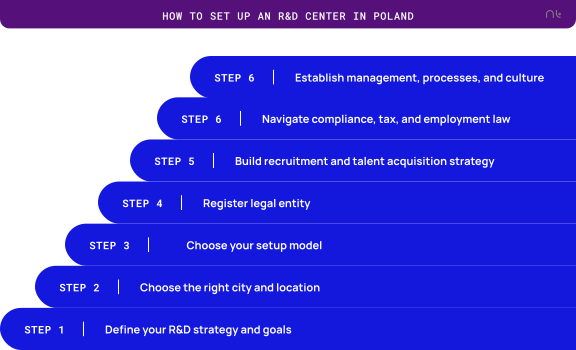
Setting up R&D center in Poland involves a series of sequential decisions and actions. Rushing any step can lead to costly corrections later. Below is a structured roadmap to set up an R&D center in Poland, from early-stage startups to large multinationals, to open their Polish R&D hub efficiently.
Before any legal or operational steps, you must define what you are trying to build. This means answering questions like: What technology domains will your center focus on? How many people do you plan to hire over the next 1, 3, and 5 years? Will this center operate as a cost center or a profit center? How closely will it integrate with your existing company?
Without clear answers, every subsequent decision, from location to partner selection to legal structure, becomes harder and more expensive. Many companies fail to establish a successful R&D presence because they open an office before they have a clear strategic brief.
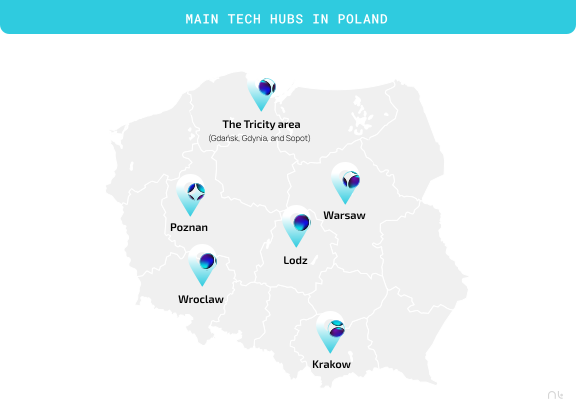
Poland has multiple major cities that host thriving tech ecosystems. Choosing the right one depends on your industry focus, the talent profile you need, and your operational preferences.
Warsaw
The capital and largest tech market. Best for companies that need senior, experienced specialists and proximity to financial, legal, and business services. The recruitment pool is large, but competition for talent is highest here.
Krakow
Poland’s second-largest tech hub, with a strong university ecosystem and a large number of global corporations that have already opened local centers. Particularly strong in finance, cybersecurity, and software development.
Wroclaw
Known for its thriving local tech industry and strong academic base. Particularly popular with semiconductor, hardware, and embedded software companies.
Poznan and Lodz
Emerging markets with growing talent pools and lower rental costs, good options for companies focused on cost optimization alongside quality.
The Tricity area
Gdańsk, Gdynia, and Sopot: has emerged as a thriving tech hub in Poland, offering a strong pool of IT talent and a growing network of startups and innovation centers. Its vibrant ecosystem and strategic coastal location make it an attractive destination for establishing and scaling R&D operations.
How you legally and operationally structure your R&D center in Poland will have implications for taxation, hiring, and long-term flexibility. The main options are:
Wholly Owned Subsidiary (Sp. z o.o.): The most common model. You register a Polish limited liability company that employs staff directly. Full ownership, full control, full employer responsibilities.
Branch office: A registered branch of your foreign company operating in Poland. Simpler to set up, but limited in operational scope and may carry parent company liability implications.
R&D partnership with a local entity: Some companies choose to partner with an established Polish technology company or outsourcing provider selection to establish their center. This accelerates setup but requires careful IP and governance structuring.
Employer of Record (EOR): For companies that are not yet ready to open a legal entity, an EOR allows you to hire Polish talent through a third-party employer. This is often used as a stepping stone toward a fully owned structure.
If you are establishing a subsidiary, the process involves registering with the National Court Register (KRS), obtaining a NIP (tax identification number) and REGON (statistical number), registering for VAT if applicable, and setting up a Polish company bank account.
The registration process typically takes 2 to 4 weeks if done correctly. Working with a local legal partner who specializes in business setup is strongly recommended. Errors at this stage, wrong company structure, missing filings, incorrect share capital, can cause months of delays.
Recruitment is the single most critical factor in the success of R&D in Poland. The country has strong talent, but it is also a competitive market, especially for senior engineers, machine learning specialists, and domain experts.
A successful recruitment strategy for your Polish R&D center typically includes:
Poland has a comprehensive and well-regulated employment framework. Key elements to understand include:
Employment contracts: Polish law distinguishes between employment agreements (umowa o prace), which carry significant employee protections, and civil contracts (umowa o dzielo, umowa zlecenie). Most R&D specialists expect employment agreements.
Social security: Employers contribute to ZUS (Zusicherungsanstalt fur Sozialversicherung equivalent) for each employee, currently around 20% of gross salary in employer contributions.
R&D tax relief: To qualify for the R&D Tax Relief (ulga B+R), companies must maintain detailed documentation of qualifying R&D costs and activities. Working with a Polish tax advisor from the beginning is essential.
IP ownership in employment contracts: Polish labor law includes default provisions that may assign certain IP rights to employees. Contracts must explicitly address IP transfer to ensure company ownership of all R&D output.
The technical and legal setup is only half the challenge. Building a high-performing R&D center requires deliberate work on organizational culture, management structure, and operational processes.
Many companies appoint a Country Manager or R&D Center Director who acts as a local anchor, someone who understands both the company’s global strategy and Polish market dynamics. This person is responsible for building a cohesive team culture, managing local operations, and representing the center to the parent company.
From day one, invest in clear communication frameworks between your Polish team and headquarters. Misalignment on priorities, timelines, and ways of working is the most common reason R&D centers underperform, not technical capability.
Poland’s main technology hubs offer different combinations of talent depth, salary pressure, competition, and specialization. The right choice depends less on finding the “best” city and more on matching the location to your hiring plan and R&D focus.
| City | Talent pool | Salary level | Hiring competition | Best fit |
|---|---|---|---|---|
| Warsaw | Very large | Highest among the four | Very high | Large R&D centers, senior engineering, fintech, AI, enterprise technology, companies needing access to business and corporate services |
| Kraków | Very large | High | High | Software engineering, fintech, cybersecurity, data, AI, multinational R&D centers |
| Wrocław | Large | High | High | Software engineering, embedded systems, electronics, automotive, advanced engineering |
| Gdańsk / Tricity | Large | Moderate–high | Moderate–high | Software, maritime/industrial technology, cybersecurity, cloud, startups and companies looking for a strong northern Poland talent base |
Newxel specializes in helping international businesses establish and scale dedicated development teams and R&D centers across Poland and Eastern Europe, offering a managed alternative that sits between full entity ownership and traditional outsourcing.
Our case
In 2023, a global SportTech company with 8.5 million customers approached Newxel with a clear mission: build a fully operational R&D center in Warsaw from scratch. The challenge was threefold: break into an untapped talent market, maintain full legal and HR compliance in a new country, and stand up a physical, branded office that employees would actually want to work in.
What we delivered
Within six months, Newxel grew the team from zero to 20+ engineers, fully integrated with the client’s existing culture, workflows, and product teams. Alongside the talent build-out, we designed and launched a dedicated branded workspace tailored to the company’s identity and operational needs.
Throughout the engagement, Newxel managed the full operational stack: HR, payroll, legal compliance, and office management, giving the client a genuinely hassle-free experience while creating a motivating, high-quality environment for the team on the ground.
The result
A thriving 20-engineer R&D hub in Warsaw, built in under six months, with zero operational burden on the client, and a foundation ready to scale further.
So, if you are considering this market and do not want to go through the full 7-step process of hiring, setting up an office, and managing operations, we can handle it. With over 8 years of experience, we have built a process to hire the right talent in 2–4 weeks while ensuring high retention and a smooth setup for your team.
The blueprint is here. Poland has the talent, the incentives, and the ecosystem. What it needs now is your decision.
Companies that invest in R&D centers in Poland today are building teams that will drive their next decade of growth, at a fraction of the cost of comparable Western European setups, without any sacrifice in quality or capability.
Newxel has taken global companies from zero to a fully operational R&D center in Warsaw in under six months. If you’re ready to move from “we’re considering Poland” to “we’re building in Poland,” – let’s talk.