Set up IT Hub in Poland: A Practical Guide for Tech Companies
10 min
· March 24, 2026
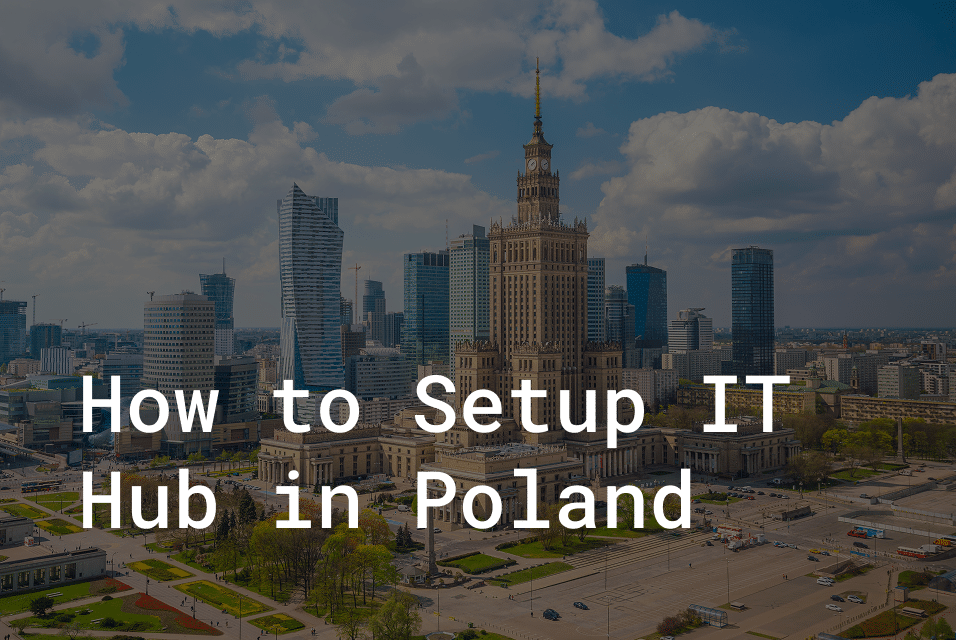
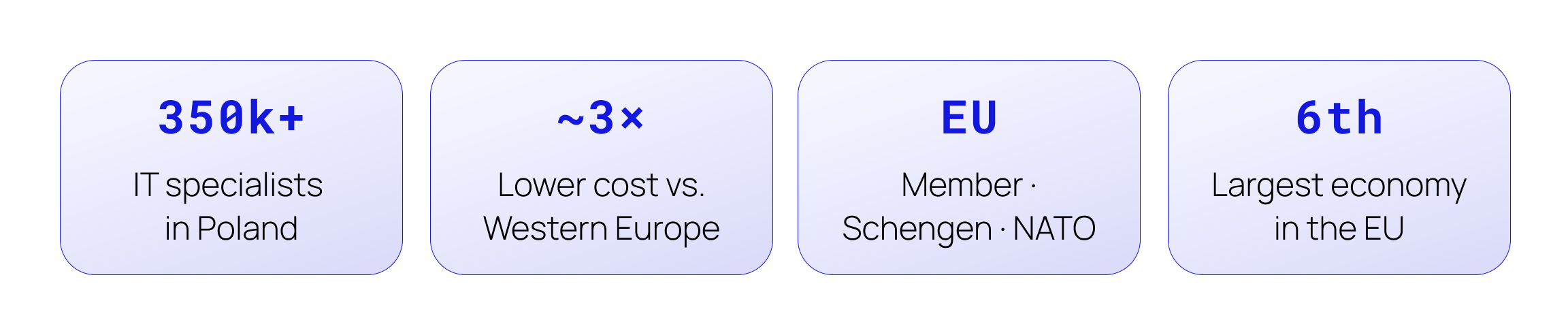
Warsaw is becoming a “European New York,” hosting global tech giants like Google, Microsoft, and Samsung, along with a growing ecosystem of hundreds of innovative tech firms. With over 350,000 IT specialists and talent costs roughly 3x lower than in Western Europe, this country has become an attractive place to set up IT hub in Poland.
Combined with the 6th largest economy in the EU and membership in both Schengen and NATO, the country offers not only cost efficiency but also economic stability, innovation, security, and seamless access to European markets.
We’ve gathered over 8 years of experience working in global markets and setting up teams in Warsaw, and we’re sharing a practical guide based on our successes and lessons learned to help you avoid costly mistakes and make your IT hub setup truly worthwhile.
For a tech company evaluating European expansion, the shortlist usually runs through Berlin for its startup culture, Lisbon for its lifestyle premium, and Tallinn for its digital governance.
Warsaw beats them on nearly every operational metric that matters at scale: IT professionals depth, IT infrastructure maturity, legal clarity, and a government that has actively courted the technology sector with tax incentives, special economic zones, and streamlined incorporation processes.
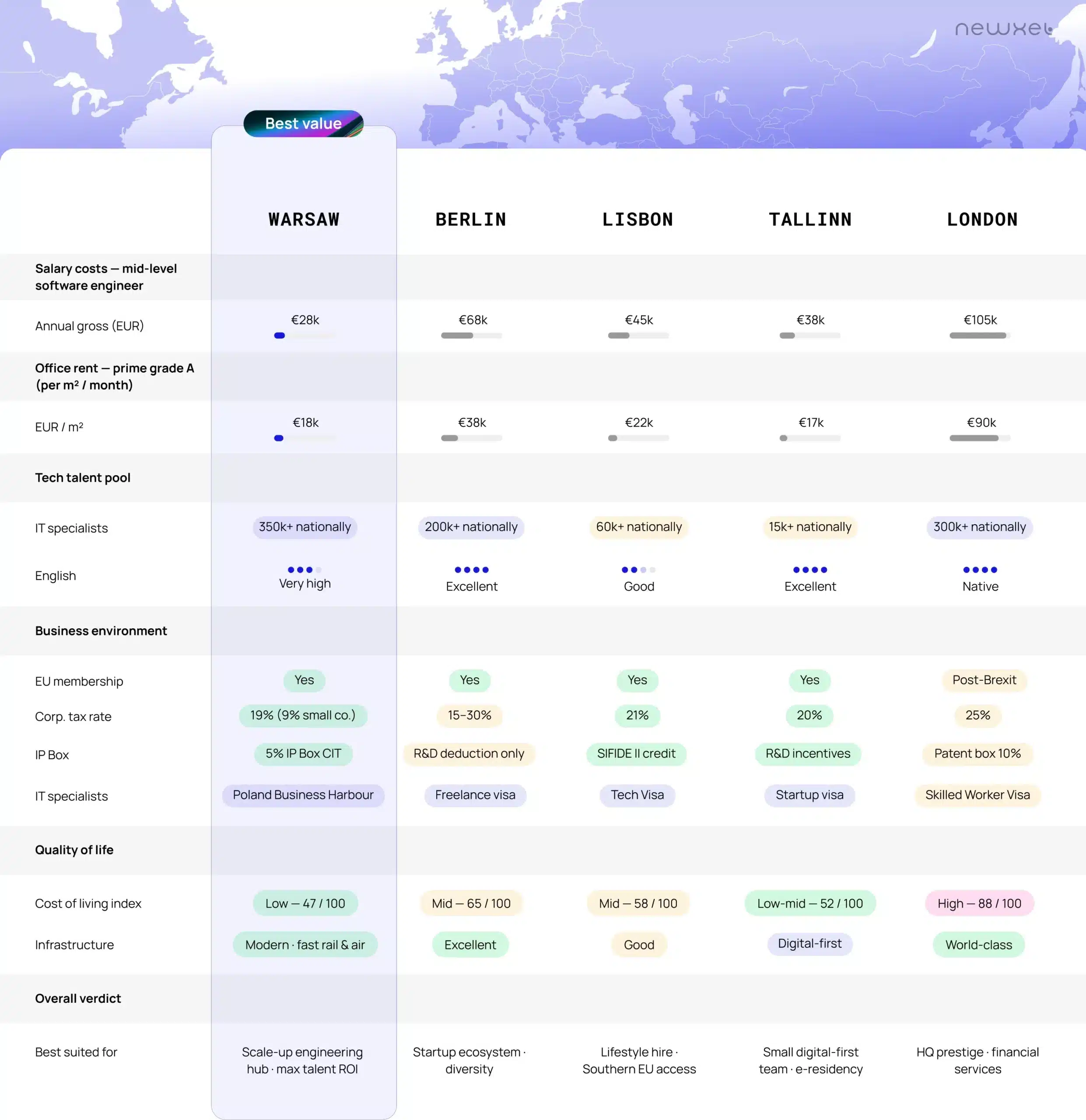
Warsaw’s strongest differentiator is the combination of factors: not just cheap salaries, but also a 350k+ talent pool, EU legal stability, and a 5% IP Box corporate tax on intellectual property income. That last point is often underappreciated: a software company where the core product qualifies as IP can dramatically reduce its effective tax burden, something Berlin and London simply can’t match.
Tallinn is the only city that rivals Warsaw on cost, but its talent pool is 20× smaller, fine for a 10-person distributed team, not viable for a 200-person engineering centre. London wins on prestige and financial services access, but loses on virtually every operational cost line.
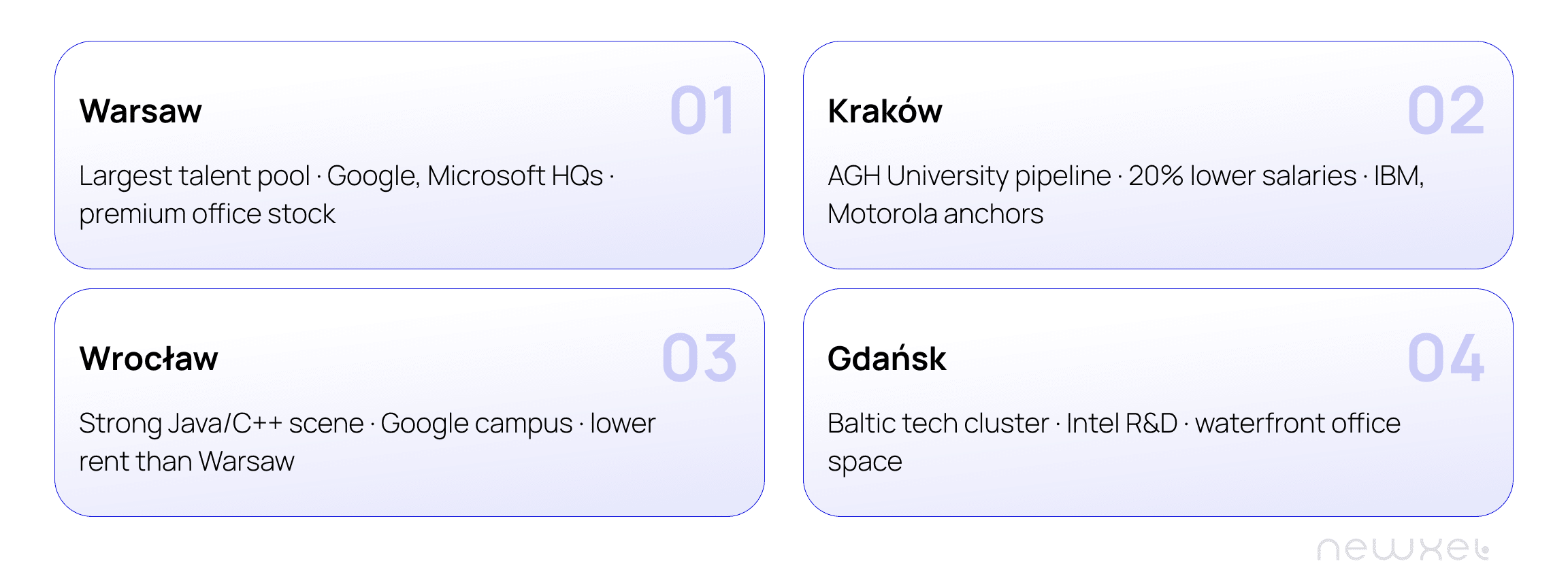
Warsaw is the obvious choice for companies that need scale: a talent pool of more than 100,000 IT professionals in the metro area alone, Grade A office towers ready to accommodate a 500-person team, and the gravitational pull of Google, Microsoft, and Samsung, already normalising the idea of a serious tech presence here. But Warsaw is also competitive.
Kraków, meanwhile, is quietly becoming the favourite of companies that want density of talent over breadth. Wrocław has a strong C++ and embedded systems culture, owing partly to the Intel and Nokia legacies there. Gdańsk punches above its weight in fintech and gaming.
Newxel advice:
Many companies run a “soft landing” first: 2–3 engineers on a local employer-of-record contract, testing the market for 6 months before committing to incorporation. It delays the IP Box tax benefits but dramatically reduces the risk of choosing the wrong city.
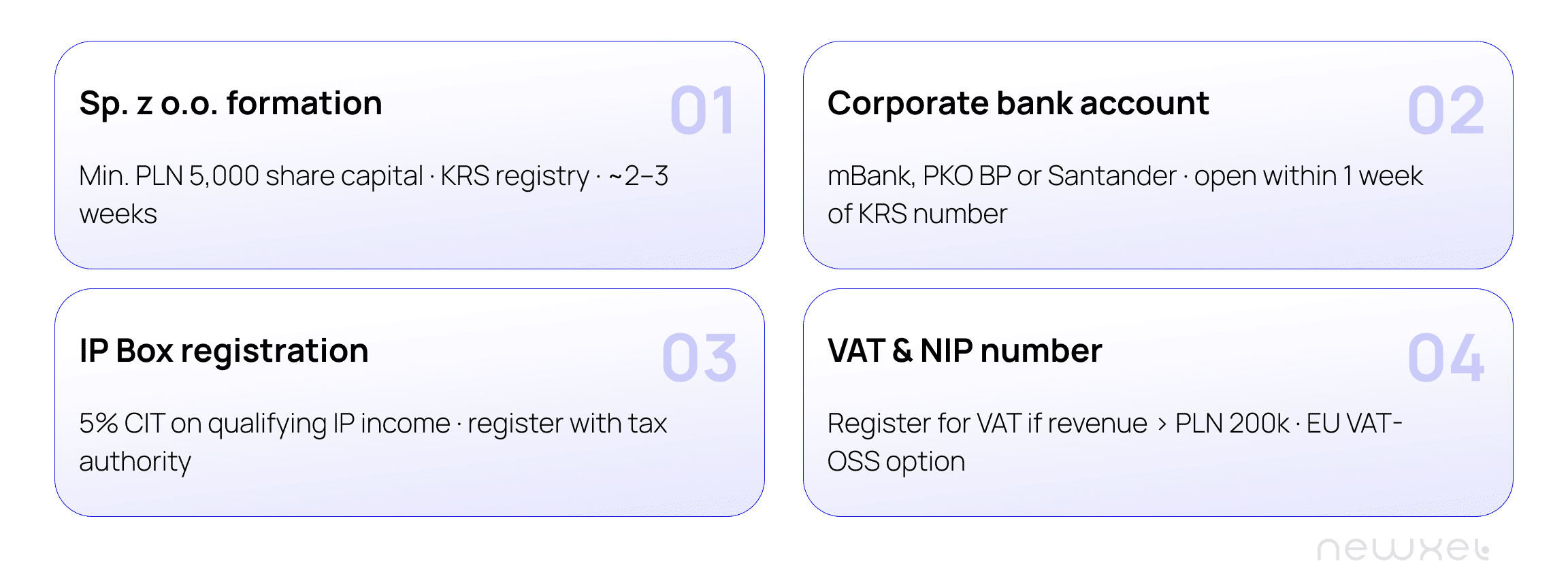
The Polish legal system is EU-standard and predictable to set up IT hub in Poland. The entity of choice for almost every foreign tech company is the spółka z ograniczoną odpowiedzialnością, or sp. z o.o. – a limited liability company that requires just PLN 5,000 (roughly €1,100) in share capital and can be incorporated in two to three weeks via a notarised deed.
But here is where most foreign companies leave money on the table: they incorporate, hire an accountant, and never ask about the IP Box. Poland’s IP Box regime allows software companies to pay a flat 5% corporate income tax rate on income derived from intellectual property: patents, copyrights, qualifying R&D.
Cost reality check:
Budget €2,000–4,000 for notary and legal fees, €500–800 for the first year of accounting setup, and €300–500 for the bank account opening process. Total legal setup cost for a well-run incorporation: under €6,000. Cheaper than a single month’s London rent.
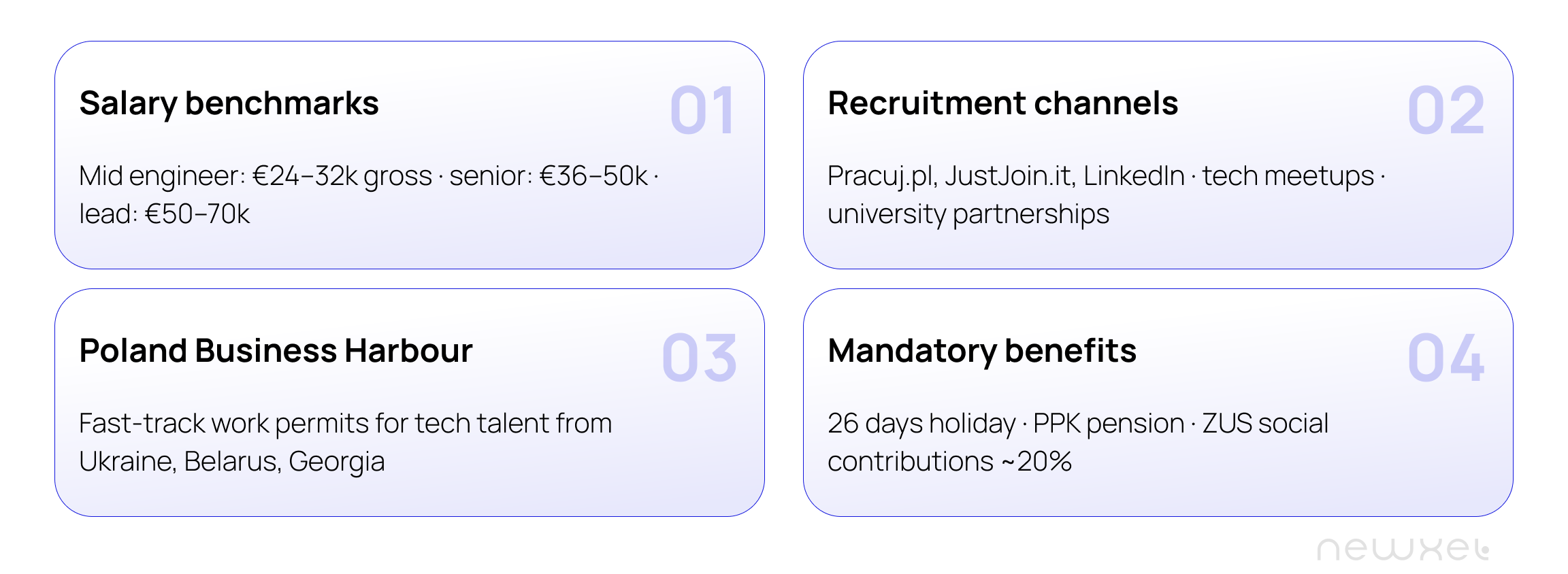
A mid-level backend engineer costs €24,000–32,000 gross per year. A senior engineer with eight years of experience costs €36,000–50,000. These are not trainee numbers Polish universities produce rigorous, mathematically-literate graduates, and the country’s decades as an outsourcing hub means the senior cohort has been battle-tested on real production systems.
What trips foreign companies up is the employment law. Polish labour law is employee-friendly by design: statutory notice periods of one to three months, 26 days of paid holiday minimum, mandatory PPK pension contributions, and detailed rules around what can and cannot be written into a contract.
Two features of the market deserve special attention to set up IT hub in Poland.
Culture note:
Polish engineers tend to be direct, technically precise, and less likely to over-promise than counterparts in some other markets. They expect to be given genuine ownership of problems, not just tickets. If your onboarding process treats them as execution resources rather than thinking partners, expect high early attrition.
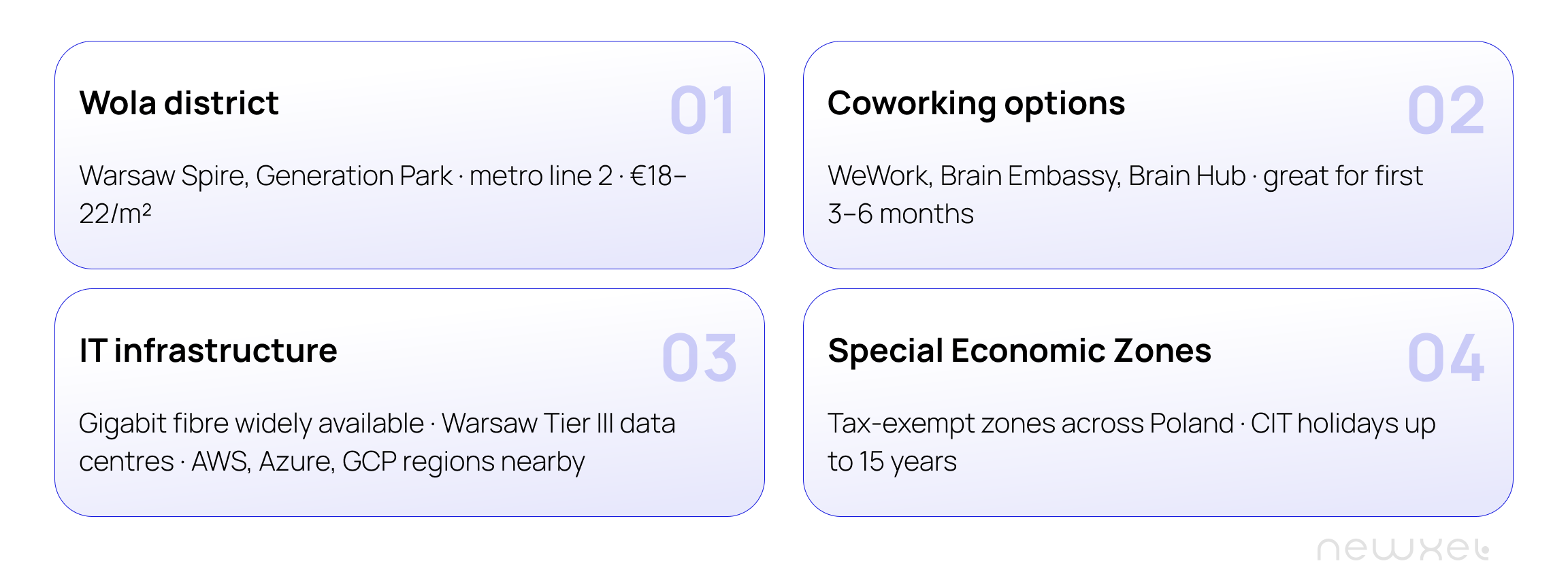
Warsaw’s office market has transformed entirely in the past decade. The Wola district is now a gleaming corridor of Grade A towers: Warsaw Spire, Generation Park, Mennica Legacy Tower. Google occupies 20,000 square metres in Warsaw Spire. Samsung’s R&D centre anchors the eastern end of the corridor. Rents run €16–22 per square metre per month, roughly half of comparable space in Berlin, and less than a quarter of London’s West End.
But here is the trap: signing a 5-year lease before you know what your team looks like.
Polish commercial lease terms are not forgiving. Break clauses are rare. Subletting requires landlord consent.
The right move for most companies to set up IT hub in Poland in the first year is a coworking licence: Brain Embassy, WeWork, and Hub:raum all have well-located Warsaw campuses, while you validate headcount and culture.
Newxel advice: Start with a 3-month coworking licence while you hire, committing to a 5-year lease before headcount is confirmed is the most common (and expensive) mistake foreign companies make.
Explore other countries to set up an R&D center with our latest article.
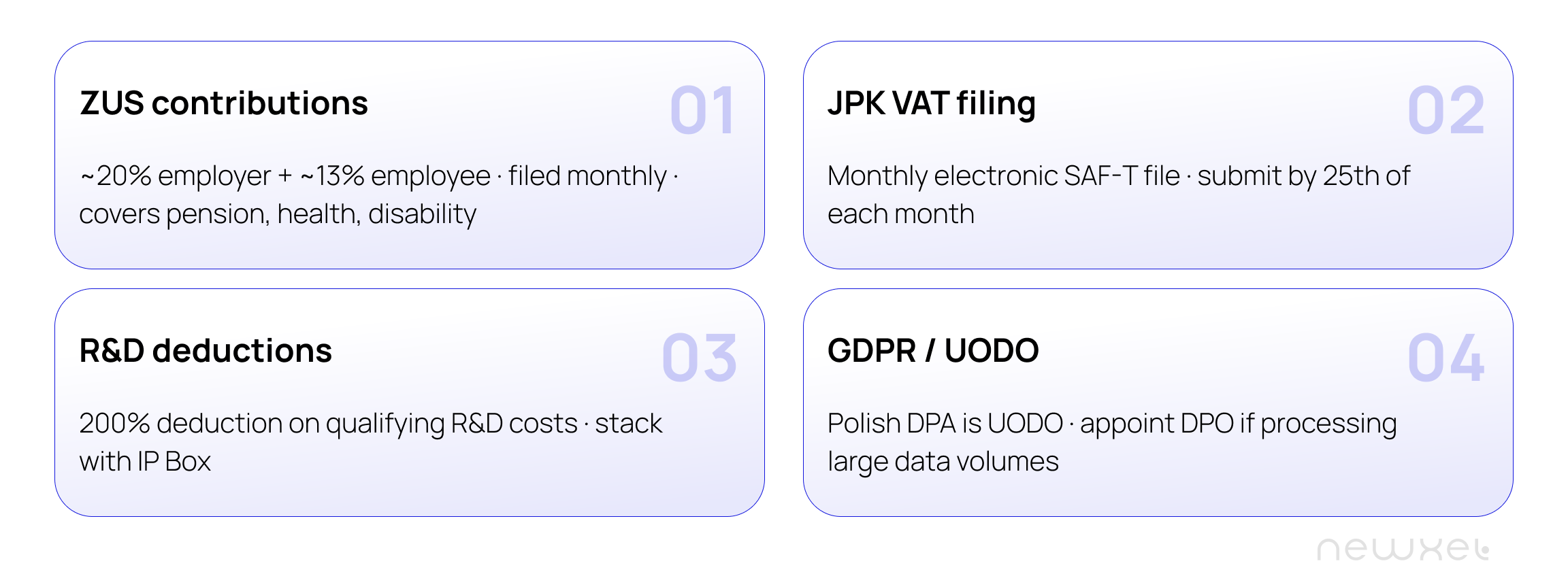
Polish accounting is detailed and deadline-driven. ZUS social insurance contributions must be filed and paid monthly, covering pension, disability, sickness, and health insurance for every employee to set up IT hub in Poland.
The JPK (Jednolity Plik Kontrolny) is a mandatory electronic SAF-T file submitted to the tax authority by the 25th of each month. The Polish General Data Protection Authority, the UODO enforces GDPR with increasing vigour, and companies handling significant volumes of personal data are expected to appoint a Data Protection Officer.
None of this is exotic or unusually burdensome by EU standards. But it is genuinely different from the UK or US systems, and the penalties for late or incorrect filings are real. Outsource payroll and accounting until you have 50 employees. The cost of a competent Polish accounting firm, €800–1,500 per month for a small team, is trivially small relative to the cost of a compliance error or a disgruntled employee whose ZUS contributions were filed incorrectly.
The payoff:
Companies that have set up Polish IT hubs correctly, legal entity optimised for IP Box, team structured around B2B where appropriate, compliance outsourced from day one, consistently report that their Warsaw or Kraków operation is their most cost-efficient engineering centre globally, delivering output per euro that no Western European office can match.
In 2023, a global SportTech company came to Newxel with a mission that was as clear as it was daunting: build a fully operational R&D centre in Warsaw, a market they had never hired in before, from a standing start. No local entity. No local contacts. No team.
The challenge was not one problem but three running in parallel. First, breaking into an unfamiliar talent market and identifying the right engineers fast, without the false starts that typically come with hiring in a new geography.
Second, staying fully compliant with Polish employment law, ZUS obligations, and the country’s detailed HR regulations: all without a local team to manage them. Third, standing up a physical office that engineers would genuinely want to come to branded, functional, and ready on day one.
Newxel as a talent partner managed the entire build: from first job posting to signed leases and onboarded engineers, as a single integrated engagement. Within six months, the team had grown from zero to more than 20 engineers, each fully embedded in the client’s existing workflows, product rituals, and engineering culture, as though they had always been there.
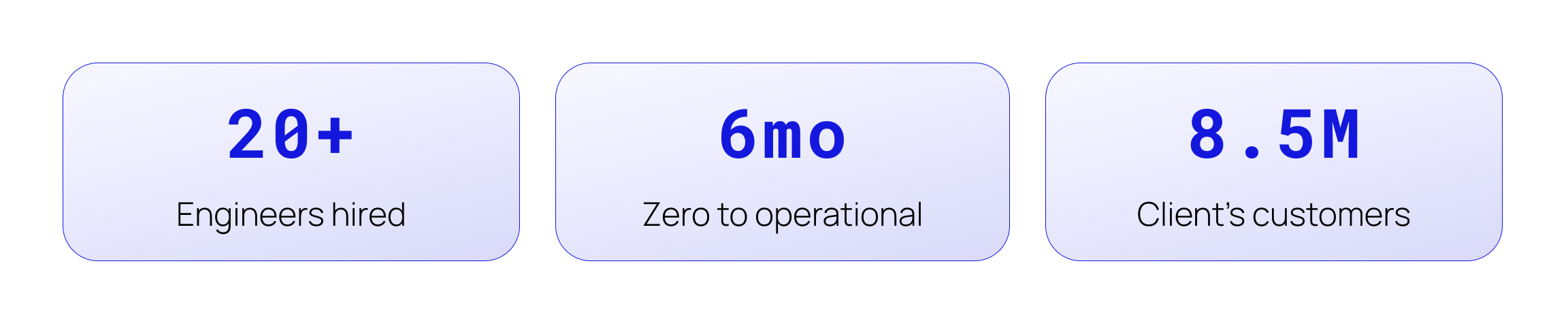
A fully operational 20-engineer R&D hub in Warsaw, built in under six months, with zero operational burden on the client, and a foundation that is already scaling further. The engineers have a home they are proud to come to. The client has a team that ships.
Warsaw is no longer a frontier market for technology companies. The infrastructure is there. The talent is there. The companies that moved early: Google, Microsoft, Samsung, Revolut did not get lucky.
Tell us what you need to build and where you want to build it. Newxel takes care of every step: recruitment, HR, legal compliance, payroll, office setup, and hands you back a fully operational Polish engineering team, typically within 2 to 4 weeks of first contact. So, if you ready to start – let’s talk!