Tech Talent Acquisition Services for IT: A Practical Guide for Engineering Leaders
25 min
· March 17, 2026

Based on Newxel’s internal hiring data, client engagements, and recruitment operations across 8 European markets.
We hear the same story from CTOs so often it’s become predictable. It usually starts with a win: a new product initiative gets the green light, the headcount is approved, and the recruiting team starts hitting the market. Everything feels like it’s moving in the right direction.
Then, ninety days slip by, and suddenly there’s a gap between the plan and the reality. The senior roles are still open. The two candidates who were actually qualified ended up taking offers elsewhere because the internal process couldn’t keep pace with the market. By this point, the roadmap has already been quietly scaled back because there simply isn’t anyone in a seat to build what was promised to stakeholders.
The most difficult part of this situation is that, on the surface, no one failed. If you look at the logs, the team followed every internal protocol and the recruiters checked every box on their list. It’s a frustrating paradox where everyone did exactly what they were told to do, yet the business ended up exactly where it didn’t want to be.
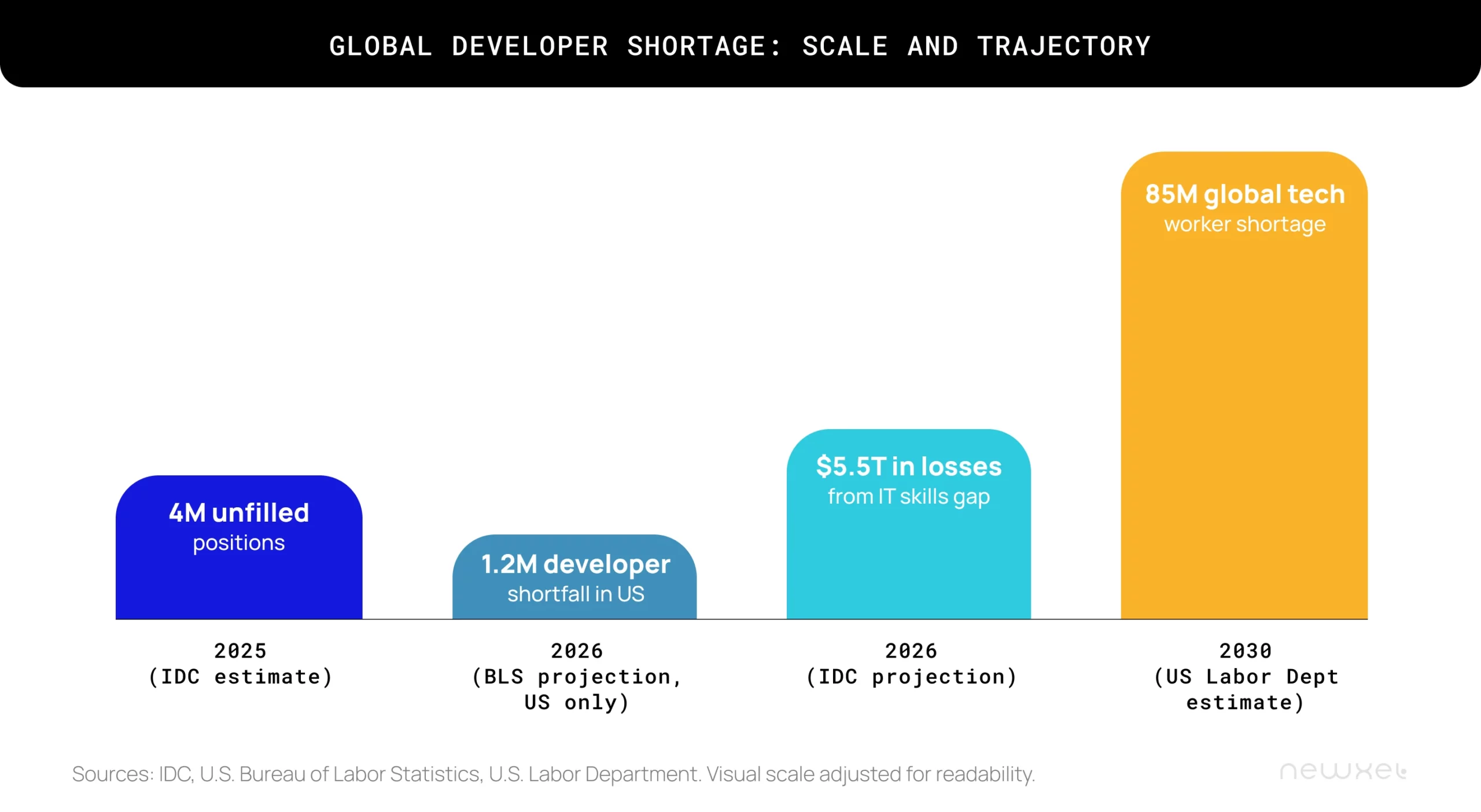
The scale of this problem is worth understanding, because it’s not just anecdotal. IDC estimated the global shortage of full time software developers at 4 million as of 2025, and projects that IT skills shortages will cost organizations $5.5 trillion globally by 2026. The U.S. Bureau of Labor Statistics forecasts software developer employment to grow 15% from 2024 to 2034, far outpacing the 3% average for all occupations, with roughly 317,700 openings projected annually in computer and IT occupations over the decade. [1, 2]
What we want to do in this article is walk through what tech talent acquisition actually looks like in practice, why it’s become so difficult, what strategies are working for the companies that are managing to grow their teams, and how staff augmentation fits into that picture as a practical option. This isn’t theory. It’s drawn from years of recruiting and managing dedicated development teams across Eastern Europe at Newxel.
There’s a common confusion that’s worth clearing up early. Recruitment and talent acquisition get used interchangeably, but they’re different things, and the difference matters a lot when you’re running an engineering org.
Recruitment is what happens after a position opens. Someone writes a job description, posts it, reviews the applications, and eventually makes a hire. It’s reactive by nature. Tech talent acquisition is the broader system that makes sure your engineering organization can actually get the people it needs, when it needs them, at the quality level required to ship production code. It includes workforce planning, proactive sourcing, employer branding, and retention, all running in the background long before any individual role opens up.
The CTOs who get this right tend to think about hiring the way they think about architecture: as a system, not a series of one off events. They map engineering headcount to the product roadmap 2 to 4 quarters out. They invest in building relationships with qualified developers before there’s a specific opening. They build their employer brand for the exact engineering audiences they want to attract, whether that’s backend engineers working in their stack, ML engineers in their problem domain, or infrastructure engineers familiar with their scale.
And then there’s the evaluation piece, which is where most companies leave value on the table. A standard technical interview tests whether someone can solve algorithmic problems. What it usually doesn’t test is whether that person can walk into an unfamiliar codebase and follow its conventions instead of rewriting everything their own way, or whether they’ll speak up early when they’re stuck rather than going dark for three days. At Newxel, these are the signals we specifically screen for, because in our experience, they’re what separate a developer who contributes from sprint 1 from one who creates friction for weeks.
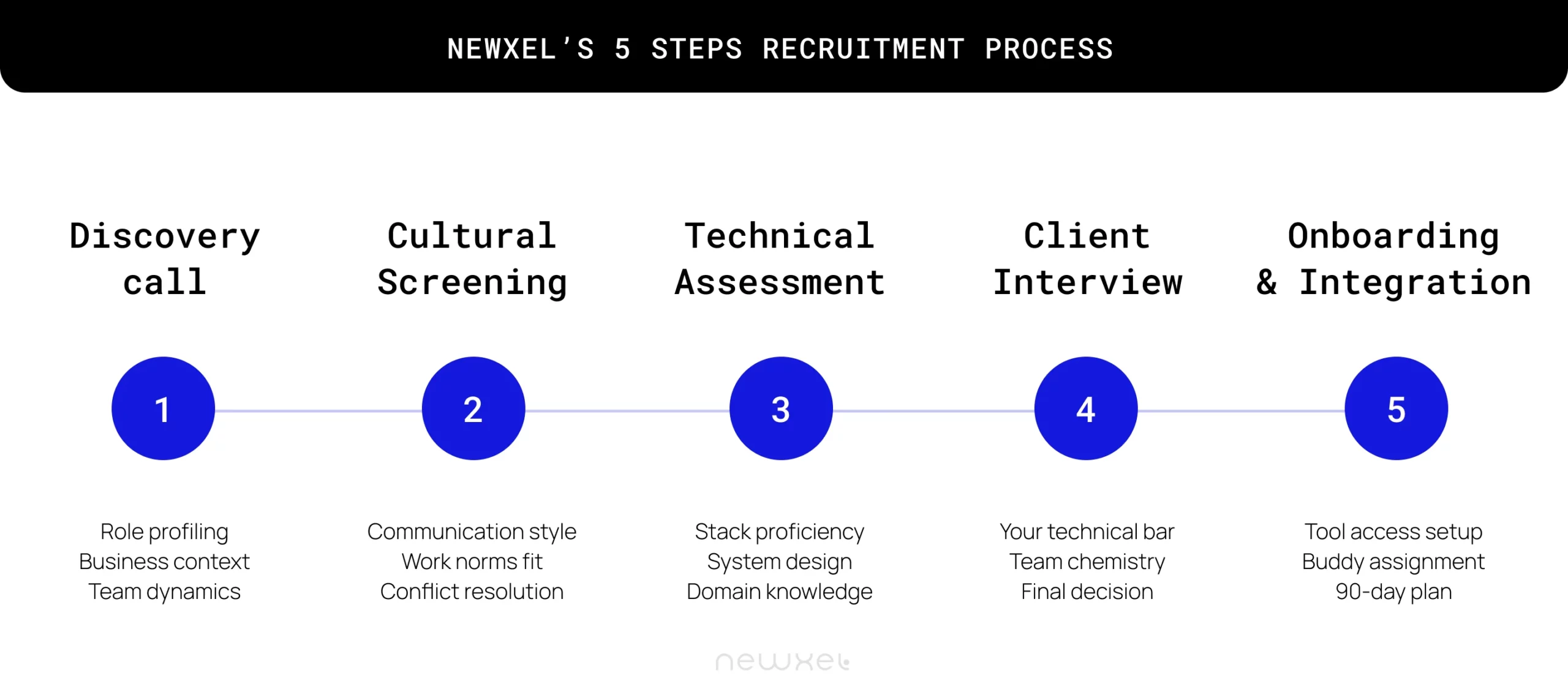
Newxel’s 5 steps recruitment process:
Before jumping to solutions, it helps to be honest about what’s going on. The hiring challenges engineering leaders face in 2026 aren’t vague. They are specific, they compound each other, and they tie directly to business outcomes.
On paper, hiring a software engineer takes 35 to 41 days from posting to accepted offer. In practice, senior roles regularly stretch to 3 to 6 months once you account for sourcing, multiple interview rounds, offer negotiations, and notice periods. IDC predicted that by 2026, more than 90% of organizations worldwide would feel the pain of the IT skills crisis, amounting to some $5.5 trillion in losses, so those empty seats weren’t just inconvenient. They are expensive. [1, 3]
Here’s what that looks like in practice. Say you have approved headcount for 4 senior engineers to build out a new product initiative. Recruiting starts sourcing. Two months later, you’ve made 1 hire, you’ve got 2 people in the pipeline who are also talking to three other companies, and the initiative’s launch date, which was set assuming a full team, is already at risk. The remaining engineers on your existing team are absorbing the extra work, which means their output on the core product is suffering too. This isn’t an edge case. This is what most scaling companies experience as their baseline.
If you’re hiring in Tel Aviv, San Francisco, London, or Berlin, your recruiting team has probably noticed that the same profiles keep showing up on LinkedIn. The developers who are actively looking tend not to match the seniority or specialization you need, and the ones who do match are already employed and get 3 to 5 inbound messages from other companies every week. IDC estimated the global shortage of full-time software developers would grow from about 1.4 million in 2021 to about 4 million in 2025.. The Bureau of Labor Statistics projected the US developer shortage would exceed 1.2 million by 2026, with 545,000 current software engineers expected to have left the workforce by then. Looking further ahead, the U.S. Labor Department estimates the global shortage of tech workers could reach 85 million by 2030. [1, 4, 5]
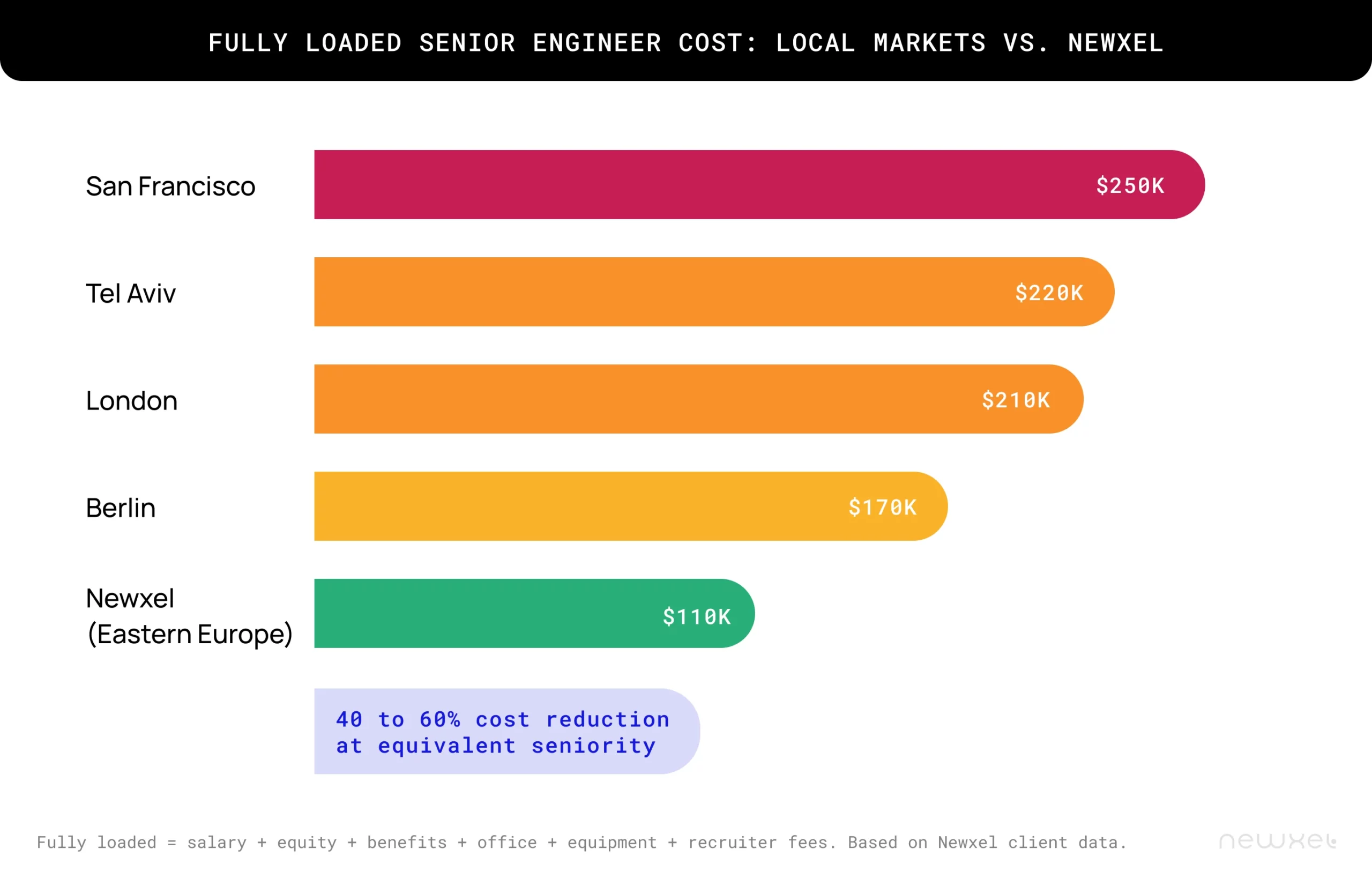
A senior engineer in Tel Aviv, San Francisco, or London costs $180,000 to $250,000 fully loaded once you add up salary, equity, benefits, office space, equipment, and the recruiter fee it took to find them. Tech salaries are projected to rise 8 to 10% in 2026 according to Addison Group’s workforce planning guide, as companies bid against each other for AI, cybersecurity, and cloud expertise. [6]
And this pressure isn’t limited to startups. We talk to CFOs at companies of all sizes who are asking their engineering leaders to explain cost per engineer, and the math on local hiring in tier 1 markets gets harder to defend every year when equivalent talent exists in other geographies at a fraction of the fully loaded cost.
The technology stack your team relies on today will look noticeably different in 2 to 3 years. Harvard Business Review research puts the half-life of tech skills at approximately 2.5 years, which means the qualifications that made someone a strong hire in 2024 may already be falling behind what the work requires in 2026. The Linux Foundation’s 2025 state of tech talent report found that AI and ML engineering roles are understaffed at 68% of organizations, with cybersecurity and compliance not far behind at 65%. These aren’t niche roles anymore. They’re table stakes, and most companies can’t fill them with their existing pipeline. [7, 8]
The AI boom has made this worse. In 2025, organizations reported real value from AI in software development (54%), data analytics (52%), and infrastructure monitoring (45%), according to the Linux Foundation. But the people who can build and maintain those systems are in critically short supply. Demand for AI related roles surged 170% between January 2024 and January 2025 according to Indeed’s hiring lab, and the BLS projects this pressure will only intensify as AI adoption accelerates across industries. [8, 9]
Explore our article on Workforce Planning for Startups to get more insights about team managment.
And this is the part that doesn’t get talked about enough. Even after you finally fill a role, keeping that engineer is its own challenge. Developers get recruitment outreach constantly. If compensation, project quality, career growth, or team culture falls below what they expect, they’ll leave. And the cost of that departure is steep: research puts it at 0.5x to 4x the person’s annual salary once you factor in recruiting, lost productivity, onboarding their replacement, and the institutional knowledge that walks out the door.
For engineering managers, this creates a cycle that’s genuinely difficult to break. Ericsson’s large-scale studies on developer onboarding documented productivity drops of 20 to 40% across the team during integration periods. So, if you’re simultaneously losing experienced engineers and onboarding new ones, your effective capacity stays flat even as your headcount technically grows. You’re running to stand still. [10]
Despite all of this, some companies do manage to build strong engineering teams consistently. When we look at what they have in common, a few patterns stand out.
Senior backend engineers don’t apply to companies they’ve never heard of unless something catches their attention first. What catches their attention is specificity: a technical blog post that explains how the team solved a real problem, a GitHub contribution that shows the quality of the codebase, a conference talk that reveals what it’s like to work there. The companies that attract the best candidates are the ones who make their engineering culture visible before the recruiter’s email ever lands.
This matters even more for companies that aren’t household names. A 200-person SaaS company can’t compete with Google or Meta on brand recognition, but it absolutely can compete on the quality of its engineering culture and the specificity of its technical messaging. In fact, that specificity is often the advantage, because the large companies are selling scale while the smaller ones can sell impact.
If there’s one single change that produces the most immediate results, it’s this one. When you limit your hiring to a single city or country, you’re working with a fraction of the available talent, and you’re competing with every other company in that same geography for the same people. Engineers with the skills you need exist in Poland, Romania, Bulgaria, Ukraine, and across Eastern Europe, Latin America, and South and Southeast Asia. Many of these regions have strong technical education systems and established engineering communities.
Global hiring doesn’t mean paying less for lower quality work. It means opening the aperture so you’re drawing from a talent pool that’s orders of magnitude larger than any single local market. A senior React engineer in Warsaw or Bucharest may have the exact same skills and experience as one in San Francisco. The cost-of-living difference means you can offer a locally competitive salary while staying within a budget that wouldn’t survive in a tier 1 market. That’s not a compromise, but just math.
The modern IT talent acquisition stack, applicant tracking systems, sourcing platforms, technical assessment tools, hiring analytics, has gotten quite good at reducing the administrative parts of hiring. These tools don’t replace judgment, but they do free up your recruiters and engineering managers to spend their time on what matters: evaluating candidates and making decisions, rather than scheduling interviews and sending follow up emails.
One example we see making a real difference: companies that replace the traditional 72 hour take home coding assessment with a focused 90-minute paired programming session tend to cut their candidate drop rate in half and shave about a week off the timeline. That’s a small process change, but it compounds across dozens of hires in a year.
The fastest way to go from “we need someone” to “someone just started” is to have a pipeline that already exists. That means staying in touch with strong candidates who weren’t quite right for the last role, keeping warm relationships with developers who expressed interest, but the timing didn’t work, and showing up consistently in the technical communities where your target candidates spend their time. Companies that do this well fill roles 30 to 50% faster than those that start from zero every time a position opens. It’s not a secret. It’s just work that most teams don’t prioritize until it’s too late.
International hiring used to be something only large enterprises with offices on multiple continents could realistically do. That’s changed. The infrastructure for remote work, distributed teams, and international employment has matured to the point where a 50-person startup can hire engineers across borders just as effectively as a company with 5,000 people.
For most CTOs, the reasoning is pretty direct. If a role has been open for 4 months locally and the product roadmap is slipping because of it, expanding the search to international markets turns an unsolvable problem into a solvable one. The talent exists, just not in your city.
For CEOs and founders, the financial argument is equally clear. Engineering is usually the largest line item on the P&L. When a senior developer in Tel Aviv or SF costs $180,000 to $250,000 fully loaded and someone at the same seniority level through a global hiring partner costs 40 to 60% less, that’s not a marginal difference. At 10 or 20 engineers, it materially changes your burn rate, your runway, and your gross margin.
And for heads of talent acquisition, global hiring solves the pipeline problem that has made their job feel impossible. Opening up 8 European markets means the senior DevOps or ML engineers they’ve been searching for exist and are reachable. With an established partner, first candidates typically arrive within 7 business days. Compare that to the months of recycling the same LinkedIn profiles.
The operational side is where most companies underestimate the difficulty, sometimes badly. Each country has its own employment laws, tax structures, benefits requirements, and termination rules. Setting up a legal entity in a new country takes months and costs tens of thousands of dollars before you’ve hired a single person. Payroll administration across jurisdictions requires specialized systems. And contractor misclassification is a growing regulatory risk, particularly in Europe, where authorities are enforcing the line between contractors and employees more aggressively every year.
Companies that try to manage all of this internally without dedicated expertise typically burn 3 to 6 months on setup, run into legal and administrative costs they didn’t anticipate, and end up distracting their finance and HR teams from the work those teams should be doing. For a CTO or CEO who needs engineers writing code in weeks, not quarters, this timeline defeats the entire purpose.
This is where the conversation shifts from “Should we hire internationally?” to “Who can handle the operational side for us?” And that’s the natural entry point for staff augmentation, not as a compromise, but as a deliberate choice to get speed, compliance, and control at the same time.
There’s a misconception that comes up almost every time we explain this model for the first time: people assume staff augmentation is just a polite word for outsourcing. It’s not, and the difference is important enough to spell out clearly.
In outsourcing, you hand a project or function to an external company, and they deliver the output. You have limited visibility into who’s doing the work, how they’re doing it, or how priorities get managed from day to day. In staff augmentation, the engineers join your team. They show up in your Slack, they attend your standups, they submit pull requests to your repositories, they follow your code review process, and they report directly to your engineering managers. The provider handles the employment and operational side: contracts, payroll, benefits, taxes, compliance, and workspace. But the work itself? That’s entirely yours to direct.
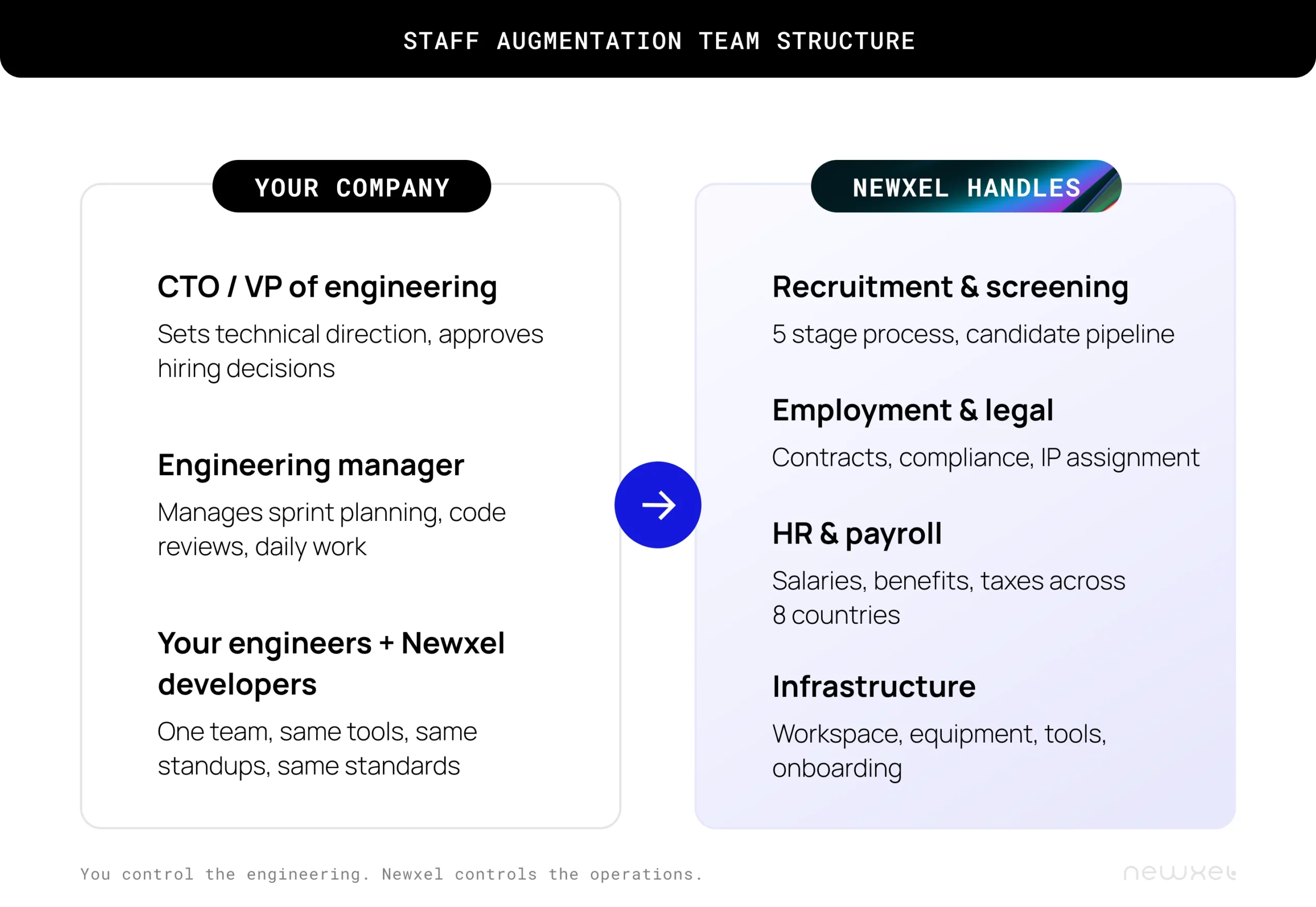
If you’ve managed engineers for any length of time, you know that the hardest part of adding someone to a team isn’t the hiring. It’s the integration. Every new developer, whether they’re internal or external, causes a temporary velocity dip while the team adjusts. The real question is how deep that dip goes and how long it lasts. And the standard complaint about external developers is exactly this: they slow the team down because they don’t understand the codebase, the conventions, or the culture.
That complaint is valid when the provider doesn’t screen for the things that determine integration speed. At Newxel, our screening process is built around exactly those signals. We test whether a candidate can work within an existing codebase rather than rewriting it to suit their preferences. We look at whether they ask questions early when they’re blocked or whether they go quiet and deliver something unexpected three days later. We assess how they communicate during code review, because that’s where the real collaboration happens. These aren’t abstract qualities. They’re specific behaviors we test through structured exercises with real codebases.
The market data suggests companies are increasingly reaching the same conclusion. Research and Markets valued the global staff augmentation services market at $7.35 billion in 2025, with projected growth to $11.94 billion by 2032 at a CAGR of 7.1%. [11]
Read how to manage offshore teams effectively with our latest article.
Rather than talking about the model in the abstract, here are the situations where we see it produce the most value.
Staffing a new product initiative without pulling engineers off the core product. This is probably the most common scenario we encounter. The VP of product has been waiting for engineering capacity to pursue a new feature set or product line, but pulling people from the existing team means the core roadmap slips. A dedicated augmented team gives you the capacity to run the new initiative in parallel without disrupting what’s already in motion.
Scaling from 10 to 50 engineers after a funding round. A Series A or B company needs to demonstrate execution speed to its investors. Waiting 3 to 6 months per hire through traditional recruiting means the next milestone is already at risk by the time the team is at capacity. Staff augmentation compresses this timeline from months to weeks, which is often the difference between hitting and missing the window.
Filling senior roles that the local market can’t produce. Your recruiting team has been looking for a senior DevOps engineer or ML specialist for months and the pipeline has dried up. Opening the search to 8 European markets where that talent actually exists changes the outcome. Sometimes the right person for your team simply doesn’t live in your city, and that’s okay.
Entering a new domain that requires specific experience. Building in fintech, healthtech, or SaaS platforms requires engineers who’ve shipped similar products before. When a provider sources by product domain rather than just tech stack, the ramp up time drops significantly because the developer already understands the problem space.
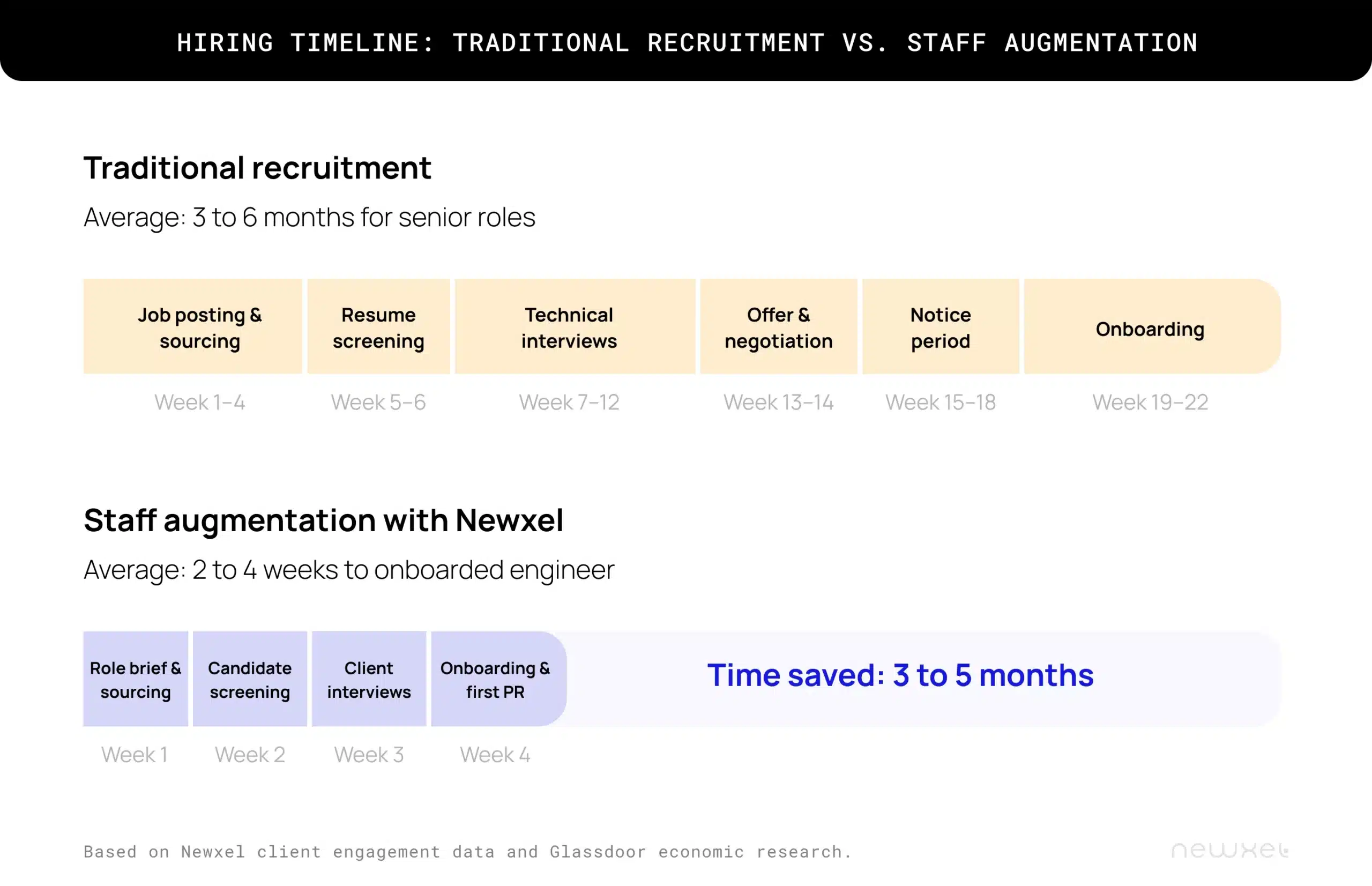
We have been building dedicated development teams across 8 European locations for years, and the model we’ve arrived at is shaped entirely by what we’ve learned works, and just as importantly, by what we’ve seen fail at other providers.
Every engagement starts the same way: a conversation about what the client needs. Not just the job title and tech stack, but the team dynamics, the development culture, the communication style, and the kind of person who will do well in that specific environment. We have learned that this upfront conversation is where most of the value gets created, because it’s what lets us send 5 relevant candidates instead of 50 resumes.
From there, each candidate goes through a 5-stage screening process: technical ability, codebase navigation, communication skills, English proficiency, and cultural compatibility. The client’s engineering team makes the final hiring decision. We handle the sourcing through our networks across Poland, Romania, Bulgaria, Ukraine, and 4 other European markets; we manage the screening pipeline; we coordinate onboarding including workspace, equipment, and tool access; and we provide ongoing employment, HR, legal, payroll, and administrative support for as long as the engagement lasts.
For the CTO or VP of engineering: pre-vetted senior candidates within 7 business days, each screened through structured technical evaluation. Full control over the team. The developers join your Slack, your standups, and your PR reviews. You manage them exactly the way you manage everyone else on the team.
For the CEO or founder: engineers on the team in weeks rather than quarters. Month to month contracts with 30 day adjustment clauses. One invoice per developer per month that covers salary, taxes, benefits, workspace, equipment, and compliance. No hidden line items. Cost savings of 40 to 60% compared to fully loaded local hires in tier 1 markets.
For the head of talent acquisition or CHRO: access to 8 European talent markets where the senior engineers you’ve been searching for exist. Every Newxel developer is a full employee of our local legal entity with benefits, paid leave, and career development. We carry 100% of the employment compliance risk. Our annual developer attrition stays below 10%, maintained through competitive local compensation, career paths, training budgets, and community programs.
For the VP of product: dedicated engineering teams built around specific product initiatives, so you stop having to choose between the core product and the new thing. Engineers matched to your product domain, not just your stack. 30 day contracts that let you scale up if there’s traction or wind down if priorities shift.
When we ask clients what stood out after working with us, three things come up consistently. The first is screening quality. We don’t just test whether someone can code, but we test whether they can work within an existing codebase, follow conventions that aren’t their own, and communicate clearly when they hit a wall. That’s what determines whether someone adds velocity in sprint 1 or creates drag for weeks. The second is retention. Our annual developer attrition stays below 10%, which means the team you build stays together instead of cycling through replacements every few months. And the third is operational coverage. Legal, HR, payroll, financial administration, office infrastructure, equipment: we handle all of it, across every jurisdiction we operate in. The client focuses on product. That’s the arrangement, and we take it seriously.
We’ve had a front row seat to how companies approach engineering team growth, and some of the patterns we see are remarkably consistent, unfortunately in the wrong direction.
Treating augmentation like outsourcing. This is the most common failure mode, and it usually comes from a previous bad experience. A company works with a vendor that sends developers without context and expects the client to figure out integration on their own. The result is predictable: external developers who slow the team down, miss conventions, and require constant hand holding. The fix is working with a provider that screens for integration, not just technical skill, and that builds an onboarding plan based on your actual Git setup, CI/CD configuration, and code review workflow.
Starting the hiring process only when the need is urgent. When a new initiative gets approved and there’s no engineering team to build it, the instinct is to start recruiting that same week. But by that point you’re already 3 to 6 months behind schedule, because that’s how long conventional hiring takes. The companies that avoid this trap maintain an ongoing relationship with a talent partner who can start sourcing before headcount is formally approved.
Refusing to look beyond the local market. We see this a lot with companies in Tel Aviv, SF, and London who spend 6 months trying to fill a role locally that could have been filled in 3 weeks through global hiring. The reluctance usually comes from concerns about time zone overlapping or communication. In practice, European time zones give you 6 to 8 hours of real overlap with Israel and US East Coast, which is more than enough for standups, synchronous PR reviews, and live debugging sessions. The time zone concern tends to dissolve once companies experience it.
Ignoring the onboarding experience for external developers. There’s a direct relationship between onboarding quality and integration speed. Companies that drop a new developer into a Slack channel and say “figure it out” will get poor results regardless of how skilled that developer is. The ones that prepare a structured onboarding covering the codebase, conventions, deployment process, and team communication norms consistently see new developers reach full productivity within 2 sprints.
Underestimating international employment complexity. Setting up a legal entity, managing multi-country payroll, staying compliant with local labor laws: this work takes far more time and money than most companies anticipate going in. The most efficient path, and often the only realistic one for companies that need to move fast, is to partner with a provider that has already built this infrastructure across the specific markets where you want to hire.
If there’s one takeaway from everything we’ve covered here, it’s that tech talent acquisition has stopped being something you can treat as a side function. It’s become a strategic capability that directly affects whether you can execute your product roadmap or not. The constraints are real: a structural global shortage of developers, salary inflation in the major markets, hiring cycles that stretch to months, and the constant risk of losing the engineers you do manage to hire.
The companies that manage this well tend to share three habits. They invest in their engineering brand so the right candidates come to them. They look beyond their local market because that’s where the math actually works. And they partner with someone who handles the operational complexity of international hiring so their leadership team can stay focused on building product.
Staff augmentation won’t solve every hiring problem. But for companies that need dedicated engineers who become a real part of the team, who ship production code, who report to the existing engineering leadership, and who don’t come with a 6 month recruiting timeline or the legal burden of setting up foreign entities, it’s hard to find a more practical option.
If you’re thinking about expanding your engineering team, we’d be happy to talk. We can walk you through exactly how Newxel’s model works with your specific requirements, show you candidates within 7 business days, and take every operational detail off your plate so you can focus on what you actually care about: shipping product.
All data cited in this article comes from the original research publications listed below. Projections and estimates reflect the methodology and assumptions of each respective source. Newxel is not affiliated with any of the research organizations cited.
[1] IDC (via Grid Dynamics, 2025). Estimated global shortage of full time software developers at 4 million; projected IT skills shortages to cost $5.5 trillion globally by 2026.
[2] U.S. Bureau of Labor Statistics, employment projections 2024 to 2034 (November 2025). Software developer employment projected to grow 15% from 2024 to 2034; approximately 317,700 openings projected annually in computer and IT occupations; median annual wage of $105,990 for computer and IT occupations in May 2024.
[3] Glassdoor economic research, hiring trends data. Average time to hire for software engineers: 35 to 41 days; senior roles take significantly longer.
[4] U.S. Bureau of Labor Statistics (via Grid Dynamics, 2025). Projected US developer shortage exceeding 1.2 million by 2026, with approximately 545,000 current software engineers expected to leave the workforce by that time.
[5] U.S. Labor Department (via Grid Dynamics, 2025). Estimated global shortage of software engineers reaching 85.2 million by 2030, representing up to $8.4 trillion in unrealized revenue.
[6] Addison Group, 2026 IT hiring trends and workforce planning guide. Tech salaries projected to rise 8 to 10% in 2026.
[7] Harvard Business Review. Research indicating tech skills become outdated in approximately 2.5 years.
[8] Linux Foundation, 2025 state of tech talent report. AI and ML engineering roles understaffed at 68% of organizations; cybersecurity and compliance understaffed at 65%. Organizations reporting AI value in software development (54%), data analytics (52%), and IT infrastructure monitoring (45%). Lack of skilled workforce cited as a top 3 barrier to technology adoption by 44% of respondents.
[9] Indeed hiring lab (via CompTIA and industry reporting). AI related job postings increased 170% from January 2024 to January 2025.
[10] Ericsson large scale studies on developer onboarding. Documented productivity drops of 20 to 40% across teams during integration periods.
[11] Research and Markets, staff augmentation services market global forecast 2025 to 2032. Market valued at $7.35 billion in 2025; projected to reach $11.94 billion by 2032 at a CAGR of 7.1%.
[12] OECD, bridging talent shortages in tech (2025). Noted that education and training institutions consistently struggle to keep pace with industry needs.