Workforce Planning for Startups: A Complete 2026 Guide + Downloadable Headcount Plan Template
16 min
· March 10, 2026
Based on 8+ years of hands-on experience building and scaling 50+ startup teams with a strategic talent management approach, we’ve seen the same pattern repeat itself across industries, stages, and geographies. Working closely with founders and top management teams who scaled organizations from zero to enterprise-grade companies, we’ve learned one critical truth:
Most hiring problems aren’t hiring problems – they’re planning problems.
We’ve sifted through hundreds of pages of documentation, analyzed extensive statistics, and spoken with project PMs across multiple teams. After more than 100 hours of research, reviewing over 20 projects, and communicating directly with UU and client leadership teams, we’ve distilled the insights into this guide.
In this guide, you’ll find:
This guide distills that experience into a practical, founder-ready framework for workforce planning – one that balances ambition with runway discipline. Today, we’re making that framework available to you for free, along with a downloadable headcount planning template you can put to work immediately.
Traditional headcount planning focuses on how many people you need annually. Strategic workforce planning (SWP) focuses on why you need them and how they impact business outcomes.
The table below compares the workforce planning vs. headcount planning
| Feature | Workforce planning | Headcount planning |
| Purpose | Aligns talent strategy with business outcomes (skills × revenue impact) | Focuses on filling open roles |
| Time horizon | Continuous planning with quarterly or milestone reviews | Annual planning cycle |
| Frequency | 4–12 updates per year based on business and funding milestones | 1 update per year |
| Skill vs role focus | Prioritizes skills and capabilities; reduces skill gaps by 30–50% through proactive planning | Prioritizes roles, reactive to shortages |
| Risk reduction | Improves hiring success and retention: can reduce mis‑hires by 20–40% | Less predictive, mis‑hires and churn more common |
| Metrics used | Skills readiness, turnover risk, capability gap velocity, burn impact | Headcount, time‑to‑fill, hires per quarter |
| Impact on speed | Faster response to change (adjust plans in weeks) | Slow response (next update only yearly) |
To sum up:
Traditional headcount planning counts how many people you need and updates annually, often reacting to immediate shortages. Strategic workforce planning (SWP) focuses on why and when you need talent, prioritizing skills, reducing risk, and aligning hires with business outcomes through continuous, data-driven planning.
For years, startups were taught to grow fast and worry about efficiency later. But this approach has caused major problems.
During the 2021–2022 blitz-scaling era, cheap capital encouraged startups to hire aggressively without linking headcount to revenue or product milestones. Across 45,000 startups, net hires grew by only 11,000 employees from Jan 2023 to early 2025, showing that reactive growth became unsustainable.
Payroll can be 60–80% of a startup’s operating costs. Without strategic workforce planning, each new hire directly affects runway and burn efficiency. Many startups now see smaller teams: Series A SaaS companies are 20% smaller than in 2020, because past reactive hiring was costly.
Traditional workforce planning usually happens once a year. In today’s fast-changing market, conditions shift quarterly. Relying on annual plans can lead to outdated assumptions, missed skills, and overspending, leaving startups unprepared for pivots.
With these challenges in mind, it’s clear that reactive planning methods fall short. To thrive in a startup environment, you need a more deliberate approach.
Before getting into frameworks, it’s worth establishing precisely what you gain from doing this well, because the workforce planning benefits are often described vaguely. Here they are concretely.
The average time between seed and Series A has expanded to 712 days, nearly two years. Every mis-hire, early attrition event, or redundant role compounds across that runway. A single $200K senior engineer hired six months too early costs roughly $100K in salary before they’re generating sufficient value.
In the current rocky fundraising environment, where investors favor financial efficiency and resourcing debates dominate board meetings, the difference between success and failure comes down to clarity and discipline on how many people to hire, when, and for which role. A coherent hiring plan is now an expected artifact in fundraising conversations, not a nice-to-have.
Netflix famously prioritized talent density over headcount. The underlying insight that one exceptional person outperforms three adequate ones, becomes even more critical at seed stage, where every hire shapes culture, code quality, and customer relationships simultaneously.
At its core, headcount planning isn’t just about filling roles, it’s about shaping the company to meet strategic business outcomes. The key is balancing immediate hiring needs with long-term strategic workforce planning. Founders who have pre-mapped their next ten hires can recruit in weeks rather than months when a window opens.
Overhiring followed by layoffs destroys morale, brand, and sometimes legally exposes the company. Strategic planning keeps you out of that cycle entirely.
Over 8 years of building engineering teams for startups, we’ve noticed that the companies who scale successfully don’t just hire better, they plan differently. They think about workforce decisions across multiple time horizons simultaneously, not just the immediate open role sitting in front of them.
That observation is what shaped the framework we now use with every startup we work with. We call it the Newxel 4-layer workforce planning for startup framework staffing.
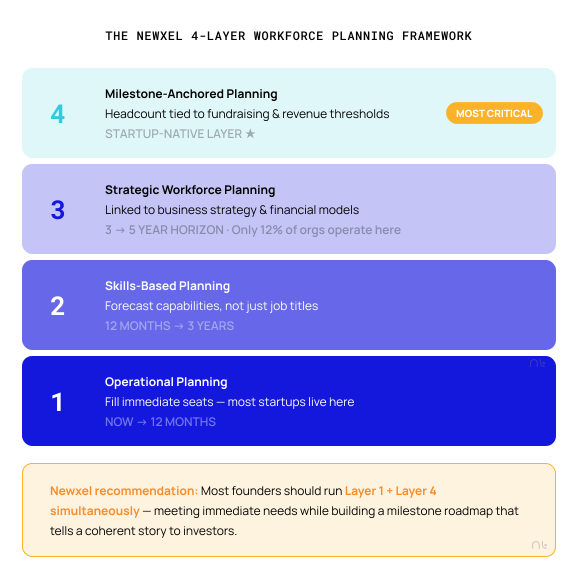
Here, your focus is on immediate delivery: filling open seats to unblock product and market priorities.
Time frame: now → next 12 months
Our case:
A fintech client needed a complete engineering squad right away to stabilize their product, add new features, and hit the next revenue milestone. The functional hiring at Layer 1 looked like:
Here, planning is organized around skills portfolios rather than job titles. You forecast which capabilities the business needs, not just which roles to fill in workforce planning for startups.
Time frame: 12 months → 3+ years (capability horizon)
This approach is more resilient because roles change; foundational skills don’t. Data from LinkedIn shows 25% of required job skills have changed since 2015, with that figure expected to double by 2027.
Our case:
Instead of hiring narrowly defined roles, we prioritized transferable, high-leverage skills:
This made the 20+ engineer team adaptable as the product evolved, without constant re-hiring or restructuring teammates.
At this layer, workforce planning is linked to business strategy, financial models, and growth scenarios. This is where traditional enterprise HR frameworks typically operate.
Time frame: 3 → 5 years out
Research from McKinsey shows that only ~12% of organizations do this consistently.
Our fintech case:
We didn’t build a rigid 5-year org chart, but we used strategic planning to inform near-term decisions. We asked:
This is the most startup-native layer. Headcount decisions are tied explicitly to fundraising milestones and revenue thresholds, not calendar timelines.
Given the 712-day median gap between Seed and Series A, this is the most operationally relevant frame for early-stage companies.
Newxel hands-on experience:
Instead of hiring “per quarter,” we anchored hiring to milestones:
Every hire had a business justification – not just a timing one.
Most founders need to operate at Layers 1 and 4 simultaneously: meeting immediate needs while building a milestone-based roadmap that tells a coherent story to investors. Layer 4 is the startup-native innovation on top of traditional enterprise frameworks for strategic workforce planning for startups.
We’ve gathered experience from 33+ team planning cases across fintech, SaaS, and marketplace startups. Over the years, patterns emerged: the companies that scale successfully don’t just hire faster, they plan smarter, across multiple horizons, and tie hiring directly to outcomes.
Before opening a single job description, pull up your product roadmap and ask one question: what needs to exist, technically, for this company to hit its next milestone?
Not “what roles do we need.” What technical capabilities need to be present and functioning.
What to do: Take your product roadmap for the next 12 to 18 months. For each major feature set or milestone, list the specific technical capabilities required to build and maintain it. Group those capabilities into hiring phases. Only then start thinking about job titles.
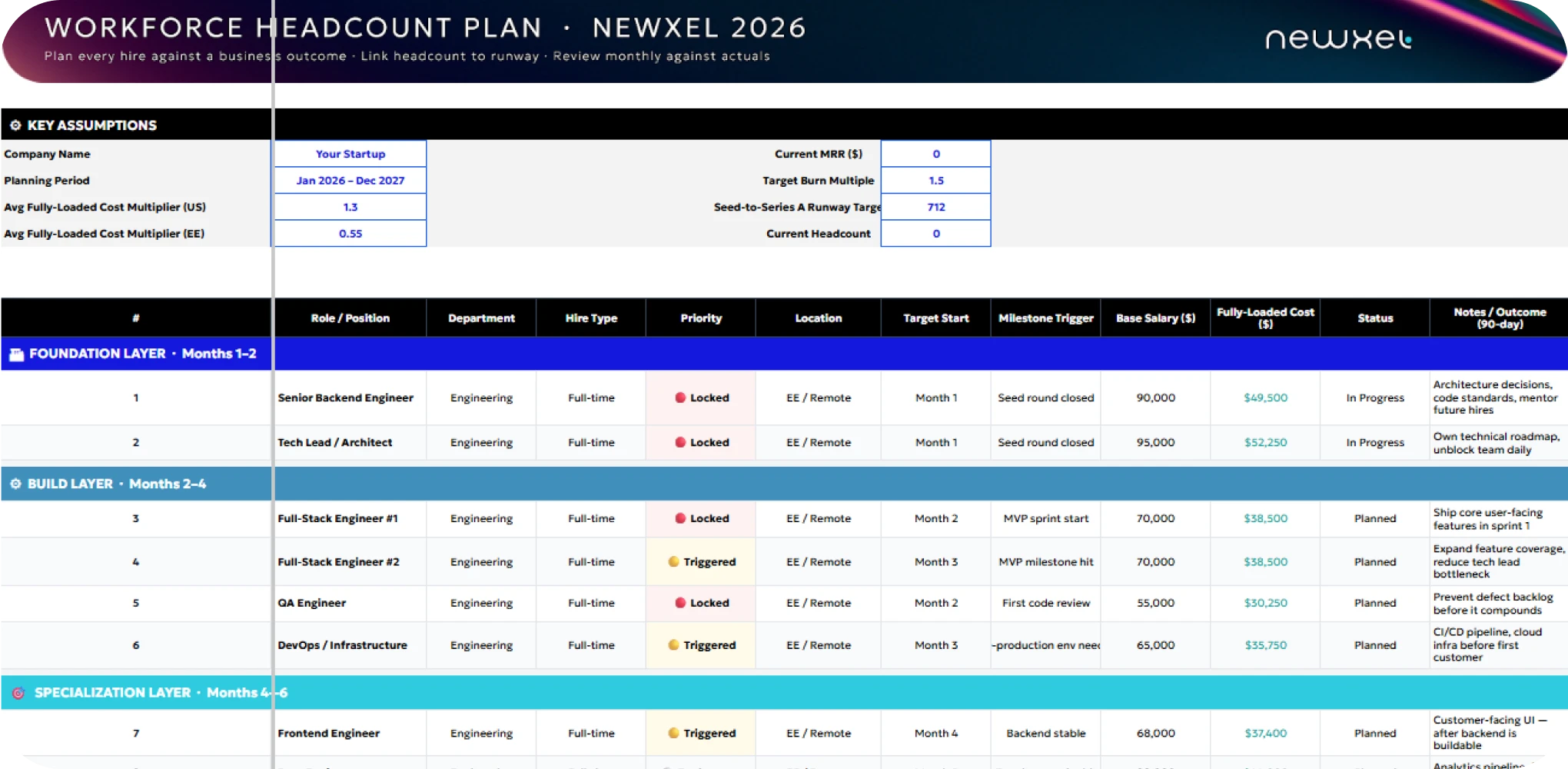
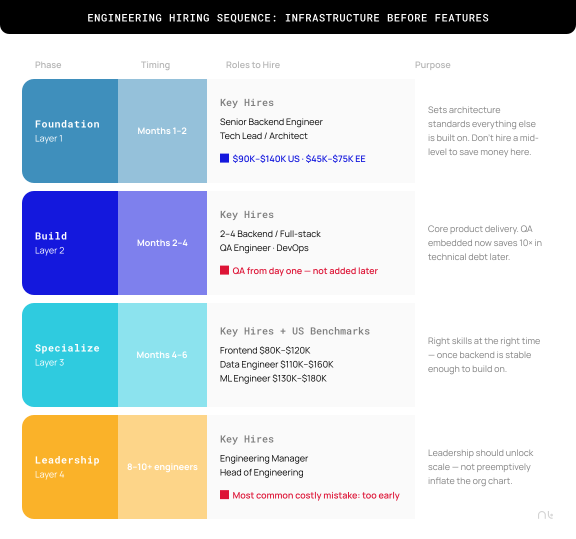
At Newxel, we follow a simple but powerful principle: infrastructure before features, foundations before specialists, generalists before narrow experts. To make this concrete, we propose the following scenario for a typical early-stage tech startup:
Set up foundation
The first step is building a solid foundation. This usually means hiring a senior backend engineer or tech lead who can make architecture decisions, set technical standards, and mentor future hires, not someone who only executes tasks.
Budget: $90K–$140K in the U.S., or significantly less if you are building a dedicated team in Eastern Europe.
This foundational hire ensures that everything built afterward has a stable, scalable architecture and clear technical standards.
Build team
Once the foundation is in place, the next step is the build layer. This usually includes two to four additional backend or full-stack engineers, with QA embedded from day one rather than added later, and a DevOps or infrastructure engineer before you even have a production environment.
Introduce specialization
After the build layer, you bring in specialized roles. Frontend engineers are added once the backend is stable. Data or ML engineers come in if the roadmap requires them. A product-aligned QA lead may join once the team exceeds six or seven engineers.
Compensation benchmarks (US):
Eastern European equivalents are typically 40–60% of these figures.
Specialization ensures that the right skills are added at the right time, rather than prematurely inflating your budget or slowing down team cohesion.
Add leadership
The final step in the sequence is bringing in leadership. An engineering manager or Head of Engineering should only be hired once the team exceeds 8–10 engineers and the CTO’s direct management bandwidth is genuinely saturated.
Hiring leadership too early is one of the most common and costly mistakes we see funded startups make. Leadership should unlock scale, not preemptively inflate your org chart.
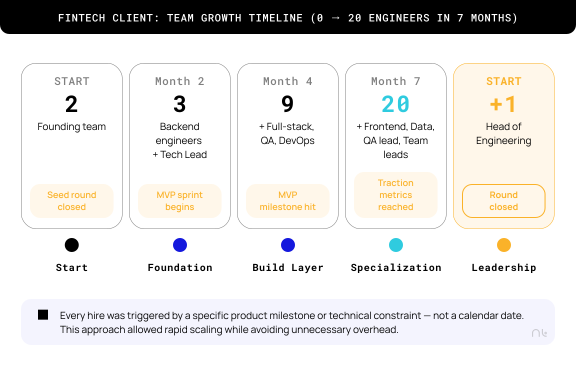
Our fintech client provides a clear example of this sequencing in action:
By 2 months, three engineers were in place to cover foundational capabilities. By 4 months, the team grew to nine engineers, adding build and some specialized roles. By month 7, the team reached twenty engineers, including dedicated frontend, data, and QA specialists, as well as team leads.
Every hire was triggered by a specific product milestone or technical constraint, rather than a calendar date. This approach allowed the company to scale rapidly while avoiding unnecessary overhead or wasted runway.
Many founders make the mistake of modeling only base salary, but the real cost of a hire is substantially higher. Planning around base salary alone can create budget surprises that hurt your runway.
Fully-loaded cost: For a U.S.-based senior engineer, fully loaded costs typically run 1.25–1.4× base salary, factoring in payroll taxes, benefits, equipment, software licenses, and recruiting fees. A $130K senior engineer costs roughly $160K–$180K all-in.
Onboarding lag: New hires usually take 60–90 days to reach full productivity, which adds roughly $20K–$25K in salary before they’re fully contributing. This is a real cost that belongs in your headcount growth model.
Dedicated team model: At Newxel, we build dedicated development teams across Ukraine, Poland, Romania, Bulgaria, Spain, Portugal, and Israel. Senior engineers in these markets typically range from $50K to $90K annually fully loaded, including operational overhead.
Time-to-hire advantage:
Over a 20-person team build, this speed difference compounds dramatically, letting startups ship faster while staying on budget.
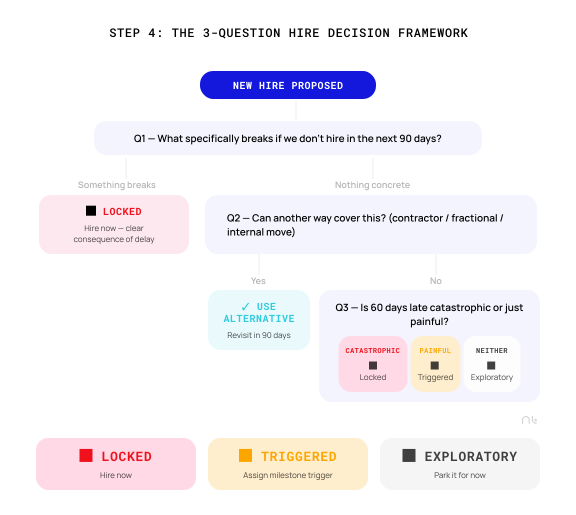
Before any role moves into active recruiting, we run it through the same three questions with every founder. It takes 15 minutes and often prevents hires that feel urgent but aren’t.
What actually breaks if we don’t hire in the next 90 days?
Be concrete. Not the team will be stretched, that’s always true. What specifically stops shipping, slips, or fails? If nothing clearly breaks, the role is likely an optimization, not a priority.
What does this hire unlock that we can’t unlock another way?
Does this require a full-time hire, or could it be handled by:
From our experience: our fintech client, a planned full-time ML hire, became a 6-month contractor once we clarified the real need, saving runway without slowing progress.
Which is worse: hiring 60 days too early or 60 days too late?
For most roles, being late causes friction. For a few, being late is catastrophic, missed launches, lost customers, stalled fundraising.
Every hire needs a line in the model with a start date, a fully-loaded monthly cost, and a productivity ramp assumption.The specific numbers to track monthly:
Burn multiple impact
For each hire, calculate how it changes your burn multiple. If you’re currently burning $300K per month against $200K in new ARR, your burn multiple is 1.5. A $15K/month engineering hire that doesn’t accelerate near-term revenue takes that to 1.6. Not catastrophic, but worth knowing before you make the hire, not after.
Runway impact per hire
Model how each hire affects your months of runway at current burn. This number should be visible to the CEO and CFO before any offer goes out.
Plan vs. actual
Track every month whether hires happened on schedule, whether attrition was expected or unexpected, and whether backfills are eating into the headcount budget. The divergence between plan and actuals is where runway surprises come from, and catching them monthly rather than quarterly gives you time to respond.
We review this monthly with every active client. In practice it takes 30 minutes and has prevented more than one hiring decision that would have looked fine on paper but quietly broken a fundraising timeline in practice.
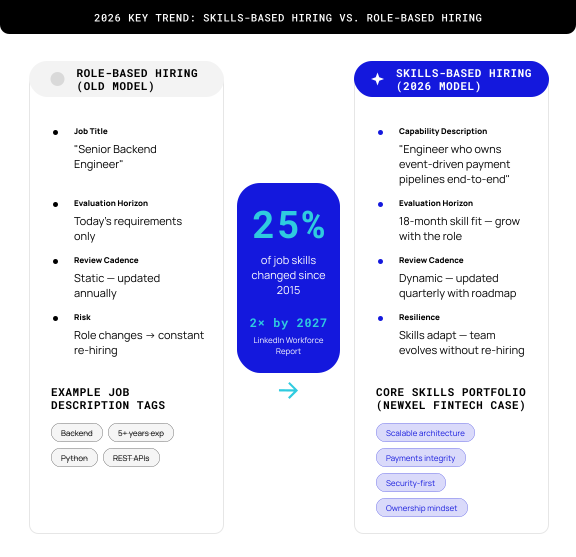
The most important structural shift in workforce planning for 2026 is the move from role-based to skills-based hiring. LinkedIn data shows that 25% of required job skills have changed since 2015, with this figure expected to double by 2027.
For startups, this isn’t an abstract HR concept. It has two concrete implications.
First, write role descriptions around skills portfolios rather than job titles. “Senior Backend Engineer” tells you almost nothing about what you actually need. “Engineer with strong Python background, experience building event-driven architectures, and comfort taking ownership of a service end-to-end” tells you a great deal.
Second, when evaluating candidates, assess the skills you’ll need in 18 months, not just today. The generalist who can grow with the role is almost always more valuable to an early-stage company than the specialist who is a perfect fit for your current tech stack.
For IT companies and tech startups specifically, traditional full-time hiring for every engineering role creates compounding challenges: local talent scarcity, compressed timelines between funding rounds, and the risk of over-hiring ahead of uncertain product-market fit.
The dedicated development team model solves several of these constraints simultaneously. Rather than hiring individual engineers as full-time employees, a startup partners with a provider that builds, manages, and retains a team of engineers who work exclusively on that startup’s product, integrated into its workflows, culture, and roadmap, while the provider handles HR, payroll, legal compliance, and operational overhead.
Newxel has been building dedicated development teams and R&D centers for tech companies since 2017, working with over 500 professionals across eight hiring locations including Ukraine, Poland, Spain, Portugal, Romania, Bulgaria, Turkey, and Israel.
Newxel helps startups design their talent roadmap and hire their own in-house development teams, ensuring investors see a real, dedicated team, not third-party contractors. They manage all legal, HR, and administrative work, so founders can focus on strategy and presentation. Their real results: guiding 40+ startups through this process.
The practical mechanics matter here. You can start with as few as 1-2 developers and scale up as needed. Some partnerships began with just 3 developers and grew to 25+ over time. There are no long-term contracts or penalties for scaling. You pay monthly per developer, so you have complete flexibility to adjust team size based on your growth and budget.
The onboarding speed advantage is significant
New developers achieve complete integration in just 2–3 weeks: Week 1: attend meetings, access all tools, and begin contributing. Weeks 2–3: execute independent tasks and collaborate effectively. Week 4+: function as a fully productive team member. This customized onboarding framework enables 40–60% faster time-to-productivity compared to conventional hiring methods.
Compare that to the industry average of 60-90 days to full productivity for a direct hire, and the runway implications become concrete.
Retention is the hidden advantage that compounds over time
Newxel achieves a 98% developer retention rate with 3.5+ average tenure. Engineering turnover at early-stage startups can run 20-30% annually, creating continuous knowledge loss and re-onboarding costs. A high-retention dedicated team maintains institutional knowledge, codebase familiarity, and cultural alignment across years, compounding in value as the product grows in complexity.
This distinction matters because traditional outsourcing typically involves handing a project to an external team that manages itself. The dedicated model keeps management control with the founder, essential for maintaining the product vision and cultural cohesion that differentiate strong startups.