Managing Offshore Teams Effectively: Best Practices That Work
24 min
· February 25, 2026
You already know your hiring pipeline can’t keep up with your product roadmap. Domestic talent is expensive, competitive, and scarce in the specializations you need. At some point, someone in a board meeting or on a Slack thread floated the idea of an offshore team. And now you’re here, trying to figure out if it’s actually worth the risk.
The numbers are encouraging: companies that manage offshore teams well consistently report 40–60% cost savings, faster release cycles, and access to talent pools they couldn’t reach domestically. But the ones that get it wrong waste months, burn budgets, and end up with code they have to rewrite from scratch.
The difference between these outcomes almost never comes down to where your team is located. It comes down to how you manage them.
This guide covers everything you need to know before, during, and after building your offshore team. We’ll walk through 7 pillars of effective offshore team management (communication, commitment, teamwork, onshore/offshore balance, requirements, prerequisites, and metrics), plus the hidden questions about data security, cost factors, nearshore vs. offshore, and code quality assurance that first timers rarely think to ask until it’s too late.
About this article: our expertise and methodology
A note on credibility: this article is written based on Newxel’s direct, hands-on experience building and managing offshore development teams since 2017. Our methodology draws on internal retention and onboarding data from 200+ developer placements across 8 European talent hubs, patterns observed across our client portfolio (from Series A startups to publicly traded enterprises), and the operational playbook we have refined through hundreds of successful engagements.
We have also incorporated insights from our client case studies (available on newxel.com), where engineering leaders share how they evaluated partners, structured their teams, and measured success. Where we cite external data, we link to the source. Everything else is firsthand expertise from our technical, HR, and delivery teams.
Before we get into best practices for managing offshore resources and the management playbook, it’s worth understanding what drives the decision in the first place. Based on conversations with hundreds of engineering and operations leaders, the triggers are remarkably consistent.
Most clients come to us after hitting one of 3 walls. The first: a domestic hiring ceiling, where they have been trying to fill senior backend or DevOps roles for 4-6 months and the pipeline is empty or unaffordable. The second: a cost to output imbalance, where they’re spending $180K–$220K fully loaded per developer in the US or Western Europe and the board is asking if there’s a smarter way to scale. The third: a speed problem, where the roadmap demands 8–10 engineers in the next quarter and in-house recruiting can’t move that fast.
But cost savings alone don’t close the deal. The CTOs and VPs of engineering we work with evaluate partners on 3 criteria: quality of the talent pool they can access, the level of operational support (so their own team isn’t dragged into HR, legal, and admin work in a foreign country), and the partner’s track record with retention. Nobody wants to rehire and reonboard the same role 6 months later.
In one of the recent engagements, a fintech company had been interviewing for a senior full stack role for 5 months with zero hires. Within 3 weeks of partnering with Newxel, they had 2 vetted candidates; the selected developer was shipping production code by week 6. That’s not an anomaly, it’s the pattern when discovery, hiring, and onboarding are handled by a partner with deep local market expertise.
This context matters for everything that follows. The best practices in this guide aren’t academic. They’re the specific answers to the concerns engineering leaders raise when evaluating whether offshore is right for them.
Every article on how to hire an offshore teams starts with communication. For good reason, it’s the single biggest point of failure. But “communicate more” is not a strategy. What you need is a communication architecture: a deliberate system designed around time zones, cultural context, and the natural friction of distributed work.
The biggest mistake first time leaders make when managing offshore development teams is trying to replicate their in office habits. Back-to-back Zoom calls across a 7-hours gap will exhaust your offshore team and accomplish less than you expect.
Instead, design your information flow around a clear sync/async split.
Something most people miss: async first communication actually improves output quality for everyone, not just the offshore team. It’s a discipline upgrade for your entire engineering organization.
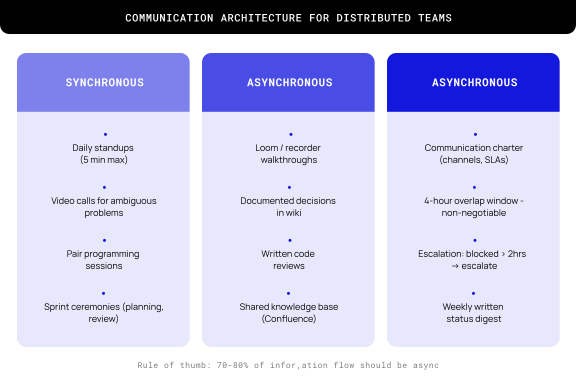
The most productive offshore engagements we observe maintain a minimum 4 hours overlap of working hours between onshore and offshore. This window is sacred: it’s when blockers get unblocked, context gets transferred, and the human connection that prevents team fragmentation gets maintained.
Practical example: if your HQ is in New York (EST) and your offshore development team is in Kyiv (EET, UTC+2), the natural overlap runs roughly 9:00 AM–12:00 PM EST / 4:00 PM–7:00 PM EET. All synchronous rituals happen in this window. Everything else flows async.
Before your offshore team writes a single line of code, create a one page communication charter. This answers the questions every new developer silently asks: where do I ask questions? How fast should I expect a response? When do I escalate? A strong charter covers preferred channels by message type, response time SLAs by urgency, escalation paths (blocked more than 2 hours? Escalate immediately), meeting cadence, and documentation standards for decisions.
A question most leaders don’t ask early enough: why should your offshore team care about your product as deeply as your in house team does? If you’re treating offshore resources as interchangeable coding machines, you will get exactly the commitment level you have designed for. Building genuine ownership isn’t about team t-shirts shipped internationally. It’s structural.
Offshore developers who understand the business context behind their tasks make better architectural decisions, catch edge cases earlier, and push back on requirements that don’t make sense. Invest time sharing product roadmaps, customer feedback, and business metrics with your entire team, regardless of location.
When a developer in Kyiv knows the feature they’re building will reduce customer churn by an estimated 15%, their relationship to the work changes fundamentally. They stop executing tickets and start solving problems.
How to do this practically: invite offshore developers to quarterly product reviews. Share business metric dashboards. Forward customer feedback. Let them join user research calls. These take minimal effort but create massive alignment, because developers who understand what success looks like make better micro decisions daily.
2. Create ownership, not task queues
Assigning offshore team members ownership of specific modules, services, or features, rather than distributing tasks from a shared backlog, creates accountability and pride. When someone owns a service, they think about it differently: they anticipate problems, maintain documentation, and care about code quality because their name is on it.
This single shift, from task assignment to ownership, is the biggest lever you have for improving offshore team quality.
3. Invest in career paths
One hidden advantage of working with a staff augmentation partner: they handle career development for your offshore team. At Newxel, our HRBP (human resources business partner) team works with each developer to create growth paths, conduct 1:1 meetings, and ensure that working on your project is also advancing their career. This directly impacts retention, which directly impacts your velocity and knowledge continuity.
The most common failure mode in offshore team management isn’t technical, it’s social. When onshore views offshore as “the vendor” and offshore sees itself as “just executors,” you’ve built a two tier system that breeds miscommunication and mediocre output. The goal is one team across 2 locations, not 2 separate teams.
Stop running separate sprints for onshore and offshore. Create cross functional sprint teams that include members from both locations: an onshore product owner, an offshore tech lead, developers from both sides, and shared QA. This forces genuine collaboration and kills the “throw it over the wall” anti pattern where onshore writes specs and offshore blindly executes.
Retrospectives should include the full team. Demo days should celebrate offshore contributions alongside onshore ones. Even something as simple as starting standups with a personal check in builds the human connection that makes distributed teamwork actually work. These rituals must happen consistently, within the overlap window, and should never feel like one way status reports.
Cultural differences in distributed teams are real, and ignoring them doesn’t make them disappear. Eastern European developers, for example, tend to be direct in technical disagreements (which is valuable) but may volunteer status updates less proactively. Understanding these patterns, and building processes around them, is far more effective than expecting everyone to adopt a single cultural norm.
At Newxel, onboarding includes cultural fit workshops for both sides. We don’t just teach the offshore team about the client’s culture. We help the onshore team understand what to expect and how to collaborate across cultures. This two way approach prevents the common frustration of “they just don’t communicate the way we do.”
Every leader looking to build offshore team grapples with the same question: what should stay onshore and what can move offshore? Get this wrong, and you either offshore too little (limiting cost savings) or too much (losing control).
| Offshore responsibilities | Offshore responsibilities |
|
|
Keep strategy, product vision, client relationships, and architecture governance onshore. Move execution (feature development, testing, DevOps, maintenance, documentation) offshore. This boundary naturally shifts toward more offshore autonomy as trust builds and your team matures.
Months 1–3 (starting phase): 70/30 onshore to offshore. Your onshore team carries the cognitive load while the offshore team ramps up on your codebase, tools, and processes.
Months 4–9 (growth phase): 50/50 or 40/60. Offshore contributes independently, owns services, and participates in architectural discussions.
Month 10+ (mature phase): many successful companies operate at 30/70 or 20/80, with onshore focused on product management and key client work while offshore drives the bulk of development.
The critical mistake to avoid: don’t rush the ratio. Trying to operate at a mature phase balance during the starting phase is the single most common error in leading offshore team. It leads to quality issues that take months to repair. In our experience at Newxel, the companies that respect this phased approach consistently reach full team maturity 2–3 months faster than those who try to skip ahead.
Something nobody tells you until it’s too late: managing offshore resources effectively starts long before your first standup call. It starts with how you define what needs to be built. Teams fall apart not because they skip requirements, but because they write them assuming the shared context of a co located office.
When your developers sit in the same office, context transmits invisibly: overheard conversations, whiteboard sketches, hallway discussions about edge cases. Your offshore team has zero access to this ambient information. Every assumption you don’t document becomes a point of failure.
The practical rule: if a requirement can be interpreted 2 ways, your offshore team will pick the interpretation you didn’t intend. Not because they’re less capable, but because they’re working with less context. Write requirements as if the reader has zero background on your product.
You don’t need 50 page specification documents. You need clarity on 4 dimensions: the user story (who benefits and why), acceptance criteria (what “done” looks like concretely), technical constraints (what the team needs to know about existing architecture), and edge cases (what happens when things go wrong). A Jira ticket covering these 4 elements is worth more than a formal spec.
For any significant technical decision (framework choices, API design patterns, data model changes) create a lightweight ADR that captures context, options considered, and rationale. This prevents your offshore team from relitigating decisions they weren’t present for, and it builds an invaluable knowledge base that accelerates future onboarding.
Pro tip: store ADRs alongside your code in the repository. When a new offshore developer joins, they read the decision log instead of asking the same questions the last person asked. At Newxel, we’ve seen teams with well maintained ADRs cut onboarding ramp up time by weeks.
The excitement of signing with an offshore partner often leads companies to skip the preparation that determines whether the engagement actually works. This is the honest checklist of what to have in place before your offshore development team writes its first commit.
Your offshore team needs identical access and tooling as your onshore team, on day one, not day 30. VPN access, repository permissions, CI/CD pipeline access, staging environments, monitoring dashboards, documentation access. Every day a developer spends waiting for credentials is burned budget and eroded goodwill.
If your development process exists only in your team’s heads, you have a problem that goes beyond offshore, but offshore will expose it brutally. Before onboarding, document: branching strategy, code review standards, deployment process, incident response procedure, and definition of done. This benefits your entire organization, not just the new team.
First 30 days: understand the codebase, deliver small low risk management tasks with close supervision. Days 30–60: expand to moderate complexity with increasing independence. By day 90: contributing at near full velocity with standard oversight.
This is where you can make the most of your staff augmentation partner. At Newxel, we don’t just source and place developers. Our onboarding process includes cultural integration, technical ramp up support, and an assigned HRBP who monitors integration milestones and flags issues before they become problems. Our internal data shows structured onboarding reduces time to productivity by roughly 40% compared to ad hoc approaches.
And something many first timers don’t realize: with staff augmentation, there’s no need to register a legal entity for the remote team. All administrative support (legal, finance, HR, payroll, compliance) is handled by your partner. You stay focused on engineering and product. We handle everything else.
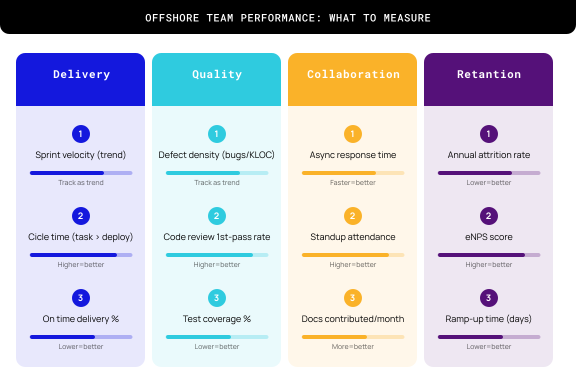
You can’t manage offshore teams effectively without data. But the wrong metrics create perverse incentives. Tracking lines of code incentivizes verbosity. Tracking hours logged incentivizes seat warming. Here’s what to measure instead.
Can you build an offshore team without a partner? Technically, yes: register a foreign entity, navigate local labor laws, set up payroll and compliance in a country you have never operated in. Some companies do it.
But what they rarely mention: it takes 6 to 12 months and significant legal and financial investment to set up properly. For most companies, especially those building their first offshore team, a staff augmentation partner eliminates the operational complexity so you can focus on building great software.
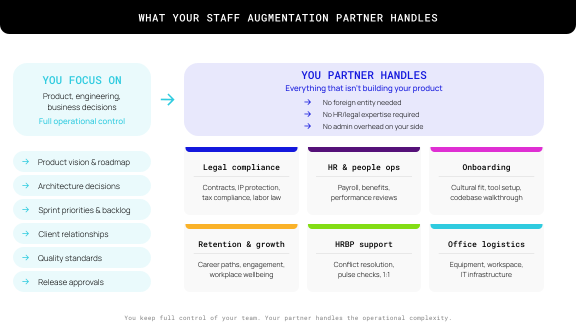
A staff augmentation partner is not a recruitment agency. The relationship doesn’t end once a developer accepts an offer. A strong partner covers the full team lifecycle:
Legal and compliance: entity management, employment contracts compliant with local labor law, tax obligations, IP protection. No foreign entity registration required on your end.
HR and people operations: payroll, benefits, vacation tracking, performance management infrastructure. Your HR team doesn’t need to become foreign employment law experts.
Onboarding and cultural integration: beyond technical setup, a good partner invests in cultural alignment. At Newxel, we pay as much attention to cultural fit and soft skills during hiring as we do to technical ability, because we have seen firsthand that the technically brilliant developer who can’t collaborate across cultures becomes a net negative.
Retention and engagement: your partner’s HRBP monitors team satisfaction, manages career development, and addresses concerns before they become resignations. This is the infrastructure that prevents the revolving door plaguing poorly managed offshore teams.
Administrative support: office space, equipment procurement, IT infrastructure, and the hundred small logistics items that consume management attention if not handled on the ground.
The net effect: a fully operational offshore development team scaling without the overhead of managing a foreign subsidiary. Your leadership focuses on product and engineering; the partner ensures the offshore team has everything to perform at their best.
The obvious questions about offshore development are usually about cost, talent availability, and time zones. The harder questions come later: Who owns the code? How do you control quality? What happens when someone leaves? How much management overhead will the engagement model actually create?
These are the questions worth answering before you sign a contract.
Security should be evaluated at three levels: legal ownership, technical access, and operational processes.
Before engaging a partner, confirm that:
Don’t evaluate a partner’s security based on an NDA alone. Ask who can access your systems, how that access is controlled, and what happens when an employee leaves.
The decision isn’t simply about geography. Compare the models across time-zone overlap, talent availability, cost, communication complexity, and the type of work you’re outsourcing.
| Factor | Offshore | Nearshore |
|---|---|---|
| Time-zone overlap | May be limited | Usually greater |
| Talent strategy pool | Often broader | Depends on location |
| Cost | Typically lower | Typically higher |
| Async communication | More important | Still important |
| Real-time collaboration | Requires planning | Usually easier |
| Best fit | Well-structured distributed teams | High-collaboration or real-time work |
For most engineering teams, a few hours of working-time overlap can be enough. The important question is not “How close is the team?” but “How much synchronous collaboration does this project actually require?”
Code quality is primarily a process and engineering-management issue, not a geographic one.
Before onboarding an offshore team, define:
A useful setup combines automated controls with human review. CI/CD can catch regressions and failed tests, while experienced engineers review architecture, maintainability, and business logic.
The most important step is to document these standards before the first sprint. A remote team should not have to reverse-engineer your engineering practices from scattered Slack messages and old pull requests.
Don’t compare an offshore developer’s monthly rate with an employee’s salary. Compare the total cost of running the team.
For an in-house team, your calculation may include:
Salary + benefits + employer taxes + recruitment + HR + office + equipment + software + legal/accounting + management overhead + turnover costs
For an outsourced or staff augmentation team, the calculation is typically closer to:
Developer rate + management/coordination overhead + tools not included in the agreement
Also account for the cost of ramp-up. A cheaper developer who takes months to become productive may cost more than a higher-priced engineer who can contribute quickly.
The right question is therefore not “Which developer costs less?” but:
“What will this team cost us to hire, operate, manage, and retain over the next 12–24 months?”
That gives you a much more realistic total-cost comparison.
Trust doesn’t come from monitoring activity or requiring everyone to be online at the same time. It comes from context, ownership, transparency, and predictable communication.
Start with:
If possible, start the engagement with an in-person kickoff. If that’s not practical, a focused video onboarding session with the full team can still establish relationships and working norms much faster than weeks of asynchronous messages.
You don’t need a complicated tool stack. You need a consistent one.
| Function | Typical tools |
|---|---|
| Project management | Jira, Linear, Asana |
| Communication | Slack, Microsoft Teams |
| Video meetings | Zoom, Google Meet |
| Documentation | Confluence, Notion, Git wiki |
| Code & version control | GitHub, GitLab |
| Async walkthroughs | Loom |
| Performance & reporting | Team dashboards, BI tools |
| Security & access | SSO, MFA, VPN, IAM tools |
Managing offshore teams effectively is all about building systems, habits, and relationships that make distributed collaboration feel natural. The companies that succeed treat offshore teams as an extension of their organization, not an outsourced function.
If you’re considering how to build an offshore team for the first time, the simple sequence can help you: get your infrastructure and documentation in order. Choose a partner who invests in your team’s success, not just fills seats. Start small with a realistic timeline. Build communication architecture before scaling. Measure what matters and adjust continuously.
If this guide raised questions specific to your situation (about team composition, tech stack compatibility, or which European talent hub fits your needs), those are exactly the conversations we have with engineering leaders every day. The challenges of leading an offshore team are real, but they are all solvable with the right partner and the right preparation.
With Newxel as your partner, you get a fully supported extension of your organization: structured onboarding with cultural integration, dedicated HRBP support from day one, legal and HR infrastructure across 8 European hubs.