Software Development Center for Remote Teams
20 min
· February 17, 2026
If you’ve been trying to grow your engineering team over the past year, you already know that the local hiring market is not getting any easier. Recruiting cycles are long, top candidates are juggling multiple offers, and the specialized skills you actually need (think AI/ML, cloud architecture, or DevSecOps) are in short supply almost everywhere. This is not a temporary staffing crunch. According to the U.S. Bureau of Labor Statistics, software developer employment is projected to grow 15% from 2024 to 2034, with roughly 129,200 openings per year, well above the average across all occupations. The demand is structural, and it is accelerating.
This is the context in which more and more technology companies are building remote software development centers, not as a cost-cutting experiment, but as a deliberate scaling strategy. The global IT staff augmentation market was valued at $299.3 billion in 2023 and is projected to reach $857.2 billion by 2031 at a 13.2% compound annual growth rate, according to Verified Market Research. Those numbers reflect a fundamental shift in how companies think about where their engineering teams sit and how those teams get built.
Disclaimer: Market data referenced from Verified Market Research (2025) and U.S. Bureau of Labor Statistics (2024-2034 projections). All external data sources are listed at the end of this article.
This guide is written for the person who needs to make a real decision about building a remote development center, whether that is a CTO evaluating operating models, a COO looking at cost structures, or an HR director figuring out how to staff a growing engineering roadmap without opening a foreign subsidiary. We are going to walk through every phase of this process: choosing the right model, finding the right partner, handling the legal and operational infrastructure, onboarding engineers who actually integrate with your team, and scaling the whole thing as your needs grow.
The goal is that by the time you finish reading, you have a practical framework you can act on, including answers to the questions you might not have thought to ask yet.
The talent gap in software engineering is not a problem that is going to resolve itself. CompTIA’s 2025 State of the Tech Workforce report projects 297% growth for software developer and engineer roles between 2025 and 2035, and 78% of employers worldwide report difficulty finding qualified IT candidates, according to HCAMag research. When your local talent pool simply cannot keep up with the pace of your product roadmap, building a remote software development center becomes less of an option and more of a necessity.
But the value goes beyond filling seats. Here is what engineering organizations actually gain from remote development when it is done properly:
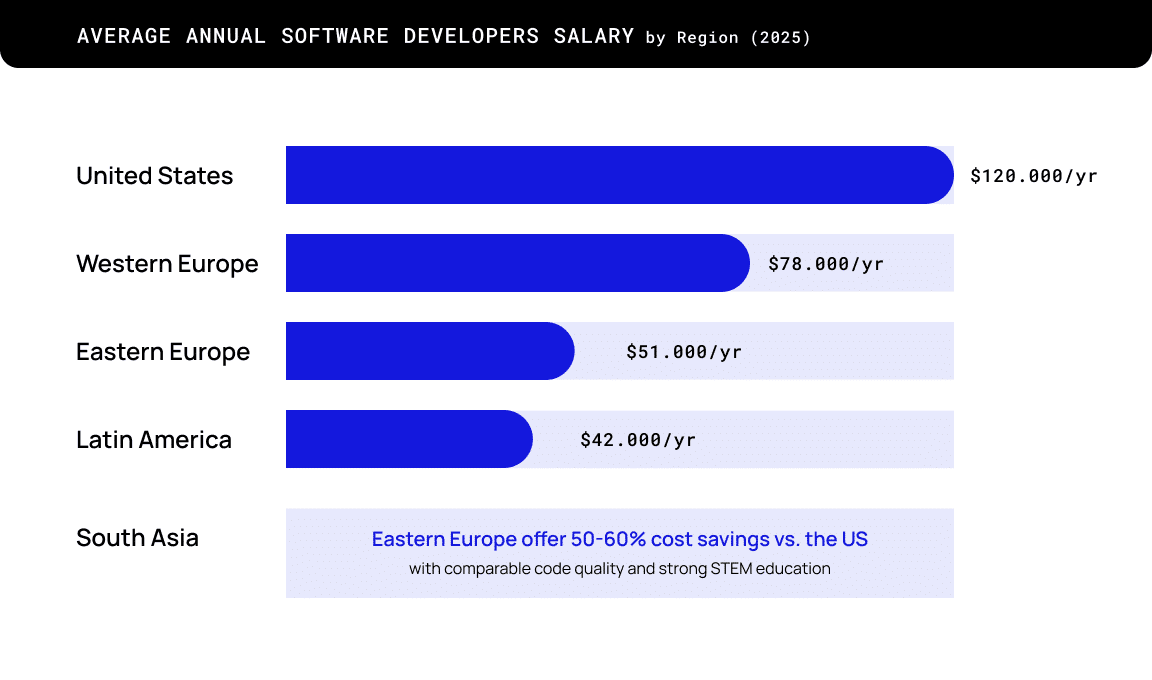
Disclaimer: Salary data synthesized from SalaryExpert, Payscale, and Gini Talent (2025-2026). Ranges reflect mid-level developer averages and vary by specific role and technology stack.
The salary differential is significant. A mid-level software engineer in Eastern Europe earns between $48,000 and $54,500 annually, compared to $110,000 to $120,000 in the United States. That represents a 50 to 60% savings on labor costs alone. However, real cost is total cost, and total cost includes recruitment, retention, infrastructure, legal overhead, and management. We will take that apart in detail in Section 4.
Before you write the first job description, there is a fundamental strategic question to answer: what operating model will your remote development center follow?
Most articles present this as a binary: outsource or build in-house. The reality is more nuanced than that. There are 3 distinct approaches, and the one you choose will shape everything from your legal exposure to your engineering velocity for years to come.
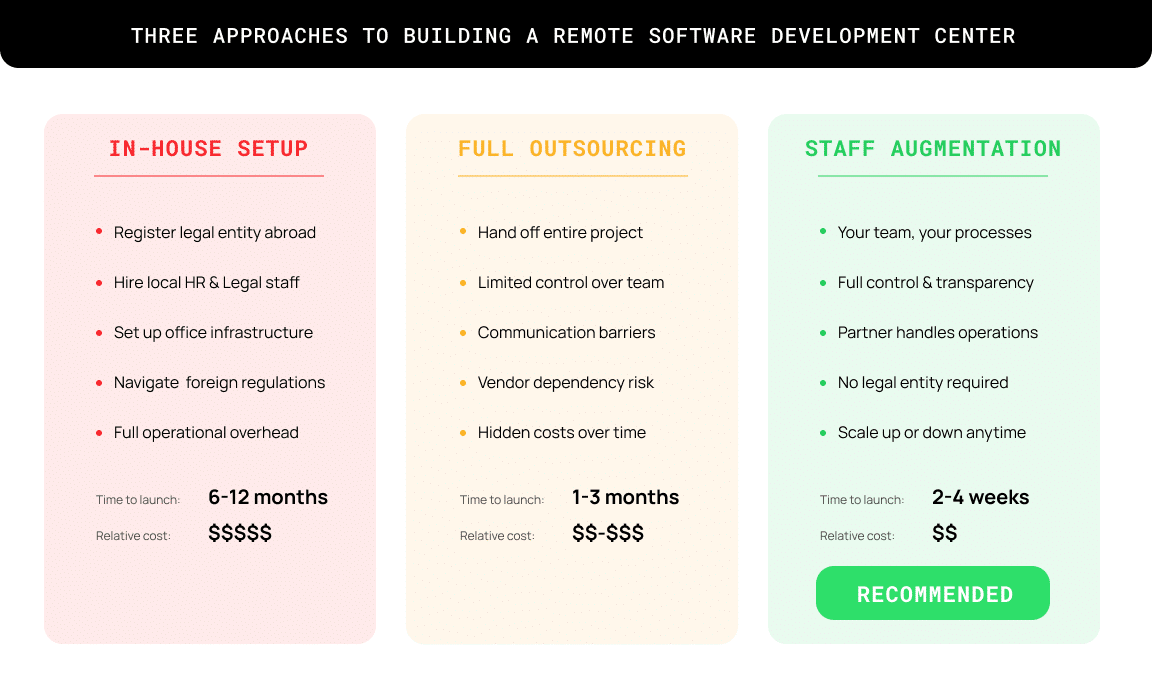
You register a legal entity in the target country, lease office space, hire a local HR and legal team, and build everything from scratch. This gives you maximum control, but at maximum cost and complexity. Expect 6 to 12 months before your first developer writes a line of production code. You will need local legal counsel (typically $15,000 to $50,000 per year), accounting services, and a working knowledge of foreign labor law. For companies planning 100+ headcount with a five-year horizon, this can make sense. For everyone else, the overhead usually outweighs the control.
You hand the entire project, or a defined scope, to a vendor. They own the delivery, team composition, and process. The advantage is speed and simplicity: you define requirements and they execute. The downside is significant: you lose control over who works on your code, how they work, and the institutional knowledge they build. When the contract ends, so does your team. There is no continuity, no embedded culture, and limited leverage.
This is the model that has quietly become the standard for fast-growing technology companies, and for good reason. Here is how it works: you define the roles, technology stack, and seniority levels you need. Your staff augmentation partner recruits, vets, and presents candidates for your approval. You interview and select them, and they integrate into your team using your tools, your processes, and your Jira board.
The critical distinction is that these are your people, operating under your management. But all the operational burden, including legal compliance, employment contracts, payroll, taxes, benefits, and office space, is handled by the partner. You do not register a legal entity. You do not hire local lawyers. You focus on building product while the partner focuses on making that operationally possible.
| With Newxel’s staff augmentation service, there is no need for clients to register a legal entity abroad. All administrative, legal, HR, and financial support is handled end-to-end, so your team is contributing from Day 1. |
This is why staff augmentation is the recommended approach for the vast majority of companies building a remote software development center. It gives you the control of an in-house team with the speed and flexibility of a managed service, without the years of setup and the operational overhead.
Deciding to build a remote development center is the straightforward part. Executing it without costly missteps is where the real work begins, and where having a clear roadmap makes a tangible difference.
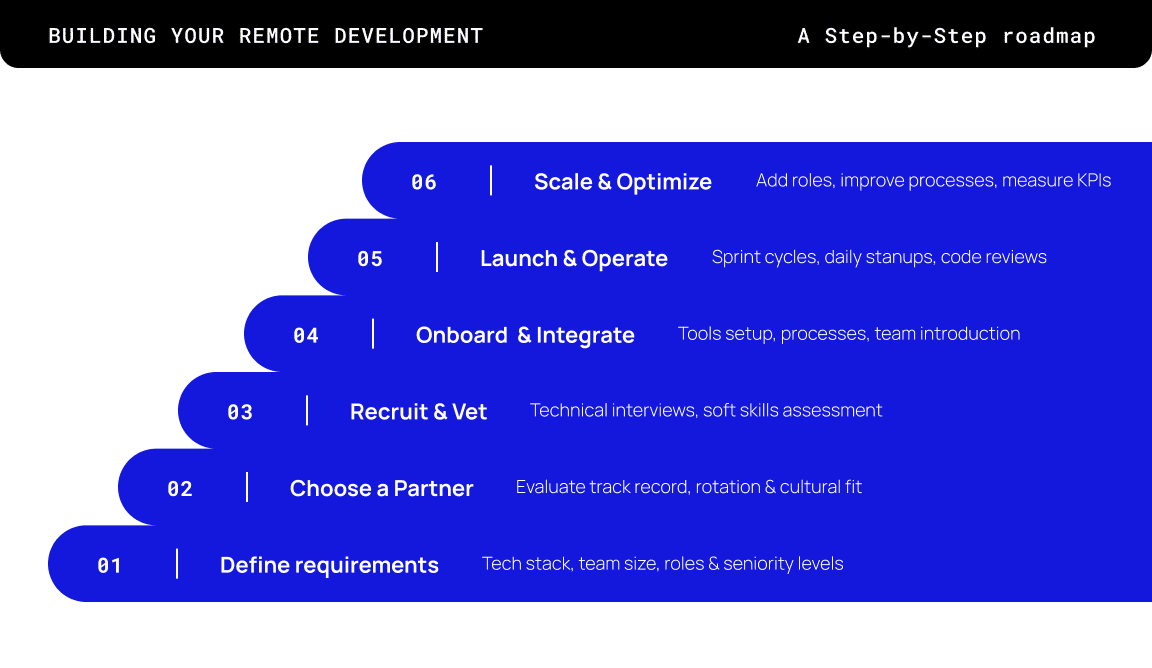
Vague briefs produce vague results. Before engaging any partner, take the time to document the following clearly:
The more specific you are at this stage, the faster your partner can deliver precisely matched candidates. This is not bureaucratic overhead; it is the single biggest factor that determines whether the engagement succeeds or becomes a frustrating cycle of mismatched hires.
This is the step where most companies make their costliest mistake. They approach partner selection as a procurement exercise, filtering primarily by price and checking compliance boxes. But the partner you choose will directly shape your engineering culture, code quality, and retention for years. Consider these points making your decision:
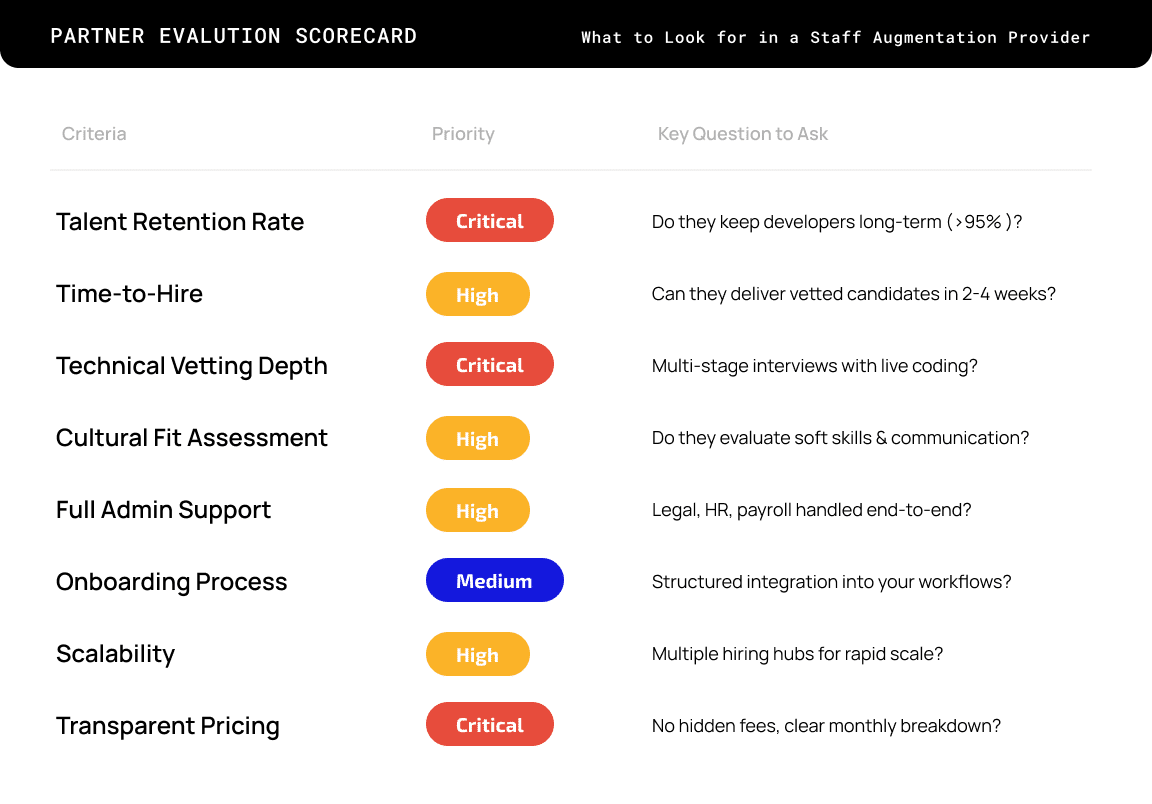
With the right partner, recruitment becomes a curated process rather than a firehose of resumes. The partner’s recruitment team sources candidates from their existing network and active pipeline. Each candidate goes through technical screening that typically includes timed coding challenges, system design discussions, and domain-specific assessments.
But here is the part that most providers skip entirely: soft skills and cultural fit evaluation. A brilliant engineer who cannot communicate clearly in Agile ceremonies, or who clashes with your team’s working norms, is a net negative regardless of their technical abilities.
At Newxel, we evaluate communication skills, English proficiency, collaboration style, and work ethic before any candidate reaches your desk. You then conduct your own interview, typically a technical deep-dive and a culture-fit conversation, and you make the final hiring decision. The entire process from requirement definition to signed offer typically takes two to four weeks.
This is where remote development centers succeed or fail, and unfortunately it is the phase that receives the least attention in most planning processes.
Onboarding a remote engineer is not the same as giving them a laptop and a Slack invite. Effective integration requires deliberate effort across three dimensions:
Newxel’s approach goes beyond placement. We actively participate in the onboarding process, ensuring that new team members understand not just the technical environment but the human one. In our experience, investing in this phase reduces early attrition by over 70% and accelerates the time it takes for a new engineer to start making meaningful contributions.
Your remote team is now part of your engineering organization, and they need to be treated that way. Include them in sprint planning, retrospectives, and architecture discussions. Give them ownership of meaningful work, not just bug fixes and maintenance tickets.
Successful remote software development centers operate on the same principles as any high-performing engineering team: clear goals, regular feedback, and psychological safety. The geographic distance is a logistics challenge, not a culture problem, as long as you treat it intentionally.
Once your initial team is delivering consistently, scaling becomes straightforward. Need to add a DevOps engineer, a QA lead, or a data scientist? Your partner’s pipeline is already active. The operational infrastructure including legal, HR, and workspace is already in place. Scaling a remote development center from 5 to 25 engineers should take weeks, not months.
Most cost comparisons in this space focus almost exclusively on salary. “Developers in Poland cost 50% less than in San Francisco.” That is true, but it is incomplete. The total cost of running an engineering team includes layers that never show up on a salary comparison chart.
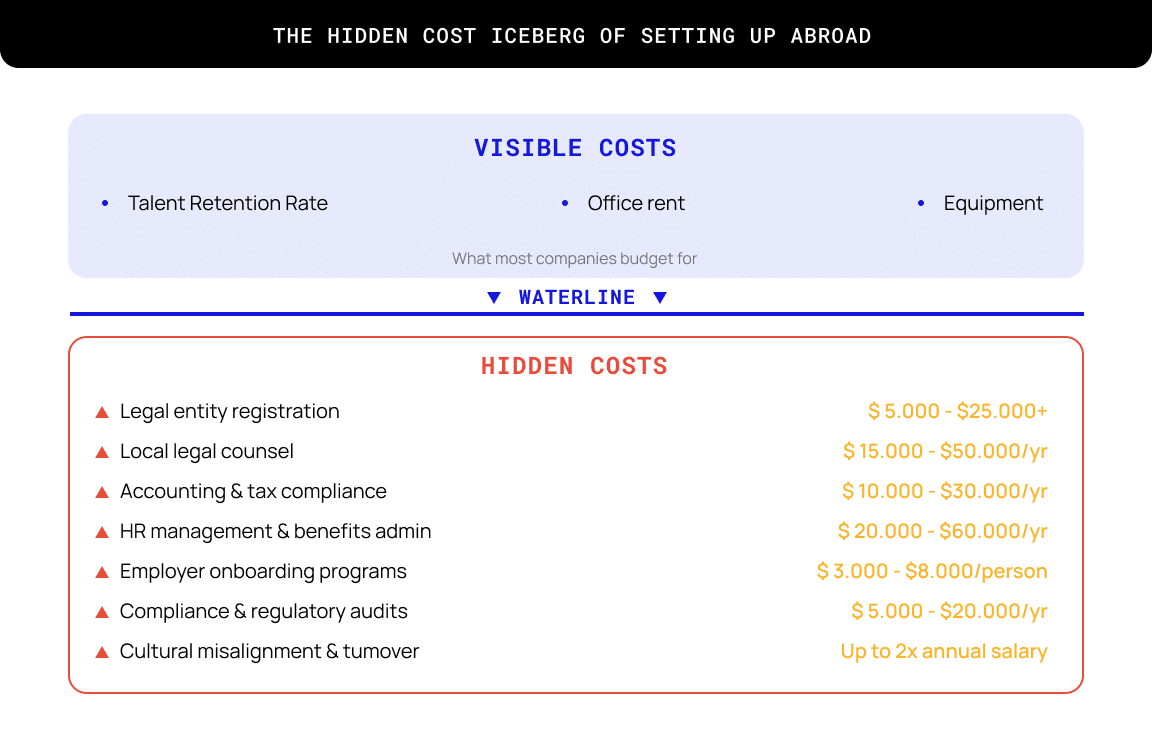
Disclaimer: Cost estimates based on Newxel operational data across 8+ years of managing remote teams in Eastern Europe and industry benchmarks from Deloitte and KPMG global mobility surveys.
When you set up a fully owned foreign entity, these hidden costs add up quickly: legal registration, ongoing local counsel, accounting, tax compliance, HR management, benefit administration, employee onboarding programs, and compliance audits. Each of these line items ranges from a few thousand to tens of thousands of dollars annually. And perhaps the most expensive hidden cost of all is cultural misalignment and turnover, which can cost up to two times a developer’s annual salary per replacement, according to Gallup research.
When you use a staff augmentation partner like Newxel, the vast majority of these costs are absorbed into a single, transparent monthly fee. There are no surprise invoices for legal registration, no scrambling to find a local accountant, and no HR emergencies when a contract does not comply with local labor law. You pay one predictable rate per developer per month, and that rate includes all operational overhead.
This is why the total cost of ownership for a partner-supported remote development center is typically 30 to 40% lower than a fully self-managed entity, even before you factor in the opportunity cost of your leadership team spending months on operational setup instead of building product.
One of the most common concerns we hear from CTOs evaluating a remote development center is whether they will actually retain control over their team. In a well-structured staff augmentation model, the answer is absolutely yes.
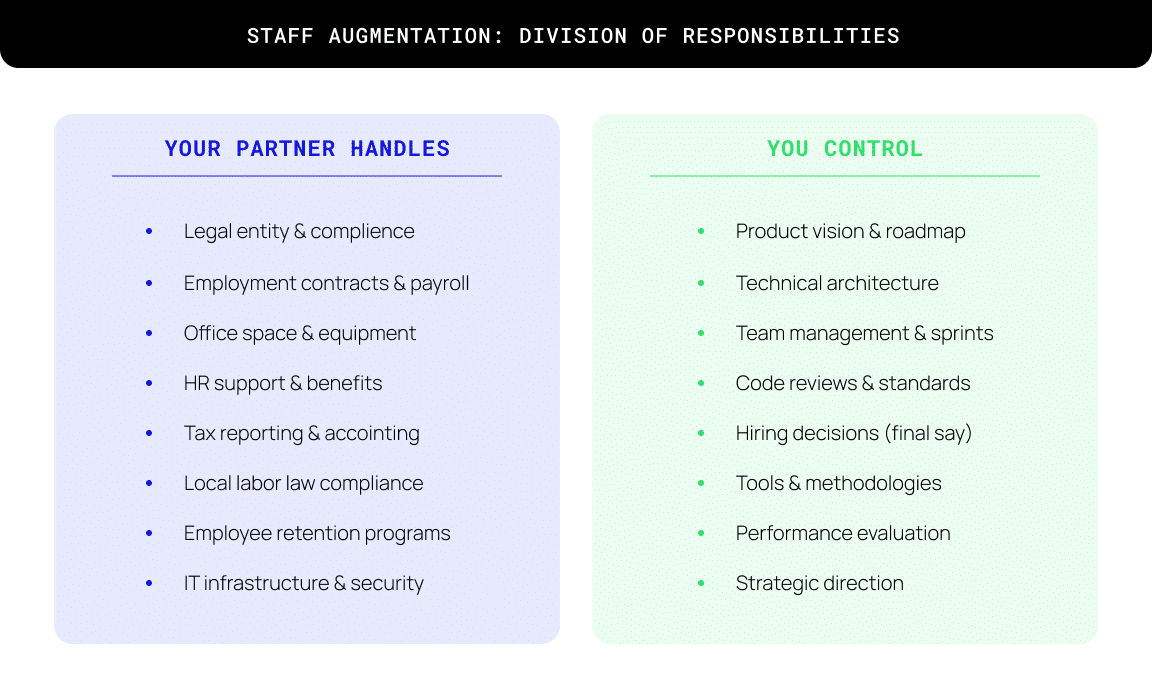
This clear separation is what makes staff augmentation fundamentally different from outsourcing. Your partner is not a vendor delivering a product to you. They are an operational extension that removes administrative friction so your engineering leadership can focus on the work that actually matters.
Technical skill is necessary but not sufficient. We have seen well-architected remote team setups deteriorate because of cultural misalignment. A developer might be a Kubernetes expert with a pristine GitHub profile, but if they cannot navigate ambiguity, communicate blockers proactively, or adapt to your team’s communication norms, the arrangement will not work regardless of their technical talent.
This is why cultural assessment needs to be a first-class part of your hiring process, not an afterthought. Here is what to evaluate in every candidate:
Eastern European developers, particularly from countries like Poland, Romania, and Ukraine, consistently perform well on these dimensions. There is a strong cultural alignment with Western work norms, excellent English proficiency among senior engineers, and an engineering culture that values rigorous problem-solving. At Newxel, cultural fit assessment is embedded into every stage of our recruitment process. We do not just screen for hard skills; we evaluate how a candidate communicates, collaborates, and handles feedback. This is why our clients consistently report that their remote team members feel like genuine parts of the team.
Building a remote software development center introduces legitimate concerns around intellectual property, data security, and regulatory compliance. These are solvable problems, but only if you address them structurally from the beginning rather than trying to patch them later.
Newxel handles all of this as part of our standard engagement. Employment contracts include IP assignment clauses, NDAs are standard, and our operational infrastructure meets GDPR standards. This is not something you should need to build from scratch yourself.
The first five engineers are a proof of concept. The next twenty are a scaling strategy. And when you reach fifty or more, your remote development center becomes a core organizational capability with its own momentum. Here is how that progression typically works in practice:
Your partner should be able to support this growth without creating bottlenecks. With Newxel’s presence across 8 European hiring hubs, we can source and onboard engineers across multiple countries simultaneously, which means scaling does not require compromising on quality or slowing down to build new operational infrastructure.
You cannot manage what you do not measure, and this applies doubly to distributed teams. Here are the metrics that give you the clearest picture of how your remote center is actually performing:
Review these metrics monthly during the first six months, then transition to quarterly reviews. Share them transparently with both your internal leadership and your partner. The best partnerships are the ones where data drives the conversation.
Over 8 years of helping companies build remote development centers, we have noticed a consistent pattern: the questions that matter most are often the ones that do not come up during the initial evaluation. Here are the ones worth asking before you sign anything:
Building a software development center for remote teams is no longer an experimental initiative. It is an established strategy used by companies at every stage, from early-stage startups to established enterprises. The infrastructure exists, the talent is available, the processes are mature, and the operational models are well understood.
The difference between success and failure comes down to 3 things: choosing the right operating model (staff augmentation provides the best balance of control and flexibility for most companies), selecting a partner with genuine operational depth rather than just a recruitment pipeline, and investing in integration and culture as seriously as you invest in recruitment.
At Newxel, we have spent over 8 years helping technology companies build remote development centers across Europe. We have placed hundreds of engineers for clients in Israel, the US, and other countries, and our 98% retention rate reflects the quality of the matches we make and the environment we create for the people who join these teams. We do not just find people, but build teams. We handle the legal, HR, and administrative infrastructure so you can focus on what you do best: building great software.
If you are exploring whether a remote development center is the right move for your company, we are happy to share what we have learned from hundreds of engagements, without obligation.
All external data referenced in this article is sourced from the following publications. These sources are provided for transparency and should be consulted for the full context of any statistics cited.
All cost estimates and process descriptions related to Newxel’s services are based on our operational data spanning 8+ years of managing remote development teams across 8 European hiring hubs.