Development Team Extension: How an Extended Team Helps Startups Scale Faster
20 min
· March 25, 2026
Most startup founders hit the same wall at some point. Engineering becomes the bottleneck. The roadmap keeps stretching, the backlog piles up faster than the team can burn it down, and weeks go by without a release while competitors keep shipping. If you have lived through that, you already know where this is going. You cannot fix it by adding one more person to the payroll.
And the pressure spikes right after a funding round. Jobright analyzed hiring data in 2025 and the numbers tell the story on their own: Series A startups posted over 153,000 job openings in a single quarter. Backend engineers, ML engineers, and technical PMs were at the top of every list. By Series B, postings climbed past 125,000. Funded startups need engineers, and they needed them yesterday.
Local hiring takes 3 to 6 months for a senior role, assuming your top candidate does not take a counteroffer in week 8. San Francisco and London salaries keep climbing year after year. Globally, we are now looking at over 4 million unfilled developer positions. None of those trends are reversing.
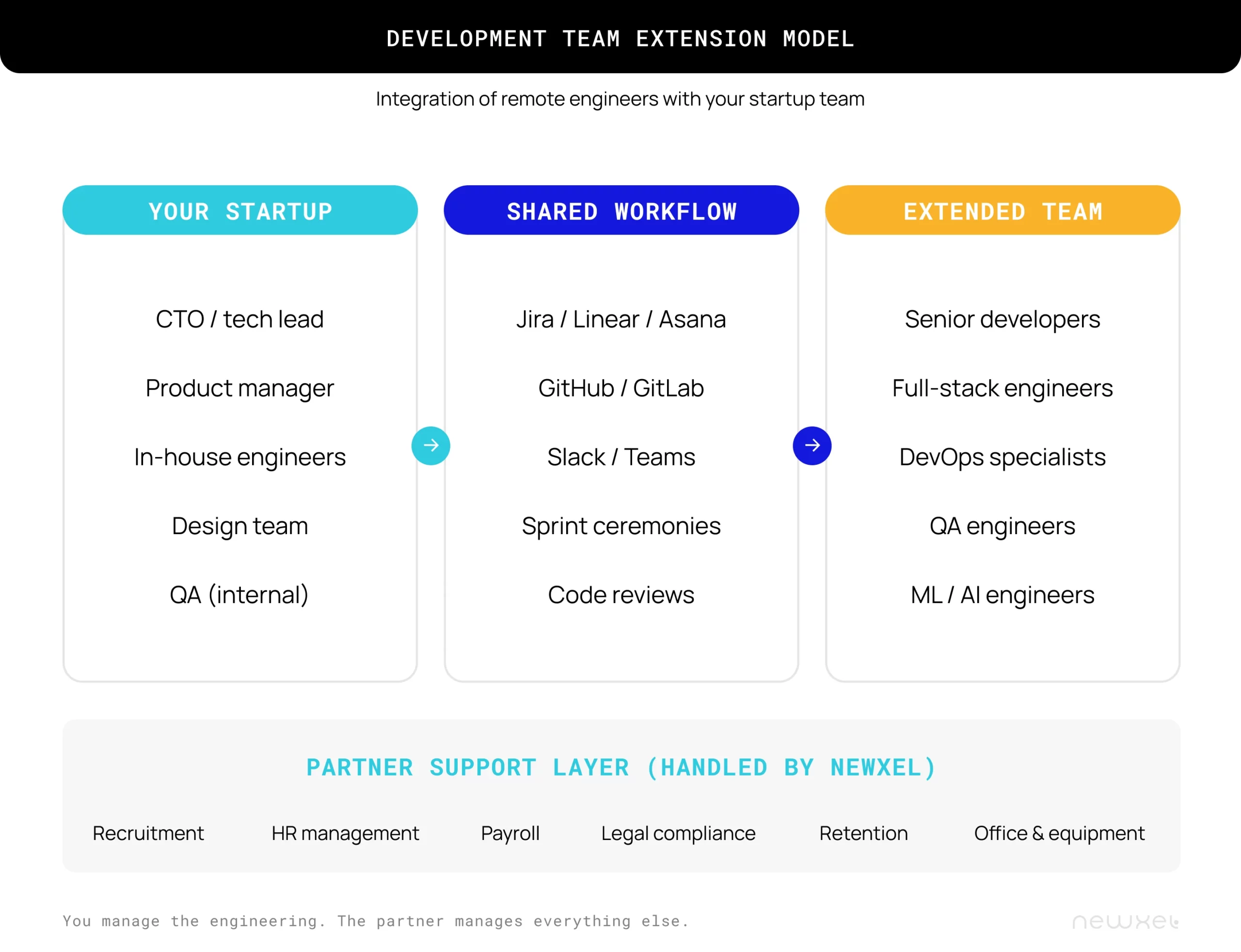
One of the ways startups are responding is through development team extension. Instead of outsourcing entire projects or bringing in contractors who sit outside the team, you embed engineers directly into your existing workflow. They use your tools, follow your processes, attend your standups, and commit to your codebase. That is a fundamentally different arrangement from outsourcing, and the differences show up in how the engineering work gets done day to day.
We started Newxel to help technology companies, mostly Israeli startups and scale ups, build engineering teams in Eastern Europe. We have been doing this since 2017. What follows draws from that operational experience, from academic research on distributed teams we have dug into over the years, from industry benchmarks, and from patterns we keep seeing across hundreds of hiring engagements. We wrote this for startup leaders who are past the definitions stage and want a practical framework for engineering capacity planning.
When founders and CTOs talk about development team extension, or sometimes software team extension, they are describing a specific setup: engineers from outside your company who work as part of your team. Not a separate vendor team. Your team. They report to your tech lead, they work in your repos, they join your sprint ceremonies. In an outsourcing arrangement, you hand over a brief and get back a deliverable. Here, the engineers are embedded in your distributed workforce and share accountability for what ships.
On paper, the engineers are employed by the partner company (in our case, Newxel). We handle their contracts, payroll, HR, legal compliance, and office setup where needed. We act as the employer of record locally, which means you skip the hassle of registering a foreign entity. Sprint planning, code reviews, architectural calls, all the technical leadership stays on your side.
If outsourcing is hiring a caterer for your event, team extension is more like hiring a chef who works in your kitchen, cooks from your recipes, and takes direction from you. You keep all the IP. We just handle the operational side of keeping the people employed, paid, and supported.
People often mix this up with staff augmentation, and the overlap is real. Both models exist because hiring is brutal right now (SHRM reported in 2024 that 77% of organizations struggle to fill full time technical roles). Where they differ is in how deep the integration goes and how long it lasts. Staff augmentation is usually a shorter engagement: you need a React developer for 3 months, an agency places one. Team extension means you are building a unit that sticks around, grows with the product, and is wrapped in a full operational layer covering everything from onboarding process design to long term retention.
At Newxel, the most common story starts the same way: a startup closes its Series A or B, and suddenly they need to double or triple the engineering team in 6 months. We have been through that conversation dozens of times. The broader market data backs it up. Riviera Partners signed 58% more engineering leadership searches in the US and 61% more in Europe in 2025. Coastal Talent saw similar volume. When companies are hiring that many VPs of Engineering, it means they are getting ready to scale headcount fast.
But hiring 10 engineers locally in Tel Aviv, San Francisco, or London within a few months? Senior engineers in those markets are already spoken for. Salaries keep going up, the pipeline never gets deeper, and your CTO is burning entire weeks on interviews instead of shipping. That is what pushes so many founders toward the extended team of startups approach instead of waiting for the local market to catch up.
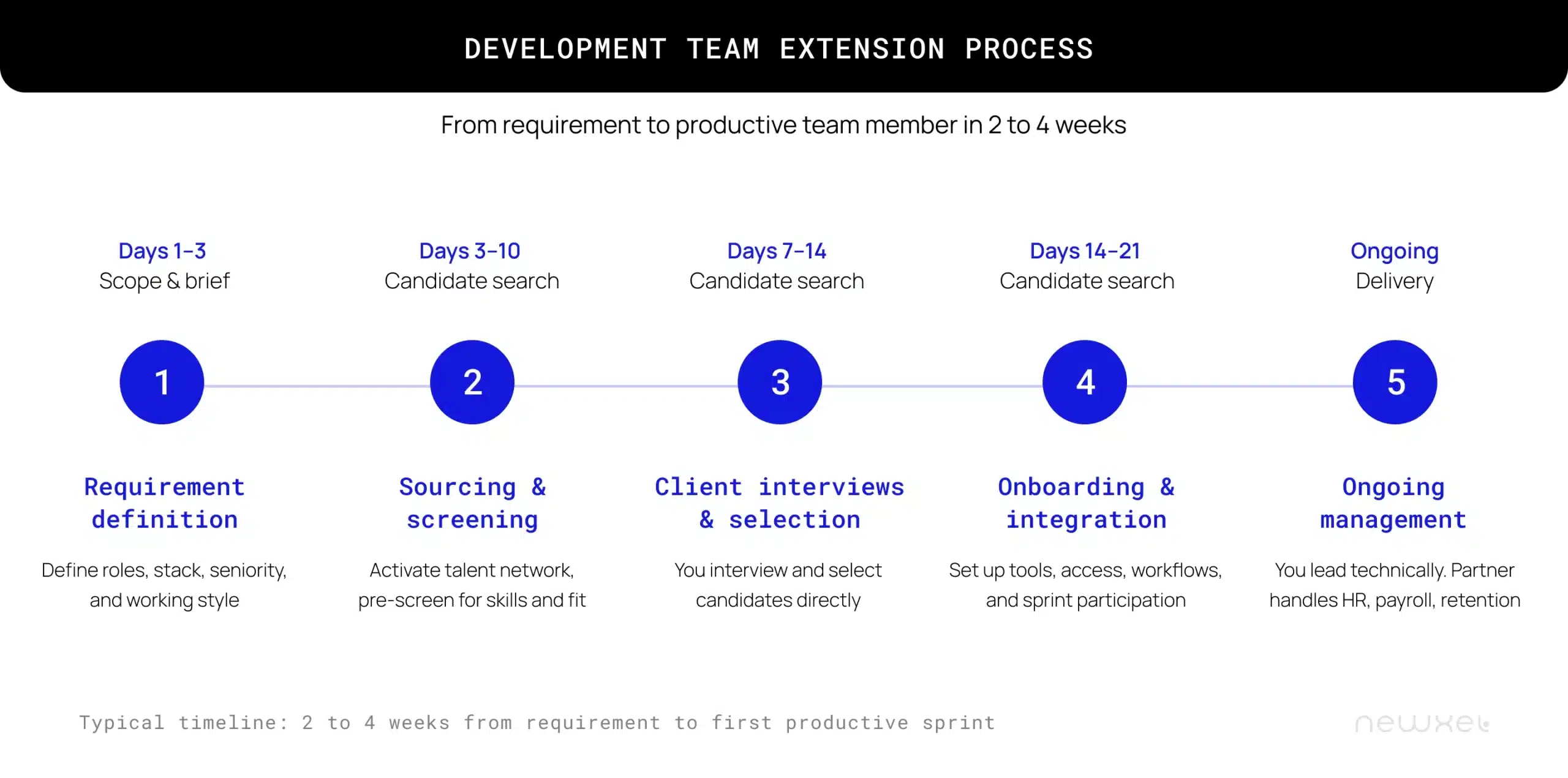
Team extension changes that math. A partner like Newxel already has sourcing networks across Poland, Romania, and other Eastern European hubs. We are not starting from scratch. Our average time from signed requirement to a developer joining your standup is 2 to 4 weeks.
Cost comes up in every conversation, but most funded startups care less about the hourly rate and more about whether they can get the right person at all. That said, the numbers are worth knowing. Uptalen compiled 2025 market data showing senior Eastern European developers at $55 to $110 per hour. In San Francisco or New York, you are looking at $150 plus before overhead kicks in. But the cost gap is not the main story. What really matters is how many engineers are available. Poland alone has over 400,000 developers according to 2025 PARP data. Ukraine adds another 340,000. Add the rest of Eastern Europe and you get to roughly 1.3 million tech professionals.
Cheap labor is not what we are selling. Eastern Europe produces over 80,000 IT graduates every year. Many of these developers have been working with Western clients for a decade or more. They know Agile. They know how product companies operate. Time zones help too. A developer in Warsaw or Bucharest shares most of the workday with London, Berlin, and Tel Aviv. Try running a standup with someone 10 hours ahead and you will appreciate that overlap pretty quickly.
76% of IT leaders say they have difficulty finding the skills they need (2025 Global Talent Shortage report). McKinsey puts it even starker: 87% of companies either have a skills gap or expect one within a few years. If you are a CTO at a Series A company trying to hire 5 engineers in a competitive market, these are not abstract statistics. They describe your Tuesday.
Hiring locally is a zero-sum game in many markets. If 15 companies in your city are all chasing the same 3 senior React developers, most of those companies are going home without a hire. Team extension gets you out of that local competition entirely. You tap into global engineering pools, and the partner deals with foreign entities, international payroll, and local labor law.
3 to 6 months. That is how long a local engineering hire takes in a competitive market, from posting the job to the first productive sprint. Through an extended software development team partner, that drops to 2 to 4 weeks. When your next investor update is in 90 days and you promised a beta, that gap between months and weeks decides whether you hit the launch window or miss the quarter. We have watched it play out both ways.
Every company in your city is fishing in the same pond. For niche roles, maybe there are 5 qualified people in the whole market and 3 of them are not looking. Open the search to 8 or more European hubs and the math changes completely. A backend Golang role that sits open for 4 months in London might close in 3 weeks through a partner sourcing in Poland. A DevOps engineer with deep Kubernetes experience who does not exist in your local market might be available in Romania next Tuesday.
Every startup founder knows how fast priorities shift. You pivot the product, and suddenly your Python backend is less important than a mobile team. A big client signs, and you need 4 more engineers by next month. A milestone slips, and budget gets tight. With an in house team, each of those shifts means restructuring, severance risk, and legal complexity. Team extension absorbs those swings because the employment relationship sits with the partner, not with you.
Running payroll across borders, sorting out employment law in each country, finding office space, setting up benefits: founders consistently underestimate how much time this eats. At a 20 person startup where the CTO is reviewing PRs in the morning and doing customer calls in the afternoon, asking that same person to also manage foreign employment compliance is a recipe for burnout. A team extension partner takes that entire stack off your plate.
Most articles about team extension do not talk about retention, which is strange, because turnover is probably the biggest risk in any distributed arrangement. Our client retention rate at Newxel is 98%, and the average partnership lasts over 5 years. Those numbers come from doing the unglamorous work: making sure engineers are paid competitively in their local market, giving them real career development paths, having HR people they can talk to when something is wrong. Most startups cannot build that infrastructure in a foreign country on their own. We already have it.
Before committing, most founders want to see what the process looks like end to end. Reasonable. Here is what the process looks like at Newxel. Other good partners run something similar, though the specifics differ.
We start by sitting down and getting into the details of what you need. Not job titles. Technical details: what stack, what seniority level, what kind of domain experience, how autonomous the person needs to be. A good partner will push back if the requirements are unrealistic or if they can suggest a better team composition. We do this frequently. We have had clients ask for 5 senior engineers when, after looking at the workload breakdown, 3 seniors and 2 mid level developers with the right domain knowledge would have delivered the same output at lower cost.
Then we start sourcing. Our own database, professional networks, targeted outreach. Every candidate gets prescreened on technical skills and English before their CV reaches your inbox. We also screen for cultural fit, because a brilliant engineer who cannot communicate clearly in your team’s language or adapt to your working style is not going to help you ship faster. Only shortlisted candidates are presented to you.
You run the interviews yourself, exactly as you would for an internal hire. Technical depth, communication, problem solving approach, team fit. We would not send you anyone we did not believe in, but the decision is yours.
Once you pick someone, onboarding works the way it would for any new hire. Jira or Linear access, Slack channels, repo access, first standup. All the paperwork, equipment provisioning, workspace, and local compliance requirements land on the partner, not on you.
On a daily basis, the engineers answer to you. Payroll, benefits, HR reviews, workplace issues, and retention sit with the partner. That division of labor, engineering leadership on your side, everything operational on ours, is what keeps the model running as the team scales.
How does team extension compare to outsourcing, staff augmentation, or just hiring in house? We hear this question in almost every sales call, and the answer matters more than the labels suggest.
| Criteria | Team extension | Outsourcing | Staff augmentation | In house hiring |
| Management control | Full (you manage) | Vendor manages | Shared or full | Full |
| Integration depth | Deep, embedded | Separate team | Moderate | Deep |
| Time to onboard | 2 to 4 weeks | 2 to 8 weeks | 1 to 4 weeks | 3 to 6 months |
| IP ownership | 100% yours | Contract dependent | 100% yours | 100% yours |
| Cost structure | Monthly per person | Project based | Hourly or monthly | Salary plus overhead |
| Scalability | High | Moderate | High | Low |
| Admin burden on client | Low (partner handles) | Low | Moderate | High |
| Best for | Long term scaling | Defined projects | Short term gaps | Core team roles |
The difference with outsourcing comes down to one question: who owns the process? With outsourcing, you write a brief and wait for a deliverable. You may never learn who built it, what trade offs they made, or why the architecture ended up the way it did. With team extension, the engineers are in your workflow. Same standups, same repos, same Slack channels. Everything they learn stays in your organization, and so does the IP. We see a lot of startups come to us after trying outsourcing first. They switch because they want to hire extended software team members they can manage directly. After living through vendor managed delivery and the context loss that comes with it, the value of embedded engineers stops being theoretical.
Staff augmentation is closer to team extension, but it usually ends once the person is placed. The agency finds you a contractor. After that? HR, retention, office logistics, legal compliance in that country, that is on you. Team extension bundles all of it. That is why it works for startups building dedicated development teams of 3 or more people in countries where they have no legal entity or HR presence.
None of this means in house hiring is obsolete. For leadership roles, for positions that require someone physically present, or for hires where cultural immersion from day one is critical, local hiring is still the better path. But for engineering execution roles, particularly when you already have people in more than one location, team extension gets you equivalent output with far less overhead and a much shorter ramp up.
We turn away clients when the fit is not right. Team extension works well under certain conditions, and poorly without them.
You need someone on your side who can lead the engineering. Could be a CTO, a VP of Engineering, a solid senior tech lead. Someone who sets technical direction, maintains standards, and reviews code. Without that person in place, adding remote engineers just creates more problems. Hire that person first.
This model works when you know what you are building and just need more people to build it. If you are still pivoting every other week trying to find product market fit, a small co located team with room to improvise is probably a better bet. Team extension delivers the most value once your architecture is stable, technical debt is not out of control, and the roadmap has enough shape that you can brief new engineers on what needs doing.
Say your next milestone is 6 months away and you have 4 open engineering seats. If local hiring takes 3 to 4 months, half your runway burns before those new hires write a single line of production code. Team extension compresses that timeline without lowering the bar on who you hire.
We talk to a lot of founders who outsourced their first version and regretted it. The vendor accumulated all the context, code quality drifted because nobody on the client side was reviewing it, and eventually the startup was dependent on a third party to explain its own product. With team extension, those problems go away because the engineers report to you, the code lives in your repos, and all intellectual property belongs to your company.
In our experience, team extension is the right call when you need at least 3 engineers, the work will last 12 months or more, you have technical leadership in house to manage them, and you want to own the delivery end to end. Outsourcing fits better when you have a clearly scoped project with a defined end date. Staff augmentation is the right pick when you need 1 or 2 people for a few months to cover a specific gap. And in house hiring is still the best path for senior leadership, strategic roles, or positions where full time physical presence matters. Plenty of our clients mix models. They hire leadership locally and extend the engineering team through us. That combination works well.
BETSOL published a report in 2025 showing that well managed distributed teams report 40% higher productivity and better retention than co located ones. The key phrase is well managed. Distributing your team does not automatically make things worse, but it does require a management discipline that many companies, especially fast moving startups, underestimate badly.
We have worked with enough clients now to see the pattern clearly. Success with extended teams comes down to 3 things: communication structure, onboarding quality, and whether remote engineers feel like they belong or feel like outsiders.
Full Scale found that teams with documented knowledge sharing practices onboard engineers 55% faster. With extended teams, good onboarding matters even more because you cannot rely on hallway conversations to fill in gaps. Get the first 2 weeks right and you set the tone for the whole engagement. That means written documentation for your codebase and architecture decisions, not tribal knowledge. Make sure the development environment setup is reproducible and your coding standards are written down somewhere. Do not assume that a talented engineer will figure it out on their own, even a senior one. Good onboarding pays for itself quickly. We have seen it cut ramp up time from 6 weeks to under 3.
Live meetings across time zones eat into everyone’s deep work hours, so the best teams use them sparingly. Day to day communication works better when it is asynchronous and complete on its own: a Slack message that someone 4 hours behind can read and act on without asking follow up questions, a Loom walkthrough instead of a 30 minute call, a shared doc instead of a verbal decision. Keep the synchronous slots for sprint planning, retros, and genuinely hard problems where you need people talking at the same time. Everything else belongs in Notion or a Loom.
This one sounds obvious but it is where most teams fail. Extended engineers who feel like outsiders, cut off from decisions and missing context, disengage fast. And disengaged engineers leave. So put them in every channel your in house engineers are in. Bring up their work in all hands. Show them the full roadmap, not a sanitized version. Give them the same feedback rhythm as everyone else on the team.
The 2025 benchmark data from Worklytics, based on analysis of millions of pull requests, confirms what experienced engineering leaders already know: the best productivity metric is not time logged but the quality and velocity of delivery. Track PR cycle times, deployment frequency, code review turnaround, and the ratio of feature work to maintenance. Those numbers tell you more than a green dot on Slack at 9 AM ever will.
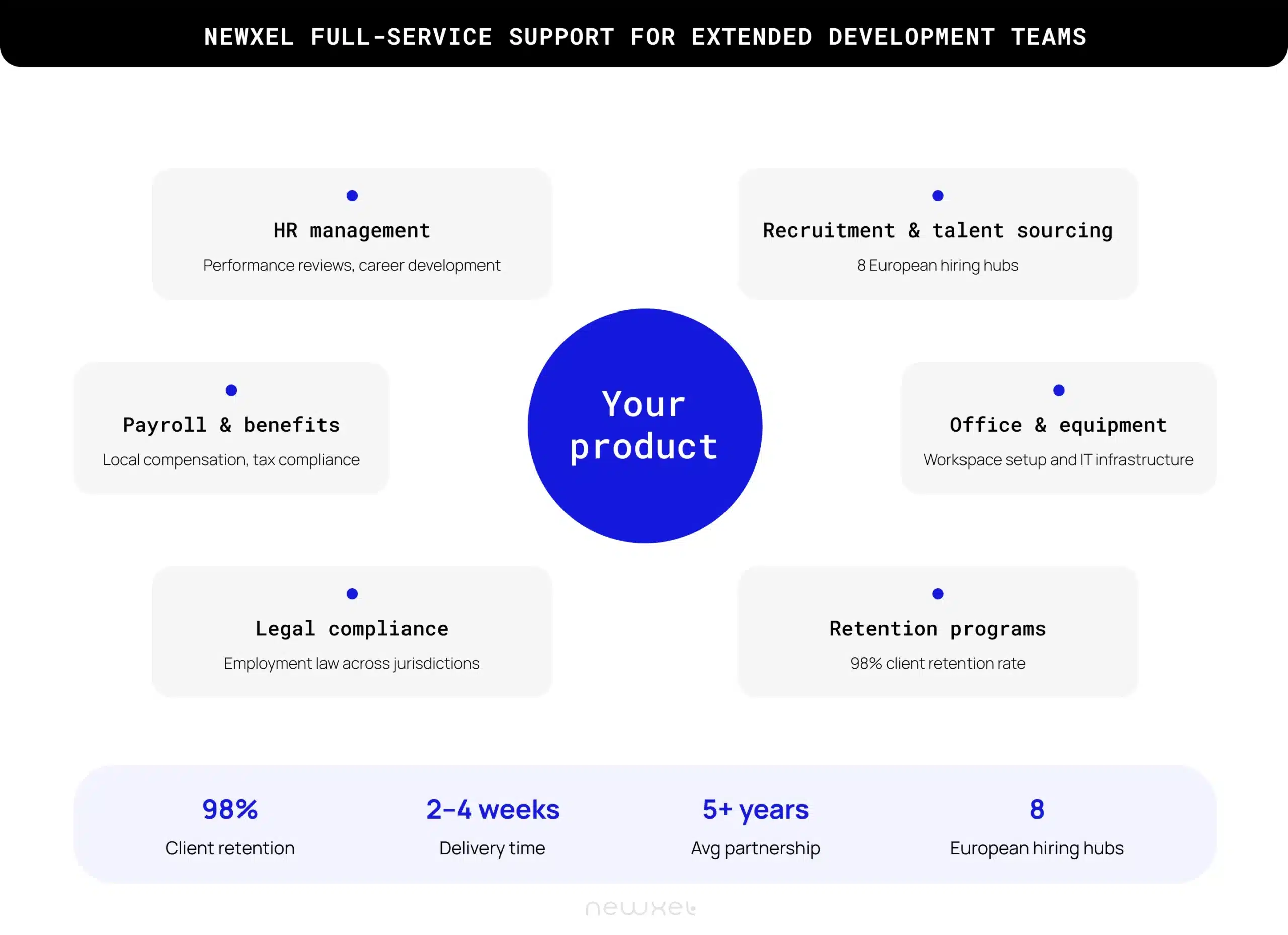
On the operations side, we handle recruiting from 8 European hiring hubs, employment law in each country, payroll, benefits, HR (including reviews and career growth conversations), and office setup where needed. We also manage the retention programs. All of it exists so you can focus on your product. We take care of the rest.
What makes the model work at scale
98% client retention. 5 plus years as an average partnership duration. We track those numbers closely and work to protect them. Compensation has to be competitive in the local market, not just undercut San Francisco and call it a deal. Engineers need to see where their career goes from here. HR has to respond fast when something comes up. And the engineers have to feel like they matter to both the client and to us.
From signed requirement to an engineer joining your standup: 2 to 4 weeks. For startups scaling hard after a round, that speed alone is often what tips the decision toward team extension over waiting on local hires.
5 years ago, most startups hired locally and that was the end of the conversation. That is no longer how it works. Distributed models that mix an in house core with global talent networks are winning, and for startups burning runway against competitors, that shift is not optional.
Development team extension is how a growing number of startups are making that work. You keep control of the engineering. You tap into a talent pipeline that already exists. You pay global rates instead of San Francisco rates. And the partnerships are built to run for years. When a startup decides to hire an extended software team through the right partner, the result does not feel like an external arrangement at all. It feels like having a second engineering office.
Both the research and our own operational experience lead to the same conclusion: distributed teams that are well managed perform at least as well as co located ones, and in some metrics, like deployment frequency and sprint completion rates, they often do better. Geography and time zone are not the deciding factors. They are communication quality, onboarding depth, and how integrated the extended team feels within the broader organization. Nail those, and the model delivers. Miss them, and no cost savings will make up for it.
We have been refining this model since 2017. 98% retention, 2 to 4 week delivery, partnerships that average over 5 years. Those numbers come from treating team extension as a long term operational commitment, not a staffing transaction.
If engineering capacity is what stands between your startup and its next milestone, reach out. Building an extended development team could be the fastest way to close that gap. We have done it for dozens of startups, and we would be happy to walk you through how it could work for yours.
21. Newxel. (2025). Internal operational data: client retention rates, delivery timelines, and partnership durations. Newxel.