Offshore Staff: Hire Offshore Employees Worldwide
26 min
· February 19, 2026

You already know that hiring offshore employees can save money. Every article on the first page of Google will tell you that. But here is what most of them skip: the decision to hire offshore staff in 2026 is no longer primarily about cost arbitrage. It is about gaining access to engineering capability that simply does not exist in your domestic market at the speed you need it.
The U.S. Bureau of Labor Statistics projects the software developer workforce to grow 17% between 2023 and 2033, roughly twice the rate of the general workforce. Meanwhile, IDC estimates that the IT talent shortage will cost organizations $5.5 trillion in losses by 2026 through delayed projects, stalled innovation, and missed market windows. By 2030, Korn Ferry forecasts a global deficit of 85.2 million skilled workers, with the technology sector bearing the sharpest pain.
Data disclaimer: U.S. BLS Occupational Outlook Handbook (bls.gov); IDC FutureScape 2026 (idc.com); Korn Ferry Global Talent Crunch Study (kornferry.com)
So the real question is not whether you can afford to go offshore. The question is whether you can afford to wait. If your engineering roadmap depends on roles that take 90+ days to fill domestically, if your competitors are already deploying distributed teams, and if your board expects you to deliver more with a budget that is not growing proportionally, then hiring offshore talent is not a contingency plan. It is an operational imperative.
This guide is not a generic overview. It is the playbook we have built at Newxel across hundreds of engagements helping software companies build dedicated offshore teams. We will walk through the why, the where, the how, and the what-can-go-wrong, so you finish reading with a clear action plan rather than a pile of vague recommendations.
The staff augmentation services market grew from $6.89 billion in 2024 to $7.35 billion in 2025 and is projected to reach $10.34 billion by 2030, at a 7% compound annual growth rate. The broader IT staff augmentation and managed services market tells an even more dramatic story: valued at $351.68 billion in 2023, it is on track to hit $1.17 trillion by 2030, growing at 11.54% CAGR.
Data disclaimer: Research and Markets, Staff Augmentation Services Market Forecast 2025–2030 (researchandmarkets.com); Verified Market Reports, IT Staff Augmentation Market (verifiedmarketreports.com)
These are not just numbers for market analysts. They reflect a structural shift in how software companies build teams. Three converging forces are driving this acceleration.
In the U.S., only 65 qualified candidates exist for every 100 open software positions. The shortage is projected to reach 1.2 million unfilled engineering roles by 2026. In the EU, more than 50% of businesses already struggle to hire IT employees, and the bloc risks a deficit of 8 million ICT professionals by 2030. The Asia-Pacific region faces a parallel crisis: a 2 million technology worker shortfall by 2030, with an annual opportunity cost exceeding $151 billion.
Data disclaimer: U.S. BLS; EU Digital Skills and Jobs Platform; Korn Ferry Institute analysis of 20 economies
The AI boom is intensifying the pressure, not relieving it. AI-related job postings in the U.S. spiked 1,800% between 2024 and 2025, with 51% of business leaders reporting AI skill deficits. Companies are paying premium salaries for senior engineers who can architect, govern, and integrate AI systems, which further squeezes the market for everyone else.
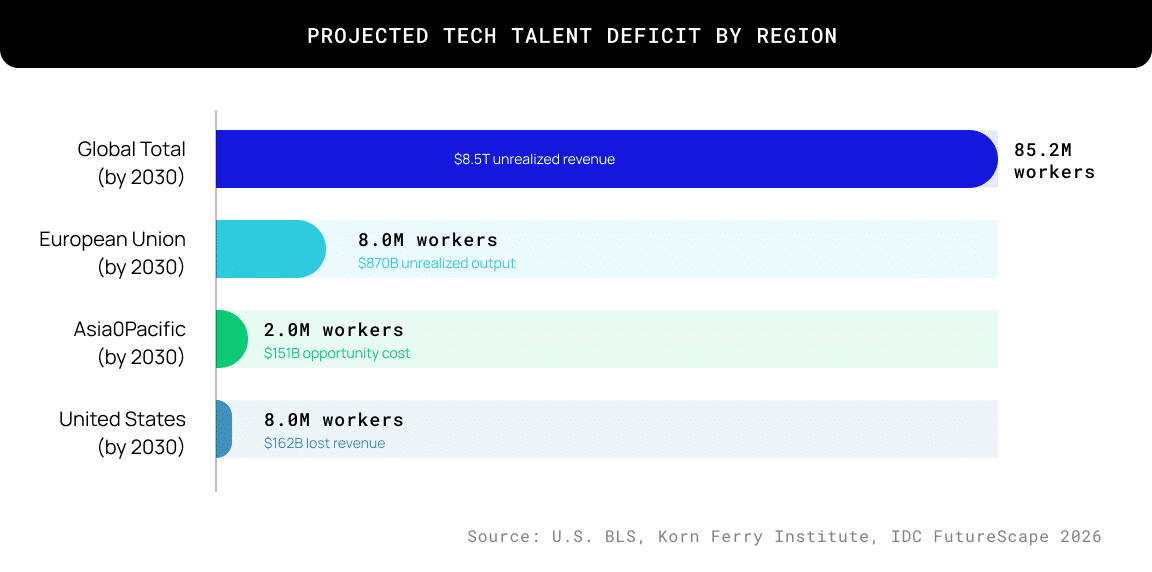
IDC puts the direct economic toll at $5.5 trillion by 2026 from delayed projects and lost innovation. Korn Ferry goes further, projecting $8.5 trillion in unrealized global revenue by 2030. For individual companies, these numbers translate to slower product launches, increased burnout among existing engineers, higher attrition as overworked teams look for relief elsewhere, and lost competitive ground that is expensive to recover.
A Gartner survey found that 86% of CIOs face greater competition for qualified tech talent, with 73% actively worried about losing the engineers they already have. Nearly half (47%) of tech workers have taken on responsibilities outside their core role because positions around them remain unfilled.
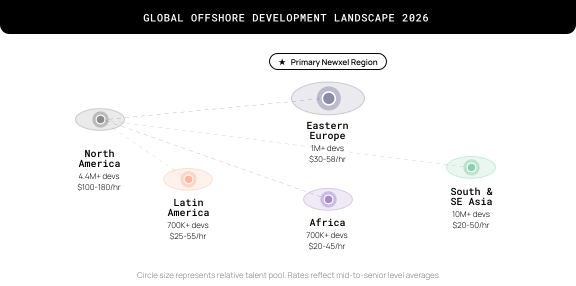
Today’s staff augmentation partners operate with AI-driven talent matching that shortens time-to-hire from months to weeks. Candidate pools are pre-vetted and organized by technology stack, seniority level, and domain expertise — so you are choosing from engineers who have already been screened, not sorting through a pile of resumes. Engagement models increasingly tie partner accountability to delivery outcomes rather than hours logged. But no algorithm replaces the human side of talent management. Hiring, onboarding, retention, conflict resolution — these are fundamentally about communication, and people need people for that. The best offshore partners combine technology efficiency with dedicated human support who know your team, understand your culture, and can pick up the phone when something needs a real conversation. Eastern Europe alone hosts over one million software developers with strong English proficiency and significant overlap with U.S. and European business hours. The question decision-makers are asking in 2026 is not whether offshore hiring works, but how to structure it so it delivers from the first sprint.
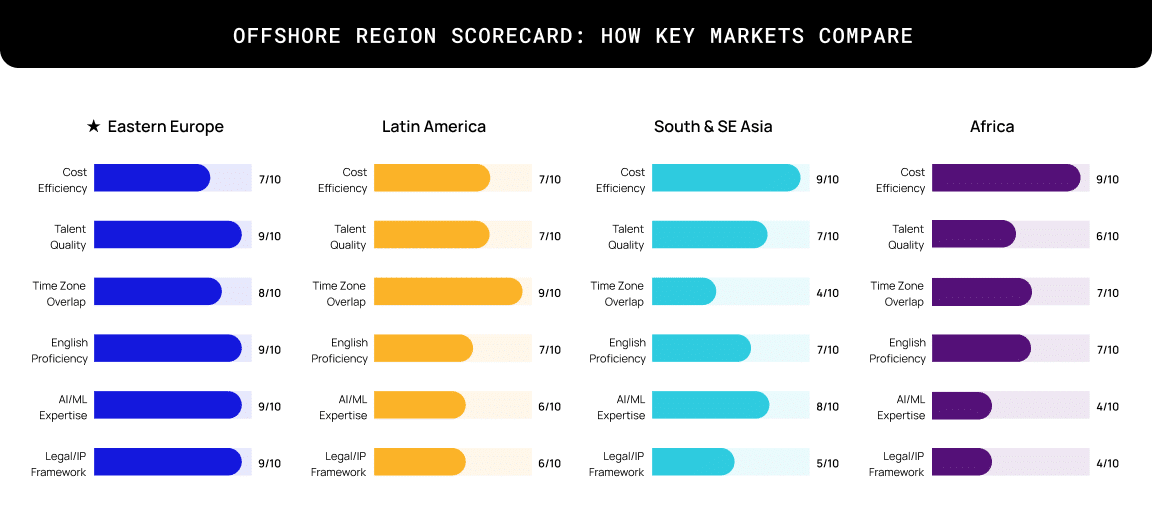
Every region has its strengths and its trade-offs. The worst mistake you can make is choosing a location based solely on the hourly rate in a comparison table. Here is what actually matters when selecting where to hire offshore staff, and how the major regions stack up heading into 2026–2030.
Note on rates: All hourly and annual rates cited in this article are aggregated averages from multiple industry sources (2025–2026). Actual compensation varies significantly based on technology stack, seniority level, domain expertise, project complexity, and specific country within each region. Niche specialists in AI/ML, cybersecurity, or blockchain typically command 20–40% premiums above general averages. Treat these figures as directional benchmarks, not fixed pricing.
| Criteria | Eastern Europe | Latin America | S & SE Asia | Africa |
|---|---|---|---|---|
| Avg. hourly rate (mid-senior) | $30–$58 | $25–$55 | $20–$50 | $20–$45 |
| Senior specialist rate | $50–$99 | $45–$85 | $25–$60 | $30–$60 |
| Developer pool size | 1M+ | 700K+ | 10M+ | 700K+ |
| English proficiency | High–Very High | Moderate–High | Moderate–High | Moderate–High |
| EU/US time zone overlap | 5–8 hrs | 6–8 hrs (US) | 2–4 hrs | 4–7 hrs (EU) |
| AI/ML talent depth | Strong | Growing | Strong | Emerging |
| Legal & IP framework | EU-aligned | Varies by country | Varies by country | Developing |
| Market CAGR (2025–2030) | 4.5% | 12.7% | 8–10% | 15%+ |
Data disclaimer: Rate data aggregated from Qubit Labs, The Scalers, DistantJob, and ConnectMKD 2025–2026 rate guides. Market CAGR from SmartDev and Verified Market Reports. All rates are indicative averages—actual figures depend on stack, seniority, and domain specialization.
Poland, Ukraine, Romania, Bulgaria, and the Czech Republic form the backbone of European offshore development. Over 4,960 custom software development companies operate in the region according to Clutch, and the Eastern European offshore development market is projected to reach nearly $18 billion by 2029.
Why this is our primary recommendation. When you compare Eastern Europe to other offshore regions on a pure rate basis, Latin America and Asia look cheaper on paper. But rate-per-hour is not the metric that matters. Total cost of delivery is. And on that metric, Eastern European developers consistently outperform.
Developers in Poland, Ukraine, and Romania are trained in university systems with strong mathematics and computer science foundations. They tend to produce cleaner code on the first pass, require less oversight, and contribute more proactively to architectural decisions. In our experience at Newxel, a senior developer in Eastern Europe at $55–$65/hr with 95% first-pass code quality and real-time communication regularly delivers a lower total project cost than a $30/hr developer in another region who needs 30–40% rework and constant supervision.
The quality difference is not subtle. Eastern European developers rank among the top globally on competitive programming platforms. Poland, Ukraine, and the Czech Republic consistently score in the top tier of the Coursera Global Skills Index for software engineering, databases, and security. More than 80% of Ukrainian developers speak English at intermediate level or above. The region’s cultural alignment with Western European and North American teams, like direct communication style, code review discipline, deadline orientation, makes integration smoother from day one.
Domain depth sets this region apart. Eastern Europe is not just a generalist market. The region has developed deep pockets of specialization in fintech (driven by proximity to European financial centers), cybersecurity (fueled by real-world threat exposure and strong academic research), cloud infrastructure, and increasingly, AI/ML. When you need engineers who can work autonomously on complex system architecture, Eastern Europe is the region where you are most likely to find them quickly.
At Newxel, we operate from offices in Kyiv and Warsaw, anchoring our talent network across the region. When we place an offshore employee from Eastern Europe on your team, they have already passed our multi-stage technical and cultural screening. This is why our retention rate holds at 98%.
Brazil, Argentina, Colombia, and Mexico have become popular nearshore destinations for U.S. companies, and the region shows the fastest growth in IT staff augmentation with a projected 12.7% CAGR from 2025 to 2030. The primary draw is time zone alignment: when your standup is at 10 a.m. EST, your Latin American developers are having their morning coffee, not winding down for bed.
Where it falls short compared to Eastern Europe: while Latin American markets produce strong generalist developers, the bench depth in niche specializations is thinner. If you need a DevSecOps engineer who understands PCI DSS compliance, or an AI architect with production deployment experience, you will likely spend longer searching in LATAM than in Eastern Europe. Rates in major LATAM markets like Brazil ($35–$55/hr mid-level, $50–$75/hr senior) have climbed to a point where the cost difference versus Eastern Europe is marginal, but the depth of available senior expertise in complex domains still favors the European market.
LATAM is a solid option if same-timezone synchronous collaboration is your top priority. But if engineering depth and autonomous execution matter more (which they do for most product teams), Eastern Europe delivers better results for a comparable or moderately higher investment.
India, Vietnam, the Philippines, and increasingly Bangladesh offer the largest talent pools at the most competitive rates. India alone has over 5 million IT professionals and produces millions of engineering graduates annually.
When it works: if you need to scale a team of 20+ engineers quickly, Asia has the volume. Vietnam’s software development sector is experiencing 20% year-over-year growth in AI capabilities. Indian developers remain globally competitive in enterprise Java, .NET, and cloud migration work.
When it does not: time zone gaps of 10–12 hours with U.S. teams demand deliberate process design. Quality variance across providers is significant. The lowest rates ($12–$20/hr) correlate with junior developers who often need substantial oversight, and the resulting rework can easily eat into your cost savings. A senior developer in Poland at $60/hr who ships production-ready code costs less in total than a $25/hr junior in a distant time zone requiring 40% rework.
Egypt, Kenya, Nigeria, South Africa, and Morocco are rapidly building their technology sectors. Africa’s IT market is expected to grow from $180 billion in 2025 toward $712 billion by 2050. Egypt in particular offers multilingual developers with rates 20–30% below Eastern Europe.
For now, this is a market for early movers with patience, not companies that need immediate production-grade output. Infrastructure reliability, IP protection frameworks, and vendor ecosystem maturity are still catching up to the more established offshore regions.
You will save 40–60% on direct salary costs. A mid-level software engineer in Eastern Europe earns $48,000–$55,000 annually; the same role in the U.S. runs $110,000–$130,000. But if cost were the whole story, this article would end here.
Note on rates: All hourly and annual rates cited in this article are aggregated averages from multiple industry sources (2025–2026). Actual compensation varies significantly based on technology stack, seniority level, domain expertise, project complexity, and specific country within each region. Niche specialists in AI/ML, cybersecurity, or blockchain typically command 20–40% premiums above general averages. Treat these figures as directional benchmarks, not fixed pricing.
The benefits of hiring offshore talent that actually tip the strategic balance are:
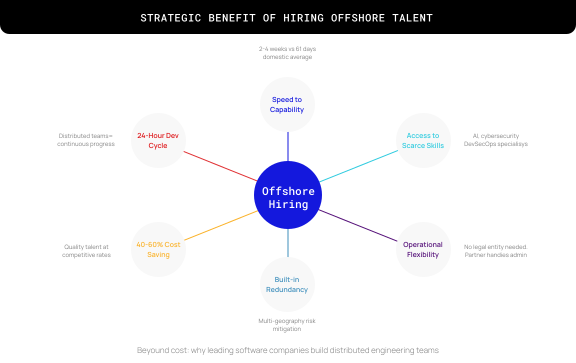
When your domestic pipeline takes 61 days and $20,000 to fill a single engineering role, and your offshore partner can deliver a pre-vetted candidate in 2–4 weeks, the speed differential compounds fast. A dedicated partner like Newxel maintains warm pipelines of screened developers organized by stack and domain, so you are not starting from scratch with every requisition.
Cybersecurity is the number-one skill shortage globally, with 46% of businesses reporting deficits. AI ranks second. Cloud FinOps, blockchain infrastructure, and legacy system modernization specialists are nearly impossible to find in certain U.S. markets at any salary. Offshore employees in Eastern Europe are often trained in these exact domains because their education systems and career markets developed around global demand.
This is the part that procurement-oriented articles never explain well enough: when you hire offshore through a staff augmentation partner, you do not need to register a legal entity in the country where your team works. You do not need to navigate local labor law, tax obligations, or employment contracts. Your partner handles everything: legal compliance, payroll, office infrastructure, HR support, benefits, and retention programs.
At Newxel, this is our core service. We employ the developers, manage the full administrative layer, and you manage the work. Your offshore staff works under your technical direction, uses your tools, follows your processes, and participates in your sprints. They are functionally part of your team. The operational burden of managing a foreign employment relationship sits entirely with us.
Concentrating your entire engineering capacity in one geography is a risk. Distributed teams create natural redundancy. If one market faces disruption—economic downturn, regulatory change, geopolitical instability—you have engineers in other locations keeping the product moving. Offshoring talent acquisition across multiple regions is a hedge, not just a cost center.
Theory is easy. Execution is where companies succeed or stumble. These are the best practices for hiring offshore tech talent drawn from our direct experience with over 100 projects across 8 hiring locations.
Most hiring failures begin with a bad job description. “We need a Python developer” is not a role definition. What kind of systems will they build? What is the team structure they are joining? Will they communicate directly with product or only through a tech lead? What is the seniority level, and are you willing to invest in someone slightly below it?
Before you start hiring offshore employees, build a role profile that covers technical skills (languages, frameworks, cloud platforms), domain knowledge (fintech regulations, healthcare compliance, e-commerce scale patterns), soft skills (English fluency level, communication frequency, autonomy level), and working model (full time zone overlap, partial overlap, or async).
| How Newxel handles this:
We start every engagement with a Discovery call where our team works with you to translate your business need into a precise candidate profile. This is not a form-filling exercise. We probe the questions you might not have considered: What is the team’s communication cadence? What does “senior” mean in your organization’s context? What soft skills have caused problems with previous hires? |
This one surprises people. Most companies assume the sequence is: technical interview first, cultural fit second. We have learned to flip it.
Technical skills are verifiable. You can test whether someone can design a microservices architecture or debug a concurrency issue. But you cannot test on a whiteboard whether they will proactively flag blockers, ask for clarification instead of guessing, or mesh with your team’s communication style. Cultural mismatch is the number-one silent killer of offshore engagements, and it is far harder to fix after someone has started.
At Newxel, every candidate goes through a cultural assessment before they enter your interview pipeline. We evaluate communication patterns, conflict resolution style, response to ambiguity, and alignment with Western work norms like direct feedback and initiative-taking. Only candidates who pass this filter proceed to the technical evaluation you conduct yourself.
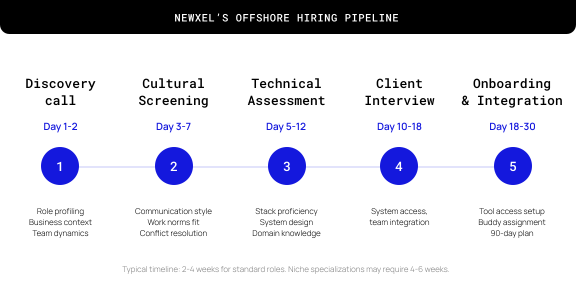
The biggest gap between companies that succeed with offshore staff and those that struggle is onboarding quality. Do not treat it as a first-day event. Treat it as a two-week project.
Effective onboarding for an offshore employee should include access to all tools, repos, and documentation from day one; a dedicated buddy or onboarding partner from your existing team; a structured first-sprint plan with gradually increasing scope; daily check-ins for the first two weeks that taper to regular stand-ups; and an explicit walkthrough of your team’s unwritten norms—how decisions get made, where informal conversations happen, what code review etiquette looks like.
At Newxel, we do not step away once someone is hired. Our onboarding support ensures that new team members understand not just what they are building, but how your team works. We facilitate introductions, set up communication rhythms, and stay involved during the first 90 days to catch integration issues early.
Replacing a developer costs 1.5 to 2 times their annual salary. For offshore teams, turnover carries an additional penalty: knowledge about your specific systems, architecture decisions, and product context disappears with the person.
Retention is not something to think about after you have built the team. It is something to design into the engagement from day one. This means competitive compensation benchmarked to local markets (not just the cheapest available), clear career growth paths, investment in learning and development, and a working environment that treats offshore employees as valued contributors rather than interchangeable billing units.
Newxel’s 98% retention rate is the result of active investment in developer satisfaction: career development conversations, community events, and working conditions that make people want to stay. We monitor engagement signals and address issues before they become attrition events.
Hours logged is not a performance metric. Code committed is barely better. What matters is sprint velocity and consistency, code quality (defect rates, code review feedback loops), product impact (features shipped, customer outcomes), and communication effectiveness (response times, proactive status updates, documentation quality).
Set these metrics with your offshore team from the outset. Review them regularly. Adjust. The teams that treat their offshore staff with the same performance rigor and development investment as their domestic team consistently get better results.
Honesty builds trust, so let us be direct: hiring offshore talent comes with risks. The companies that succeed are the ones who plan for these risks instead of pretending they do not exist.
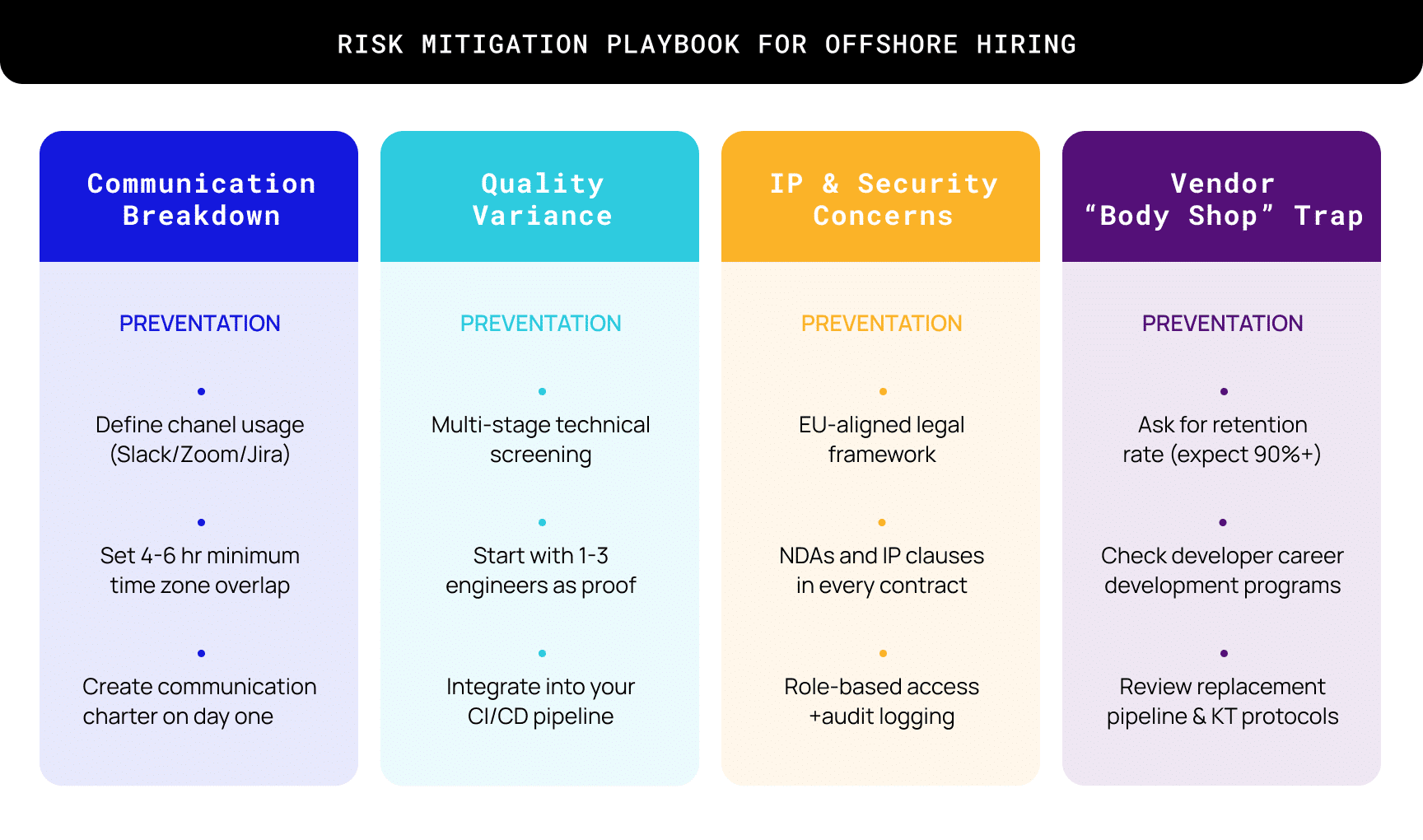
Different time zones, language nuances, and cultural norms around directness can create information gaps that compound over time. Prevention: establish a communication charter on day one. Define which channels are used for what (Slack for quick questions, video calls for alignment, Jira for task management). Set minimum overlap hours. For Eastern European teams, 4–6 hours of shared working time with U.S. East Coast is typical and sufficient for most workflows.
You hire based on rate alone, and you get code that requires extensive rework turning your 50% savings into a net cost increase. Prevention: never hire offshore talent without a strong technical screening process. A reputable partner will have already filtered for technical proficiency. Your job is to test for contextual understanding—the kind of system-level thinking and product awareness that generic coding tests miss. Also: start small, begin with one or two engineers, prove the model, then scale.
Sensitive code or business logic is handled by engineers in jurisdictions with varying IP protection. Prevention: work with a partner that operates in countries with EU-aligned or GDPR-compliant legal frameworks. Ensure NDAs and IP assignment clauses are standard in every contract. Use enterprise-grade access controls: VPNs, role-based repository access, and audit logging. At Newxel, NDAs and IP protection are baked into every engagement by default, and we support clients in implementing access control architecture that matches their security posture.
You engage a vendor who treats developers as interchangeable billable hours rather than individuals invested in your product. Prevention: look for partners with high retention rates (ask for the actual number, and ask how it is calculated). Look for partners who invest in developer career development, not just placement volume. Ask what happens when a developer wants to leave: does the partner have a replacement pipeline? Is there a knowledge transfer protocol? These questions separate strategic talent partners from staffing agencies.
The offshore model is evolving rapidly. These are the shifts that will reshape hiring offshore employees over the next five years.
Over 65% of recruiters already use AI tools in their talent acquisition workflows. By 2028, AI-driven matching will reduce time-to-hire for specialized roles from weeks to days. But AI handles screening, not judgment. The human evaluation of cultural fit, growth potential, and product thinking will remain the differentiator between adequate hires and exceptional ones.
Companies are moving beyond the binary of “full-time hire” versus “contract body.” The emerging model combines a stable core of dedicated offshore engineers with flexible specialist slots that can be activated for specific project phases—security audits, performance optimization sprints, AI integration waves. This gives engineering leaders the stability of a dedicated team with the agility of on-demand expertise.
CTOs increasingly want to measure business outcomes rather than billable hours. The shift toward shared accountability models, where the offshore partner has skin in the game on delivery quality and speed, will accelerate through 2030. Providers who invest in tooling, automation, and quality assurance will outcompete those relying solely on labor cost arbitrage.
Central Asia (Kazakhstan, Uzbekistan) is posting a projected 7.76% CAGR in IT services through 2030, with government-backed tax incentives for foreign investment. Africa’s tech ecosystem is maturing fast. Companies that establish early relationships in these markets will have access to talent pools before they become crowded and expensive.
Read also our article on Managing Offshore Teams Effectively: Best Practices That Work.
Before choosing an offshore partner, US companies should verify more than technical talent and hourly rates. The right offshore IT staffing services should also cover employment, tax, legal, security, and operational requirements across jurisdictions.
Use this checklist before signing an agreement:
☐ Define the engagement model: Confirm whether you are using staff augmentation, a dedicated team, T&M, monthly billing, or a fixed-term arrangement.
☐ Verify worker classification: Establish who legally employs the developers and who is responsible for payroll taxes, benefits, and local employment compliance.
☐ Review the MSA and SOW: Make sure the Master Services Agreement and Statement of Work clearly define responsibilities, deliverables, timelines, pricing, and acceptance criteria.
☐ Clarify scope-change procedures: Agree in advance on how additional work, new roles, changing requirements, and extensions will be approved and priced.
☐ Check IP ownership: Confirm that source code, documentation, designs, and other work created by the offshore team are assigned to the appropriate party.
☐ Review confidentiality terms: Ensure NDAs and confidentiality provisions cover employees, contractors, subcontractors, and any third parties with access to company information.
☐ Confirm data protection measures: Check how personal and business data is stored, accessed, transferred, and deleted, particularly if EU or other regulated data is involved.
☐ Check security standards: Ask about access controls, encryption, security policies, background checks, incident response, and relevant certifications.
☐ Understand payment terms: Confirm what the monthly rate includes, how invoices are calculated, payment deadlines, and whether HR, payroll, legal support, equipment, or other costs are included.
☐ Define replacement terms: Establish what happens if a developer leaves, becomes unavailable, or does not meet expectations, including the expected replacement timeline.
You have made it this far, which tells me you are serious about building an offshore team. Here is the practical sequence we recommend to move from planning into execution: