How to Hire an Offshore Development Team? Field-Tested Approach
[Bonus - Scorecard Template]
18 min
· December 22, 2025
Last updated: June 16, 2026

You’ve probably read enough generic advice about offshore development to last a lifetime. This is not one of those guides.
We’ve been building and managing offshore engineering teams since 2017, partnering with hundreds of companies: from early-stage startups to global enterprises. Today, we run 30+ active offshore teams with more than 500 specialists worldwide. Along the way, we’ve seen what works, what fails, and where companies unknowingly put time, budget, and delivery at risk.
This guide is built on real experience: the questions our clients didn’t know to ask, the pitfalls they nearly fell into, and the costly mistakes we helped them avoid.
By the end, you’ll know:
Your local market might have five React developers. Eastern Europe has thousands. Asia has tens of thousands. And companies are acting on that reality. Deloitte’s Global Outsourcing Survey shows 80% of business leaders plan to maintain or increase their investment in third-party outsourcing.
When you go offshore, you’re not settling for “available”, you’re choosing from “exceptional.” Need a developer with a particular tech stack, industry experience, and a track record of scaling production apps? They exist. And with hiring offshore developers, they’re finally within reach.
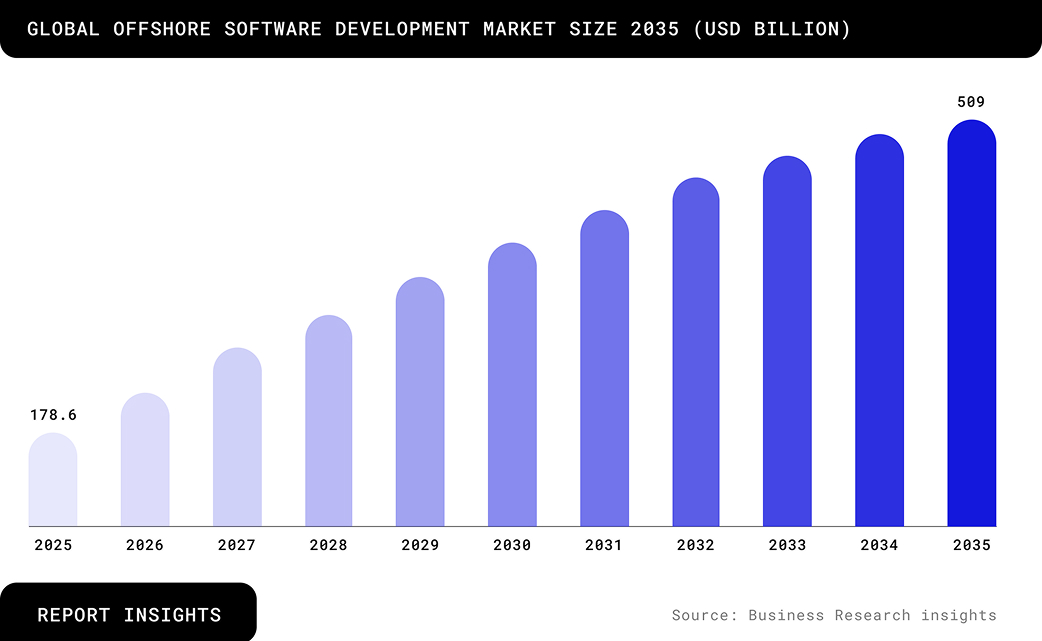
The global offshore software development team market is experiencing significant growth and is projected to reach $198.3 billion by 2026. And the reason is simple: the economics work.
Companies can save 40–70% on development costs by hiring offshore talent instead of relying solely on U.S. or Western European rates, without sacrificing quality.
Those savings are not theoretical. They can be the difference between 18 months of runway versus 36 months, or between hiring three developers versus seven. In competitive markets, that’s not a budget decision – that’s a survival advantage.
Here’s what most people miss: offshore isn’t just about today’s output. It’s about building a development engine that scales with your ambition. Need to go from two developers to twenty in six months? Achieving that in places like Porto can be challenging. However, with the right offshore partner, it’s not just possible – it’s standard practice. The focus shifts from talent availability to how quickly you can onboard and integrate new team members.
Before you start looking for vendors, get crystal clear on what you actually need. Nail down these four things:
What exactly are you building? Be specific. Are you creating an MVP from scratch? Scaling an existing product? Building a new module for your platform? Or do you just need team extension: more skilled engineers to accelerate development on a large product that’s already in motion?
Each scenario demands different team structures. An MVP needs scrappy generalists who ship fast and pivot easily. Scaling a product requires specialists who architect for growth and manage technical debt. Team extension means to find offshore developers who can plug into your existing processes. Companies typically choose between three offshore engagement models: recruitment support, staff augmentation, or fully managed offshore development teams.
List every technology that matters to your project: frontend frameworks, backend languages, databases, cloud infrastructure, UI/UX specialists, DevOps tools – everything. Then prioritize: which technologies require deep expertise from day one, and which can be learned on the job?
For example:
A fintech app that handles payments needs experienced engineers with a strong background in security, while a content platform may be able to train someone on its content management system (CMS) as they go.
Be specific in your descriptions; don’t just list “React” or “Python.” Instead, indicate whether you are using React with TypeScript, Python with Django or FastAPI, AWS, or Google Cloud. Also, clarify if your architecture is based on microservices or a monolith. These specifics will help you determine whether candidates are genuinely qualified or simply matching their resumes to keywords.
If you’re a large business, don’t lead with cost-cutting as your primary goal. Hiring the cheapest developers from Asia may save you money initially, but you could end up spending months trying to fix subpar code, managing communication issues, and dealing with quality problems.
Set realistic expectations: aim for savings of 40-60% compared to local rates in the US, UK, or Israel. This represents substantial savings without losing code quality.
Here’s what most people miss:
When you work with a provider who hire offshore programmers, builds and maintains the team for you, the rate should cover administrative, legal, HR, and infrastructure costs, too. You’re not just paying for developer hours – you’re paying to avoid all operational headaches. Outstaffing gives you more control over day-to-day work compared to fully managed teams, while still removing legal and HR overhead.
Location is more than just a point on a map. It influences communication speed, productivity patterns, and the destination at which your product reaches the market. Here’s a breakdown:
| Region | Best for | Cost saving | Advantage | Challenges |
|---|---|---|---|---|
| Latin America | Teams requiring real-time collaboration with the US | 40–50% | Cultural alignment, English proficiency | Smaller talent pool vs. Europe; high price |
| Asia | Strong technical education, excellent product thinking | 40–60% | High-quality engineering with some overlap | Limited overlap for West Coast companies |
| Africa | Large talent pool, fast team scaling | 60–70% | 24/7 development cycles & async-friendly teams | Cultural and communication gaps possible; quality varies more widely |
| Eastern Europe | Growing tech hubs, low prices | 65–75% | Cost-efficient teams with partially aligned hours | Higher delivery risk, less mature outsourcing ecosystem |
If your top priority is real-time collaboration with the US, with plenty of working hours overlap, Latin America is your best fit. If your highest priority is strong technical expertise at a competitive cost, and you’re comfortable with a 2–4 hour overlap, Eastern Europe is the ideal choice. If lower costs are the primary driver and you’re prepared to manage higher risks related to quality, communication, and cultural fit, then Asia may be the right option.
Newxel operates primarily in Eastern Europe, providing you with access to engineers at 40–60% lower costs. We support organizations from global enterprises to fast-growing startups, managing R&D teams across multiple countries while delivering consistent performance, long-term retention, and seamless collaboration.
Explore how to Set up IT Hub in Poland with our practical guide for tech companies.
Our clients value this model because the results are consistent. We currently operate 30+ active offshore teams and support more than 500 engineers across multiple countries. We partner with fast-growing startups and global enterprises alike, often building teams of 20–30+ specialists dedicated to a single product.
Most of our partnerships last beyond 4 years, and our largest clients with a dedicated offshore team have been with us for over 7 years. High retention, stable delivery velocity, and predictable timelines are the reasons they stay, and why collaboration continues to scale over time.
There are dozens of ways to hire offshore talent, but in 99% of real cases, our clients narrow it down to three options: recruitment firms, freelance platforms, or offshore development team providers. Each works best for different business stages and priorities. Let’s break down when to choose which one, and why for offshore dedicated development team.
These agencies act as headhunters in the offshore market. They identify qualified candidates, vet them, and present them to your team.
Pros: You maintain direct employment relationships and complete control over team composition. They handle the painful parts: sourcing, initial screening. Suitable for companies that want to build their own offshore entity but need help with the ground game.
Cons: You’re still handling payroll, benefits, legal compliance, retention, and all the administrative overhead. If someone quits, you’re back to square one with the recruiter. You are also responsible for fostering team culture and managing performance across different time zones, which can be challenging.
Upwork, Toptal, gun.io, and the rest of the platforms give you direct access to individual developers with ratings, portfolios, and hourly rates.
Pros: Maximum flexibility and speed. Need someone for a two-week sprint? Done. Want to test multiple developers on small tasks before committing? Easy. Lower overhead for short-term or specialized needs.
Cons: You’re assembling the team yourself, which means you’re also managing coordination, quality control, knowledge transfer, and continuity risk. Freelancers juggle multiple clients. They’re rarely available for urgent calls. They disappear mid-project. And when your star developer ghosts you the week before launch, you’re scrambling to find a replacement who can decipher their code. Great for tactical projects, but risky for strategic ones.
These are dedicated teams-as-a-service. They recruit, employ, manage, and retain the team, while you focus on work.
Pros: These providers take care of everything except the actual product decisions. They handle recruitment, HR, infrastructure, employee retention, backup resources, and management overhead, making it all their responsibility. You get team stability without administrative burden. If someone leaves, they replace them. You focus on building product, while they focus on building teams.
Cons: You may have less direct control over individual hiring decisions, however, reliable providers involve you in the process. Your reliance on the provider’s management quality and company stability is crucial. Additionally, while pricing is typically higher than hiring freelancers directly, it is still lower than the costs for building your own in-house team.
This is where most companies screw up. They scan a website, have one sales call, and sign a contract based on vibes and pricing. Then, 3 months later, they’re stuck with a mediocre team they can’t easily replace.
Do it better. Research what you can find online, then come armed with specific questions. A reliable provider will answer these easily and back up their claims with proof.
Here’s your evaluation framework:
You’re trusting this company to build a critical part of your product. So, it’s essential to clarify how stable they are and how long they have been doing this.
Questions to ask:
A company that’s been building offshore teams for many years has systems. They’ve handled developer turnover, shifting client priorities, and tough project moments, and they know how to keep delivery on track.
Do they actually build things like what you’re building? Fintech is different from e-commerce. Healthcare is different from SaaS tools. B2B enterprise software is different from consumer apps.
Ask for case studies in your space. Talk to their references. Get specific: How did you handle PCI DSS compliance? What was your approach to payment gateway integration? How do you manage microservices at scale? If they’re giving generic answers, they’re winging it.
Clarify how the vendor screens talent, and what their hiring process actually evaluates. Make sure you can interview the specific developers who will join your team, review their past work when possible, and run a technical challenge.
Ask about their hiring bar: What percentage of candidates do they actually hire? If it’s above 10%, they’re not being selective enough. Top providers hire only the top 3–5% of applicants and reject 95%+ during screening. And don’t just take their word for it – ask for proof.
Request hiring funnel data, sample assessments, or specific examples of how many candidates were vetted to fill a single role. A credible vendor will have real numbers, not just claims.
Speed means nothing if quality suffers. The question isn’t just “how fast can you hire?” It’s “how fast can you hire good people?”
How quickly can they staff your team with the number of developers you need? Request details about their hiring process and infrastructure. Do they have dedicated recruiters for different tech stacks? What’s their typical time from initial conversation to developers writing code?
If they claim they can staff five senior React developers in two weeks, push for examples of when they’ve actually done this – and what guarantees they provide that candidates hired in 2 weeks will meet your quality bar (cases, processes, funnel). The answer reveals whether they have real systems in place or they’re just promising fast delivery.
No one likes invoice surprises (especially when scaling an offshore team). Clarify the monthly rate for the team and exactly what’s included: salaries, HR support, workspace, equipment, legal support, and management overhead.
Ask vendors directly: whether there are any additional fees?
Also, verify how pricing changes if you scale the team up or down over time. Be cautious of vendors who offer unrealistically low rates. The lowest headline number is rarely the lowest total cost of ownership.
Share your team requirements, and we’ll launch a ready-to-deliver team in just 2–4 weeks.
Different teams – work differently (and that’s okay). Some rely on detailed documentation and formal approvals, while others move fast with Slack messages and async communication. Neither approach is right nor wrong, but a mismatch can slow everything down.
Ask how the vendor ensures cultural fit between your internal team and the remote engineers: onboarding practices, shared values, communication expectations, and day-to-day collaboration norms. And always ask where you can see proofs, such as case studies or client testimonials, of how they successfully integrated offshore engineers into existing teams.
Your needs can change. Maybe you’re raising a Series A and need to double the team. Maybe you’re entering a slower growth phase and need to trim costs.
Start by understanding their capacity. If you need to add three more developers next quarter or 10 more next year, can they support that growth? Do they have the recruitment infrastructure and office space to scale without quality loss?
Ask for real examples: how many people, how quickly, and what outcomes were achieved.
Equally important: what happens when you need to scale down? Flexibility matters in both directions.
What’s their average developer tenure? If people are leaving every 6 months, you’re constantly onboarding replacements and losing tech knowledge. Good providers keep developers for years, not quarters.
Across the industry, the average developer tenure on offshore projects is just 1.3 years. At Newxel, it’s 3.5 years, which provides stability and continuity you can rely on. Retention is significantly higher when engineers are employed full-time on a single long-term project rather than rotating between short engagements.
Ask how they retain talent: career development programs, training budgets, project variety, and compensation reviews. Developers stay where they’re growing and valued. If the provider treats them as interchangeable resources, they’ll treat your project the same way.
Clarify how you’ll collaborate with the team day-to-day. Will you communicate directly with every engineer, or only through a single point of contact?
Confirm the tools, meeting, availability windows, and expectations for responsiveness. The goal is simple: no communication barriers, just one integrated team working in sync.
More importantly, how do they handle communication breakdowns? Because they will happen. Someone will misunderstand the requirements. Who’s reachable when? Test their communication during the evaluation process. This is a preview of what working together looks like.
A great sales pitch doesn’t guarantee great delivery. Before committing to a long-term partnership, shortlist two or three vendors and give each of them a small, clearly defined pilot project. Run it for a week or two with a modest budget, enough time to see how they actually work, communicate, and handle your expectations in real conditions. A pilot reveals what marketing can’t: team chemistry, ownership, speed, and problem-solving under pressure.
During the pilot, focus on the essentials:
A strong pilot performance is the closest thing to a guarantee you’ll get before you scale the team and raise the stakes.
Look at the contract the vendor provides. Most established providers have tested agreements. Their standard contract should already cover the important stuff you might not even think to ask about: IP ownership, liability, data protection, team changes, and dispute resolution.
Read the contract. Actually read it. Not just the rate card—the entire thing. Pay special attention to intellectual property ownership (you should own everything they build), termination clauses (what’s the notice period and exit process), confidentiality and data protection provisions, liability and indemnification terms, dispute resolution mechanisms, and how scope changes and rate adjustments are handled.
Get your lawyer to review it. Most providers have fair standard contracts, but occasionally you’ll find landmines like shared IP rights, automatic renewal clauses that lock you in, or harsh termination penalties that make it expensive to leave if things aren’t working. Negotiate the things that matter. Don’t nickel-and-dime the rate if they’re already competitive. Focus on structural terms: flexibility to scale, trial periods, performance guarantees, or communication protocols.
Set up your communication infrastructure before day one. This includes: shared Slack or Teams workspace, project management tools (Jira, Linear, whatever you use), code repositories and access permissions, video conferencing protocols, and documentation and knowledge base access.
Define your communication rhythm: daily standups at what time? Weekly planning sessions? Sprint reviews? Who joins what meetings? Make this explicit. “We’ll figure it out as we go” leads to confusion and resentment.
Establish escalation paths. If a developer is blocked, who do they ask? If your product manager is unreachable, who’s the backup? If there’s a production emergency at 3 AM, who gets called? Map this out in writing.
Your offshore team is not a vendor to manage at arm’s length. They’re not contractors you outsource tasks to and forget about. Include them in product discussions. Invite them to the company all-hands. Give them context on business goals and user feedback.
Invest in their professional development. Remember each offshore developer’s name, time zone, and what they’re working on. The teams that succeed with offshore development are those that create a unified team, which happens to be distributed.
Build trust through transparency. Share roadmaps, strategic decisions, and even challenges. When the offshore team understands not just what to build but why it matters, their contribution quality transforms.
Newxel has been building and managing offshore engineering teams since 2017, helping companies scale with confidence. Today, we run 33 active R&D teams, powered by 30+ recruiters that deliver fully staffed teams in 2–4 weeks.
Our people stay: we maintain a 98% retention rate, an average 3.5-year developer tenure on projects, and clients partner with us for 5+ years on average.
The pricing is transparent. No hidden fees, no surprise invoices. You know exactly what you’re paying for: dev salaries, infrastructure, management, HR, everything – in one clear number.
We handle the operational complexity: payroll, benefits, HR, legal compliance, and office infrastructure, so you can focus on building product. You get the output and stability of an employed team without the administrative burden of being the employer.
We use a proven 5-step hiring process that delivers high-quality engineers in 2–4 weeks, without hidden costs or surprise markups. Our pricing is fully transparent: number of developers × fixed monthly rate = your invoice. That rate already includes recruitment, onboarding, HR operations, legal compliance, payroll, and equipment.
If you’re looking for offshore development team who values reliability, talent quality, and delivery excellence, Newxel is built for you.
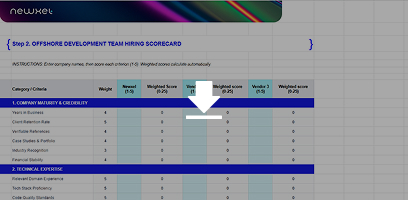
Use this scorecard to evaluate potential offshore partners. Rate each criterion on a scale of 1-5, with five being exceptional.
Bonus: Offshore development team hiring template
Run this evaluation for each vendor during your search. Use it to structure reference calls and pilot project assessments. The scorecard won’t decide for you, but it will prevent you from overlooking critical factors while being dazzled by a good pitch.
Bonus
We’re including our internal Vendor Evaluation Template that we use to help clients choose the right offshore development partner with confidence.