GITEX 2026 Preview: What AI Engineering Leaders Are Watching in the UAE
9 min
· August 31, 2026
Every December, Dubai becomes the center of gravity for global tech, and this year, that gravity is pulling harder toward AI than ever before. At Newxel, we’ve spent the past 9 years building engineering teams across the world, and more recently, building tech teams for the UAE market. GITEX 2026 is one of the clearest public signals we’ve seen yet of just how fast that demand is moving, and it lines up closely with what we’re already hearing from clients building AI-native teams.
Here’s our take on what’s happening at GITEX this year, what the numbers behind it say about where AI engineering is headed, and what we’re seeing on the ground as companies try to build these teams for real.
GITEX 2026 marks a genuine reset for the event, not just a new date on the calendar. After 45 years at Dubai World Trade Centre, the main expo has relocated to Expo City Dubai:
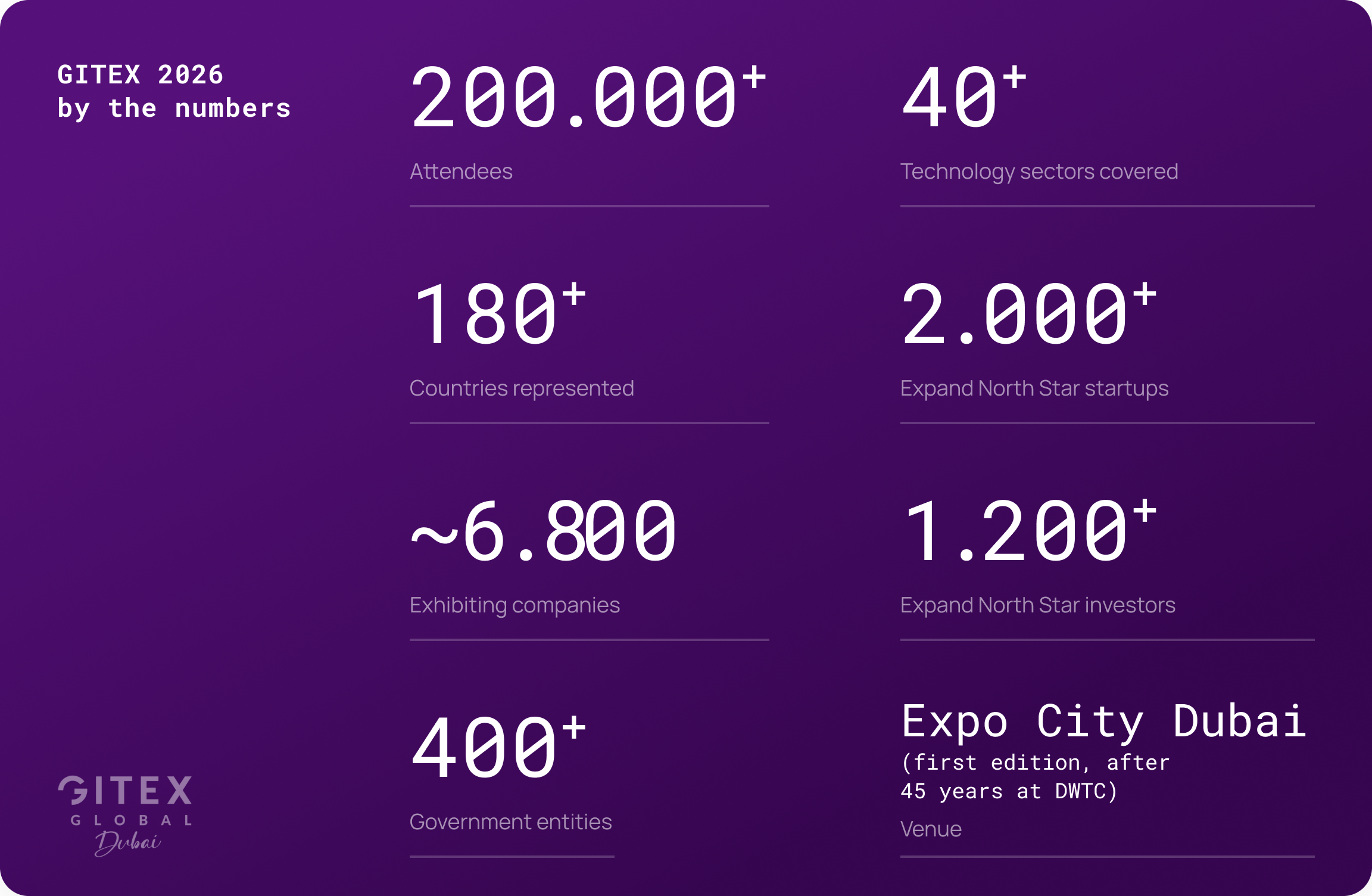
The scale is hard to overstate. Organizers are projecting more than 200,000 attendees from over 180 countries, close to 6,800 exhibiting companies, and 400+ government entities. That’s on top of the event reuniting with Expand North Star, the region’s flagship startup and investment event, which is expected to bring together over 2,000 startups and 1,200+ investors , worth watching closely if you’re tracking early-stage AI companies rather than enterprise deals.
We’ve watched GITEX grow from a general tech expo into something closer to a barometer for AI investment and policy. That shift matters to us specifically because it mirrors a shift we’re seeing in our own client conversations: companies aren’t asking us “should we use AI” anymore. They’re asking, “how fast can we build a team that can actually ship it.”
This year’s expanded GITEX sector list , now covering over 40 technology categories , is a useful proxy for something we’ve been tracking closely: AI engineering is fragmenting into specialized sub-disciplines, fast. The new and expanded tracks include AI infrastructure, quantum computing, intelligent mobility, physical AI and robotics, AI-powered energy infrastructure, advanced cybersecurity, agentic AI, and AI-driven commerce.
The market data backs this up. According to Quantalent’s 2026 UAE hiring analysis, open AI/ML positions in the country grew roughly 45% year-over-year, while the qualified candidate pool grew only about 12% in the same period, a gap that’s forcing companies to get much more precise about who they’re actually hiring. PwC’s 2026 AI Jobs Barometer found that UAE job postings requiring AI skills grew by around 2,700 between 2024 and 2025 alone, putting the UAE among the fastest-growing AI talent markets globally. And per reporting cited by Gulf Business, AI-related hiring climbed from roughly 32% of all UAE roles in the 2023–2024 period to about 48% in 2024–2025.
A few years ago, a company hiring “an AI person” usually meant one generalist ML engineer. That’s no longer how it works. In our own hiring pipeline, we’re increasingly matching candidates against much more specific mandates: infrastructure engineers who understand GPU orchestration, agentic-systems engineers who can design multi-step autonomous workflows, MLOps specialists focused purely on deployment and monitoring, and, a specialization we didn’t see requests for two years ago, engineers who can fine-tune open-source models like Llama or Mistral for Arabic-language use cases, a niche that’s grown alongside regional projects like Abu Dhabi’s Falcon LLM.
GITEX’s expanded track list is essentially confirming, at a macro level, what we’re already seeing at the hiring-request level: the “hire AI engineer” job title is splintering, and companies that don’t know which specialization they actually need end up hiring the wrong profile, and then re-hiring six months later.
| Signal | 2026 figure | Source |
|---|---|---|
| AI/ML open positions, YoY growth | ~45% | Quantalent AI |
| Qualified candidate pool, YoY growth | ~12% | Quantalent AI |
| UAE job postings requiring AI skills, 2024→2025 | +~2,700 | PwC AI Jobs Barometer |
| AI-related roles as share of all UAE hiring, 2023–24 → 2024–25 | 32% → 48% | Gulf Business |
| Employers planning to expand headcount in 2026 | 56% (#1 globally) | Khaleej Times |
| Specialization | What it actually covers | Where demand is coming from |
|---|---|---|
| AI infrastructure engineer | GPU orchestration, model-serving infrastructure, scaling compute | Infrastructure and physical AI tracks at GITEX |
| Agentic-systems engineer | Designing multi-step, autonomous AI workflows | Agentic AI track; enterprise automation projects |
| MLOps specialist | Deployment, monitoring, model lifecycle management | Companies moving AI pilots into production |
| Applied ML / GenAI engineer | Fine-tuning and integrating foundation models into products | AI-driven commerce, product teams |
| Regional-language AI engineer | Fine-tuning open-source models (Llama, Mistral) for Arabic NLP | UAE’s push for Arabic-language AI, e.g. Falcon LLM |
The Summit’s core themes this year, AI governance, data sovereignty, industrial AI in manufacturing and healthcare, and capital flows shaping the next wave of investment, track closely with the questions we’re fielding from UAE-based companies exploring staff augmentation.
This isn’t an abstract policy debate. The UAE’s Personal Data Protection Law (Federal Decree-Law No. 45 of 2021) restricts cross-border transfers of personal data unless the receiving jurisdiction meets adequacy requirements set by the UAE Data Office, with non-compliance risking fines of up to AED 5 million. Sector rules go further: banking and financial data generally has to stay in-country under Central Bank of the UAE guidance, and healthcare data is restricted from leaving the country except under special authorization. The UAE’s National Strategy for Artificial Intelligence 2031, which targets an estimated AED 335 billion contribution to GDP, is increasingly enforced through procurement rules and sector regulation, meaning companies using offshore AI platforms are already running into limits when they try to work with government entities, banks, or healthcare providers.
Data sovereignty comes up constantly in our UAE conversations. Companies building AI systems, especially in regulated sectors, want to know exactly where their data and their engineering talent sit, which is part of why nearshore and dedicated offshore teams have become such an active topic for us in this market. It’s not just a cost question anymore; it’s a compliance and governance question, and GITEX putting that front and center on the Summit stage is a good indicator that this will only get more central to how AI teams get built and staffed going forward.

Explore how Newxel helped Renesas to turn a simple staffing request into an R&D center and strategic partnership.
GITEX has increasingly become a convergence point for AI policymakers, researchers, and industry leaders, not just a commercial trade show. This year’s lineup is a good illustration of that shift:
Put those five in one room and you get a rare cross-section: the CEO of the company that arguably kicked off the current AI wave, the leader of the region’s own AI champion, the government official setting UAE AI policy, one of the field’s foundational researchers, and the head of a company building alternative AI compute infrastructure.
That’s not a typical conference speaker list, it’s a signal that the conversations happening on that stage will shape policy, capital, and infrastructure decisions that reach engineering teams within months, not years. We pay close attention to this lineup for exactly that reason: it tends to tell us where client demand is about to shift before it shows up in our own pipeline.
Everything above points to the same practical conclusion, and it’s worth spelling out because it changes how teams should actually approach hiring right now:
With demand for AI/ML roles growing roughly 45% year-over-year against a candidate pool growing only around 12%, the constraint isn’t finding “an AI engineer”, it’s correctly identifying which specialization (infrastructure, agentic systems, MLOps, applied ML, regional-language fine-tuning) your roadmap actually requires before you start sourcing. Get that wrong and you’re back in the market in six months.
2. Governance expertise is becoming a hiring criterion, not a legal afterthought.
Engineers who understand PDPL constraints, cross-border transfer rules, and sector-specific data residency requirements are increasingly valuable in regulated UAE sectors, and that’s shaping how we source and vet candidates for the region rather than treating compliance as something bolted on after the team is built.
3. Infrastructure investment signals hiring waves before they happen.
The sectors getting the most stage time at events like GITEX, infrastructure, agentic AI, physical AI, are reliable early indicators of where hiring demand accelerates next. We’ve seen this pattern before with earlier waves of cloud and DevOps hiring, and AI is following the same curve, just faster. UAE employers already lead global hiring intent for 2026, with 56% planning to expand headcount, according to a regional labour market study reported by Khaleej Times worth planning around now rather than reacting to in Q1.
GITEX 2026 is a useful checkpoint for anyone trying to gauge how seriously the UAE is investing in becoming an AI engineering hub, not just an AI adoption market.
From where we sit, building engineering teams for companies navigating exactly this shift, the event’s expanded scope this year is less a novelty and more a confirmation of a trend we’ve been living inside of for a while: AI engineering is specializing fast, governance is becoming a core hiring criterion, and the companies that move early on both will be the ones best positioned once the rest of the market catches up.
Newxel has spent 9 years building dedicated engineering teams for companies worldwide, with deep roots in Eastern European tech talent and a growing focus on the UAE market. We help companies move past the “hire an AI engineer” mindset and toward building the right specialized team whether that’s AI infrastructure engineers, agentic-systems specialists, or MLOps talent sourced, vetted, and onboarded with data sovereignty and regional compliance requirements built in from day one.
If you’re heading to GITEX 2026 and thinking through how to scale your AI engineering capacity, we’d be glad to compare notes.