AI and Global Hiring Trends: Why Big Tech Is Cutting Jobs While Investing in AI
10 min
· October 5, 2026
AI, AI, AI. It is hard to scroll through a business or technology news feed today without seeing another headline about artificial intelligence transforming the way we work. But the shift is no longer happening only in product roadmaps and AI labs. It is increasingly visible in hiring decisions, workforce structures, and the skills companies are looking for.
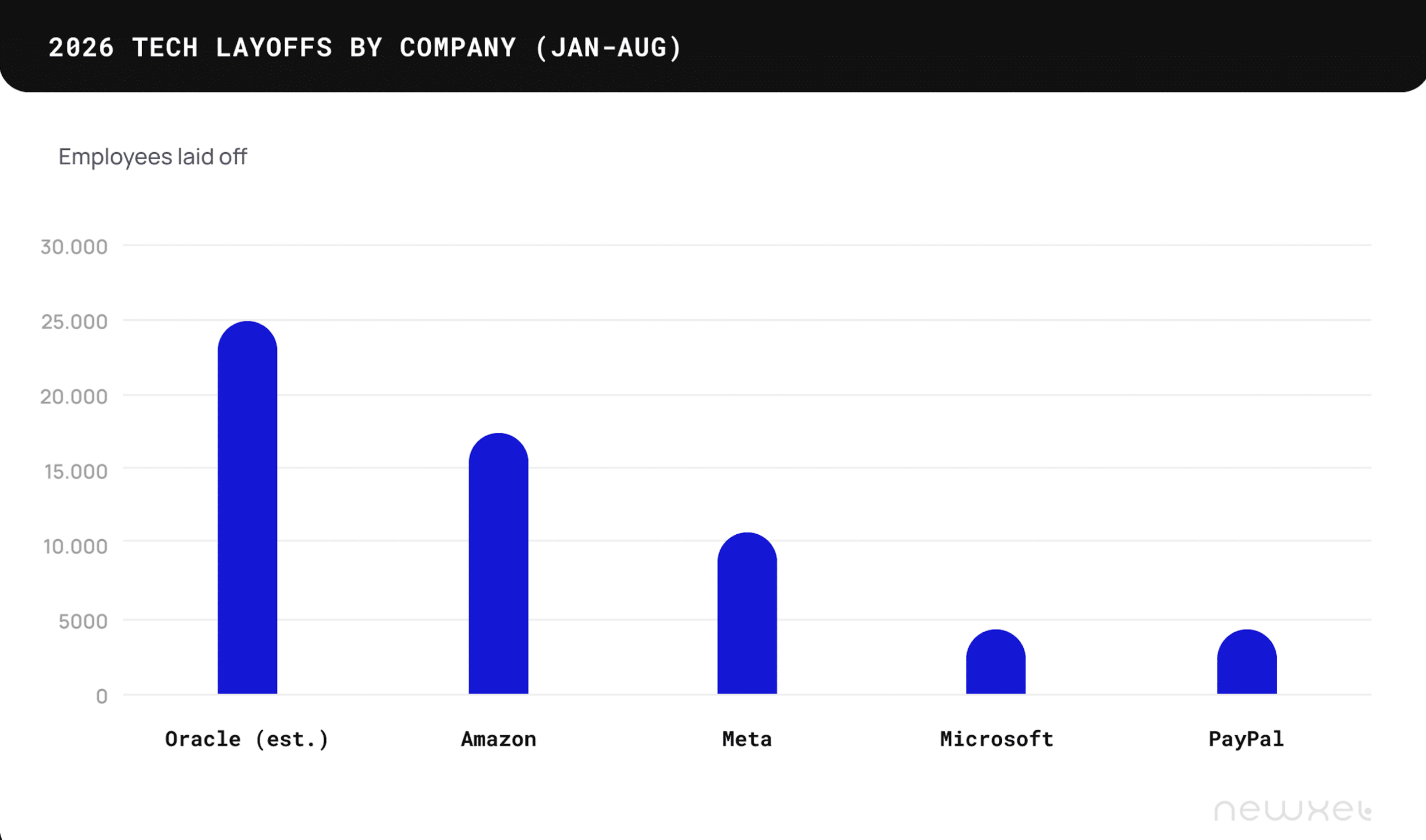
In 2026, U.S. tech companies announced nearly 140,000 job cuts, with major companies including Meta, Oracle, Microsoft, and Amazon accounting for almost 50,000 of them. At the same time, these companies are making some of their biggest-ever investments in AI infrastructure and AI talent.
So what is actually happening to the global tech workforce? And, most importantly, what does this mean for developers, engineers, and technology professionals planning their next career move?
In this article, we look at the latest hiring and workforce data, what Meta, Microsoft, Oracle and other Big Tech companies are doing, which technology roles are changing fastest, and what professionals can do to stay relevant as AI becomes part of the global hiring equation.
Before generative AI became a core part of the technology stack, hiring followed a relatively familiar model. Companies built engineering teams around functions: frontend, backend, QA, DevOps, product, design, support, management. As companies grew, they added more people to handle more work.
Developers spent significant amounts of time writing boilerplate code, debugging, documenting systems, searching through documentation, and performing repetitive technical tasks. Hiring decisions therefore often revolved around a combination of technical skills, years of experience, and the number of people required to deliver a project. AI is changing that equation.
A developer with access to powerful coding agents can potentially handle work that previously required several tools, processes, or additional engineering capacity. A support team can automate part of its ticket workflow. A product manager can use AI for research and documentation. A recruiter can automate sourcing and screening.
The important distinction is that AI changes tasks before it necessarily eliminates entire occupations. That distinction is becoming increasingly important for understanding today’s hiring market.
In May 2026, Meta began cutting approximately 8,000 roles, around 10% of its workforce at the time. The cuts came as the company pushed toward greater efficiency while dramatically increasing its AI spending. Meta’s Q2 results confirmed that approximately 8,000 employees were affected by the May reduction and that the company expects 2026 capital expenditures of $130–145 billion.
The contrast is striking.Meta is simultaneously reducing parts of its workforce and building out enormous amounts of computing infrastructure for AI. The company has also been reorganizing around AI capabilities, including its Meta Superintelligence Labs.
Microsoft cut 4,800 jobs in 2026, with the reductions concentrated in its Xbox gaming division. At the same time, the company kept expanding Azure AI capacity, part of a broader industry pattern where Microsoft, Google, Amazon, and Meta are on track to spend roughly 725 billion dollars combined on AI infrastructure this year, a 77% jump from 2025.
AI was part of the broader business transformation, but Microsoft made an important distinction: the roles eliminated in that round were not being directly replaced by AI. The company said that the way technology is built, deployed, and used is changing, requiring changes in how teams are organized and where resources are allocated.
Oracle provides an even clearer example of this restructuring effect. Rather than one single 20,000–30,000-person layoff event, Oracle’s workforce declined by approximately 21,000 employees, or 13%, during fiscal 2026, from around 162,000 employees to 141,000. Oracle’s annual filing attributed workforce adjustments to multiple factors, including management and product changes, performance issues, strategic shifts, acquisitions, and the adoption of AI.
At the same time, Oracle’s cloud business was expanding rapidly. In FY2026, cloud infrastructure revenue grew 77% year over year, while total cloud revenue grew 39%.
That is another important piece of the story: a company can reduce its overall workforce while simultaneously expanding the parts of the business that are growing fastest.
Amazon has cut more jobs than any other tech company in 2026, responsible for over half of the roughly 30,000 industry-wide layoffs recorded by February alone. The company eliminated 16,000 corporate roles in late January, on top of 14,000 cut the previous October, and by August its 2026 total had passed 17,000. Amazon framed the cuts as removing management layers and bureaucracy, even as CEO Andy Jassy committed 200 billion dollars in capital expenditure, predominantly toward AWS to meet AI and core cloud demand.
Across all four companies, the same shape repeats: shrinking headcount in support and generalist roles, paired with capital spending on AI infrastructure that dwarfs whatever the layoffs saved.
Anthropic’s research gives a more precise answer than “AI is coming for tech jobs” in general. Using a measure they call observed exposure, which tracks how much of an occupation’s actual task load AI is already handling rather than just what’s theoretically possible, they ranked which jobs are furthest along.
Computer programmers top the list, with roughly 75% of their tasks already showing significant AI coverage, the highest of any occupation in the study. That lines up with what’s visible anecdotally across the industry: coding assistants and AI agents have moved from novelty to daily tool faster than almost any other application of the technology. Customer service representatives and data entry keyers aren’t far behind, with the latter at 67% coverage, since much of that work involves reading and transcribing information, exactly the kind of task LLMs handle well.
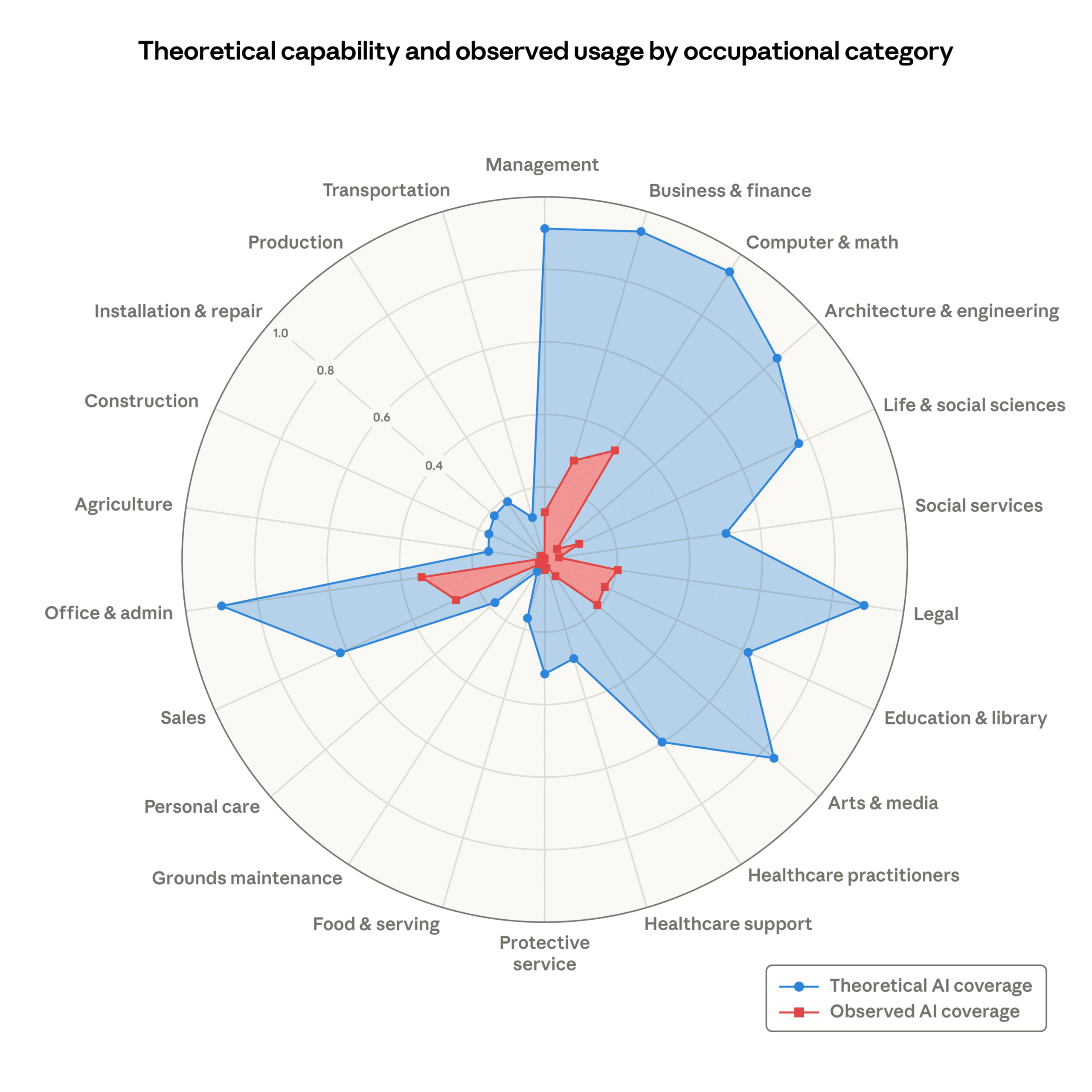
Source: https://www.anthropic.com/research/labor-market-impacts
This is worth pausing on, because it reframes what “changing fastest” actually means. It’s not that programming jobs are vanishing. It’s that a growing share of the day-to-day work inside those roles, boilerplate code, debugging, documentation, is being absorbed by AI tools, which changes what a programmer is actually hired and paid to do. The job title survives. The task list underneath it doesn’t.
That’s consistent with the pattern showing up at Meta, Microsoft, and Oracle. The roles disappearing in the layoffs skew toward generalist and support functions, the same categories where AI coverage is already high, while the roles still being aggressively hired for, AI research, ML infrastructure, specialized engineering, are ones where AI is more of a tool than a replacement.
Anthropic CEO Dario Amodei has been warning since mid-2025 that AI could eliminate up to half of entry-level white-collar jobs within five years, pushing youth unemployment as high as 20%. When Axios asked him why he was speaking so bluntly about his own industry, he said simply that most people are unaware that this is about to happen.
Mark Zuckerberg made a similar prediction on the Joe Rogan podcast in early 2025, telling Rogan that Meta expected to have an AI that can effectively be a mid-level engineer within the year, writing code that used to go through human engineers first.
Satya Nadella has taken a more structural view. At Microsoft Ignite, he described the company’s AI agents as teammates, part of a broader push toward what Microsoft researchers now call the “work chart,” an organizational model built around tasks and outcomes rather than fixed job functions and departments. It’s a quieter way of saying the same thing Amodei and Zuckerberg said more bluntly: the org chart that defined tech hiring for decades is being redrawn around what AI can do, not around headcount.
Not every voice in the industry agrees on the scale or timeline. Critics like Mark Cuban have pointed out that past waves of automation ultimately created more jobs than they destroyed, and OpenAI’s Sam Altman has since walked back some of the earlier doom-laden predictions, arguing that the companies adopting AI fastest are also the ones hiring the most.
To sum up:
The more defensible conclusion is therefore not that AI is eliminating work. It is that AI is changing which work gets done by people, which work gets automated, and which skills become more valuable.
None of this means tech hiring has stopped. It means it’s narrowed sharply. At the same time record layoffs were hitting generalist and support roles, roughly 275,000 AI-related job postings sat open in the U.S., with a 92% increase in hiring for AI-specific positions and a 56% wage premium on the most in-demand roles.
The workers losing jobs, largely in customer support, content moderation, QA, and middle management, are not the ones being hired for machine learning, AI safety, or data infrastructure. It’s not a hiring freeze. It’s a redirection, and it’s leaving a lot of experienced, competent people stuck between two very different labor markets.
For developers, the practical takeaway is that generalist roles are absorbing most of the risk, while specialized AI and ML roles are seeing the opposite: rising demand and rising pay. Broad full-stack experience still matters, but it’s no longer enough on its own to insulate someone from a layoff round.
There’s also a repricing pattern worth watching. Research suggests a meaningful share of AI-attributed layoffs result in the same roles being rehired later, just offshore or at a lower salary. That’s a different problem than jobs disappearing outright, and in some ways a more complicated one for companies to plan around and for workers to navigate.
For companies building teams, the implication is straightforward even if it’s uncomfortable: betting everything on one local labor market, especially a market as expensive and AI-disrupted as Silicon Valley or Seattle, is a riskier strategy than it used to be. Spreading hiring across regions and building flexibility into team structure is becoming less of a nice-to-have and more of a hedge against exactly the kind of structural shift Meta, Microsoft, and Oracle are all going through right now.
Share your team requirements, and we’ll launch a ready-to-deliver team in just 2–4 weeks.
While companies such as Meta, Microsoft, Oracle, and Amazon are restructuring parts of their workforce, demand for specialized engineering talent has not disappeared. In many cases, it is moving toward different skills, different locations, and different team structures. That is where global talent models become relevant. Newxel helps technology companies build and scale engineering teams across eight talent hubs in Europe, providing developers and technology specialists through dedicated development teams and staff augmentation.
The model is designed around a simple idea: companies should be able to access the talent they need without having to build an entire local infrastructure around it. Newxel handles recruitment, employment, HR, legal, payroll, equipment, and day-to-day operational support, while clients stay focused on their products and engineering priorities.
The numbers reflect the model: Newxel reports an 85% offer acceptance rate, 98% developer retention, and average engineer tenure of 3.5+ years. For companies facing a technology market where priorities can change faster than traditional hiring processes can keep up, this flexibility can matter as much as cost.