Scaling engineering past the Dubai ceiling: how UAE tech companies build the second-100 engineers without paying local-market prices for all of them
18 min
· August 31, 2026
Based on Newxel’s work with tech companies scaling engineering into and across GCC markets from a European delivery base.
There’s a specific meeting that many UAE tech founders have somewhere between engineer 15 and engineer 25. The CTO walks in with an offer letter for a senior backend engineer. AED 42,000 base, DHA medical, education allowance for the kids, 30 days annual leave, and a signing bonus because the last candidate they wanted took a bank offer three weeks into the pipeline. It’s the fourth attempt to fill this specific role. The founder signs the offer, walks back to the desk, and opens the hiring plan. Another 30 engineers to add over the next 18 months. The maths in the CFO’s model stops looking like a scale-up and starts looking like a burn problem.
Newxel builds dedicated engineering teams from European hubs for tech companies operating across MENA, EU, US, and Israel. The pattern we see in the UAE market, both from clients already operating in the region and from prospects entering it, is consistent. The founding team builds the first 10 to 20 engineers in Dubai and it works. It’s the second 20, and the 20 after that, where the model stops working. The reason has three parts: senior talent is scarce, packages have climbed to levels most burn models were not built to absorb, and tenures are short enough that team knowledge doesn’t compound the way an engineering leader expects.
This article is a practitioner’s take on what UAE tech companies can do when they run into the local hiring ceiling. It’s written for founders, CTOs, and heads of engineering at UAE scale-ups trying to grow engineering capacity fast enough to keep up with the product roadmap and the funding cycle, without letting the packages, the retention risk, or the Emiratisation compression wreck the plan.
Before recommending an operating model, it’s worth being direct about the market conditions creating the problem.
The UAE tech ecosystem has grown fast. Multiple government initiatives have brought thousands of tech companies into the country over the past decade, and the demand side of the engineering labour market has grown faster than the supply side. Senior engineer packages in Dubai for AI, cloud, cybersecurity, and platform engineering roles run in the AED 25,000 to 45,000 per month range and higher, before housing allowance, medical, and end-of-service liability. Fully-loaded cost for a senior engineer sits above AED 40,000 per month in most cases, and above AED 55,000 for the top 20% of specialisations.
Competition for the best engineers extends beyond other tech scale-ups. It includes banks with sector-specific Emiratisation targets and large budgets, telecom operators, government-linked entities, and sovereign wealth fund portfolio companies. When you post a senior backend role, you’re competing with all of them on package, on brand, on career trajectory, and on visa security.
Attrition is a live problem. Public salary and market surveys from Michael Page, Hays, and Robert Half consistently report high mobility among senior tech professionals in the Gulf. Engineers move for a 30% package increase from a competitor. They move when an equity refresh gets pushed. They move for London or Berlin when a spouse’s career shifts. And they move for personal reasons that no HR intervention would have prevented.
The office footprint grows with the team. Mainland UAE licences require an EJARI-registered physical address, and DET visa quotas broadly follow a 9 square metres per visa rule of thumb. A 60-person engineering team needs a properly-sized office to sponsor its own visas, and that office costs what Dubai office space costs.
Emiratisation compresses the arithmetic further. Once you cross 50 total employees on the mainland licence, the 10% quota against skilled headcount kicks in. Every skilled hire you make in Dubai adds to the denominator. If your engineering team is entirely on the UAE payroll, your Emiratisation obligation is calculated against the full engineering headcount, and closing the gap through Emirati engineer hiring puts you in direct competition with banks that pay considerably more.
This is not a criticism of the Dubai market. It’s the market. And it’s the market that most UAE tech scale-ups underestimate when they build their hiring plan.
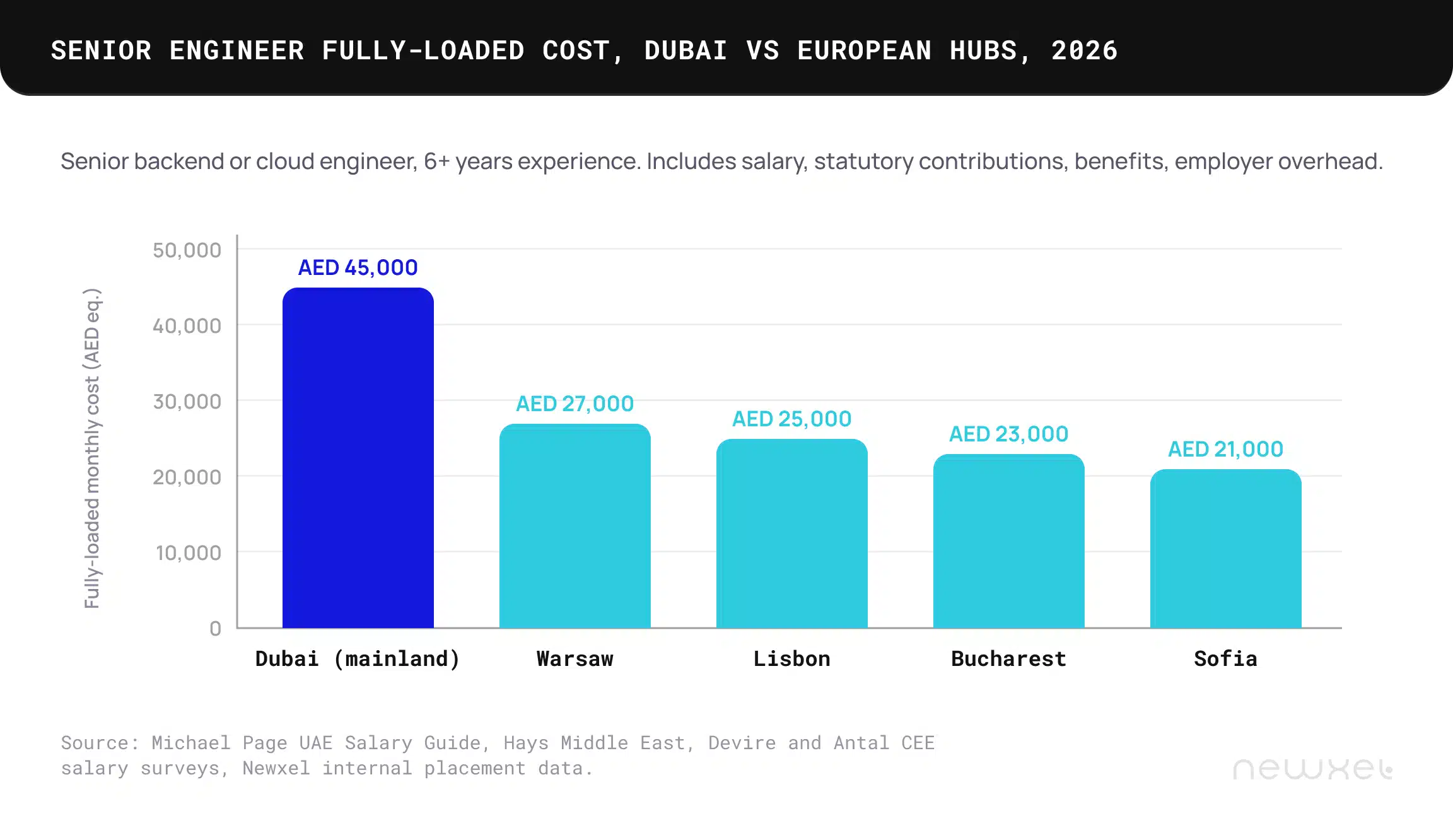
Figure 1. Senior engineer fully-loaded cost, Dubai vs European hubs, 2026. Source: Michael Page UAE Salary Guide, Hays Middle East, Devire and Antal CEE salary surveys.
Every founder in this position tries the same sequence of workarounds before arriving at an operating model that scales. It’s worth naming the sequence, because most of these approaches are partial answers.
Option one: hire harder locally. Bigger packages, more aggressive sourcing, executive search retainers, referral bonuses, employer brand investment. This works to a point. The point is roughly the ceiling of what the Dubai senior engineer market can supply on your timeline. You’ll close some roles. You’ll pay a premium for them. You’ll still fall short of the plan, and the packages you paid to close the closable roles will be referenced when your existing team asks about pay reviews.
Option two: sponsor regional talent. Bring in senior engineers from Egypt, Jordan, Lebanon, or India on employment visas. This is a useful lever, and it’s what many UAE scale-ups do at 20 to 40 engineers. The constraint is that you’re still on the UAE payroll, still in the EJARI office, still under Emiratisation obligations, and now managing visa timelines that add 6 to 10 weeks to every senior hire before they start. Retention for regional talent varies and often depends on whether family relocation works out.
Option three: hire contractors. Freelance engineers, often working remotely, contracted through your UAE entity or through their own home-country structures. This is fast and it looks cheap. It’s also the option that most often unravels under scrutiny. UAE tax residency rules, foreign contractor classification questions, IP assignment complications, and the general fragility of contractor arrangements at scale make this a poor foundation for a growing engineering organisation.
Option four: open an India office. Works, at cost, on a specific set of conditions. India delivery centres are a mature model with advantages for companies that need volume delivery on well-scoped work, and the time zone (roughly 90 minutes ahead of GST for most Indian hubs) is workable. The trade-offs are the ones every India delivery model has had for two decades: attrition, entity setup, management overhead, and the ongoing question of whether the team you built has the seniority and autonomy the product needs.
Option five: build a dedicated engineering team in European hubs through an EOR partner. This is the model most tech companies we work with have converged on for the parts of their engineering roadmap that don’t need to sit in Dubai, and the rest of this article walks through why.
The reason this model works for a UAE scale-up is a combination of talent supply, retention, and time zone. The European senior engineer market has depth and tenure characteristics that Dubai’s market cannot yet match, and it can be accessed without adding to the UAE payroll, the EJARI office, or the Emiratisation denominator.
Newxel hires the engineers you specify, in the European jurisdictions where the density is highest for the stack you need. Poland, Romania, Bulgaria, and Portugal are our most active hubs. Each engineer joins our local employment structure in that jurisdiction as a full employee, with proper contracts under local labour law, statutory contributions, income tax withholding, and mandatory benefits. They’re hired for you, they work only on your product, and they report directly to your engineering leadership in Dubai. They are your engineers, employed through us.
Your operating experience is close to identical to hiring locally. You define the role. You interview and approve every candidate. You set the tech stack, the sprint cadence, the review process, the working hours, the on-call rotation. You do the performance management, because you’re the one with visibility into the work. Newxel handles the employment infrastructure in each jurisdiction, along with everything that comes with genuine employment: parental leave, tax residency questions, benefits enrolment, contract renewals, offboarding when it happens.
Two market conditions make this work specifically for UAE scale-ups.
The first is senior density. Poland, Romania, and Bulgaria each have engineering populations measured in the hundreds of thousands, with mature senior tiers built up over 20 years of nearshore engagement with Western European and US companies. Portugal has a smaller absolute pool but exceptional depth in specific areas like backend distributed systems and cloud infrastructure. For most stacks a UAE tech scale-up needs to hire, the senior candidate density in these hubs is multiples of what Dubai can offer on the same timeline.
The second is tenure. Multi-year retention in mature European engineering hubs runs materially better than Dubai’s senior tech attrition figures. A senior engineer who joins a properly-run dedicated team in Warsaw or Bucharest typically stays multiple years. That compounds. By the time your Dubai team has cycled through two full generations of senior backend engineers, your European team is often the same core group, deeper on your codebase and your product than any 12-month Dubai hire will reach.
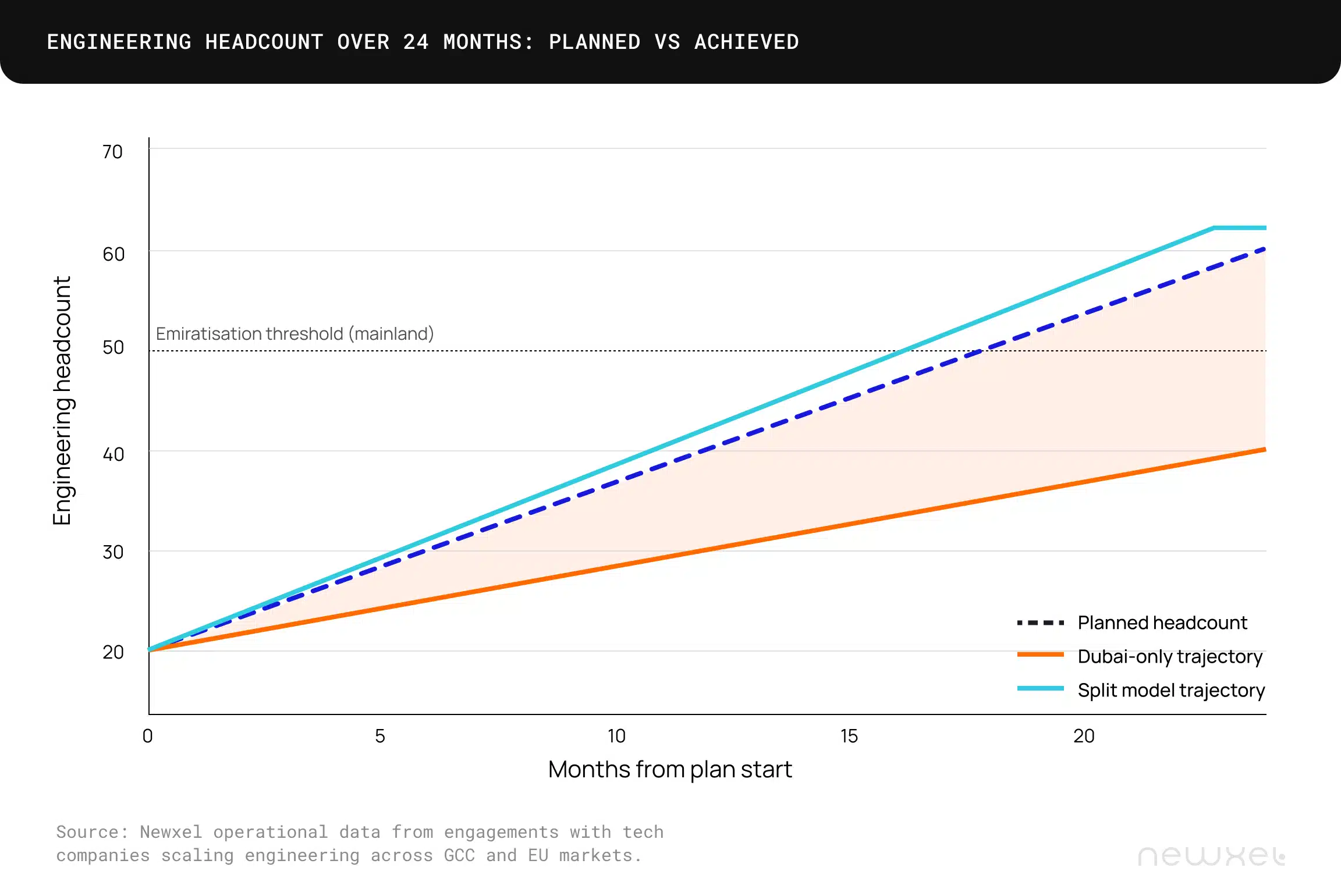
Figure 2. Engineering headcount over 24 months: planned vs achieved, Dubai-only model vs split model. Source: Newxel operational data.
The question we hear most often from UAE-based CTOs is not whether the model is sound. It’s whether they can run engineering teams in a different geography without losing the coordination a local team gives them. Fair question, and one worth walking through in detail.
Time zone works in your favour. Our European hubs run between two and four hours behind Gulf Standard Time depending on hub. Warsaw is three hours behind. Bucharest and Sofia are two. Lisbon is four. In practice, this means your Dubai team’s morning coincides with a productive block of the European team’s day. When your engineering leadership walks into the Dubai office at 9 AM, the European team has already been working for anywhere from an hour to three hours and has queued up code reviews, questions, and design decisions. When your Dubai team goes home at 6 PM, the European team has another two to four hours to work through complex problems asynchronously and hand off progress for the next morning.
Coordination structure is where most distributed engineering setups fail, and it’s the piece worth investing in properly. What works, in our experience, is a hybrid rhythm: daily standups scheduled during the overlap window (typically 11 AM to 2 PM Dubai time), a weekly all-engineering sync with structured written updates, monthly on-site trips (either your Dubai leadership visiting the European hub or the European team leads coming to Dubai), and quarterly full-team gatherings for planning and team building. Written communication discipline is the operational muscle you have to build. If your Dubai engineering culture runs on hallway conversations and undocumented decisions, extending it to Europe will be painful. If your culture already has strong async documentation habits, the split feels natural within a few sprints.
Reporting lines stay clean. Your CTO in Dubai runs the whole engineering organisation. Engineering managers, tech leads, and principal engineers in Europe report to the CTO or to the appropriate direct report. Newxel doesn’t insert a project manager into the reporting chain. The team is yours to run.
Product security and IP are handled through the standard mechanisms every distributed engineering team uses: SSO, VPN or zero-trust access, code repository controls, DLP tooling, and NDAs and IP assignment clauses baked into every engineer’s employment contract at hire. This is not exotic. Every serious tech company running distributed engineering has this stack in place. What EOR-based staff augmentation adds is a single vendor of record standing behind the employment relationship in each jurisdiction, which simplifies your legal exposure compared to running direct employment relationships across four or five foreign entities.
For a UAE-based scale-up, this is where the operating model produces its biggest structural payoff, and it deserves to be explained plainly.
Emiratisation quota is calculated against your skilled workforce on the mainland licence. Every engineer on the UAE payroll counts in the denominator. If your engineering team is 40 people, all in Dubai, and your commercial and operations team is 20, your total skilled headcount is 60 and your 10% Emiratisation obligation is 6 Emirati hires. Trying to close that gap through Emirati engineer hiring puts you in a market where banks and telecoms outbid you daily.
Now shift the picture. Same product. Same commercial ambition. 15 engineers in Dubai (your leadership layer, security, DevOps, and a couple of principal engineers who need to be local) and 25 engineers in Europe through the dedicated team model. Your UAE skilled headcount is now 35. Your Emiratisation obligation is 3.5, rounded up to 4. The four Emirati hires now belong in commercial, compliance, government relations, and public affairs roles, where the fit is strategic and where Nafis salary support of up to AED 8,000 per month per eligible national improves the economics.
The engineering roadmap stops competing with the compliance obligation for the same dollar. That’s the structural payoff.
For UAE tech companies specifically, this is the operating architecture the market physics tends to push scale-ups toward, whether they arrive at it deliberately or through trial and error. Solve the scaling problem, and the Emiratisation problem gets easier as a side effect.
Two numbers matter most in the planning conversation.
Ramp time. For most stacks and most European hubs, 6 to 12 weeks from signed engagement to a five-engineer team ramped and merging code. Common stacks (Node.js, Python, Java, TypeScript, Go, .NET, React, Vue) in Poland, Romania, and Bulgaria run at the faster end. Specialised roles (senior ML engineers, mobile platform leads, low-latency systems specialists) push toward the upper end. Larger team ramps typically take 10 to 16 weeks for teams of 10, with the standard practice being to phase the hiring across two waves so you can start operational integration in parallel with the second wave of interviews.
Cost. Fully-loaded cost for a senior engineer through a dedicated team in Poland or Romania typically runs 25% to 45% below the equivalent fully-loaded cost of a Dubai hire. That’s before the fixed overhead of adding EJARI-linked office capacity for growing UAE headcount, and before the Emiratisation exposure reduction. The savings are real. They are not the reason to do this. Speed, senior density, and retention are the reasons. The savings are a consequence.
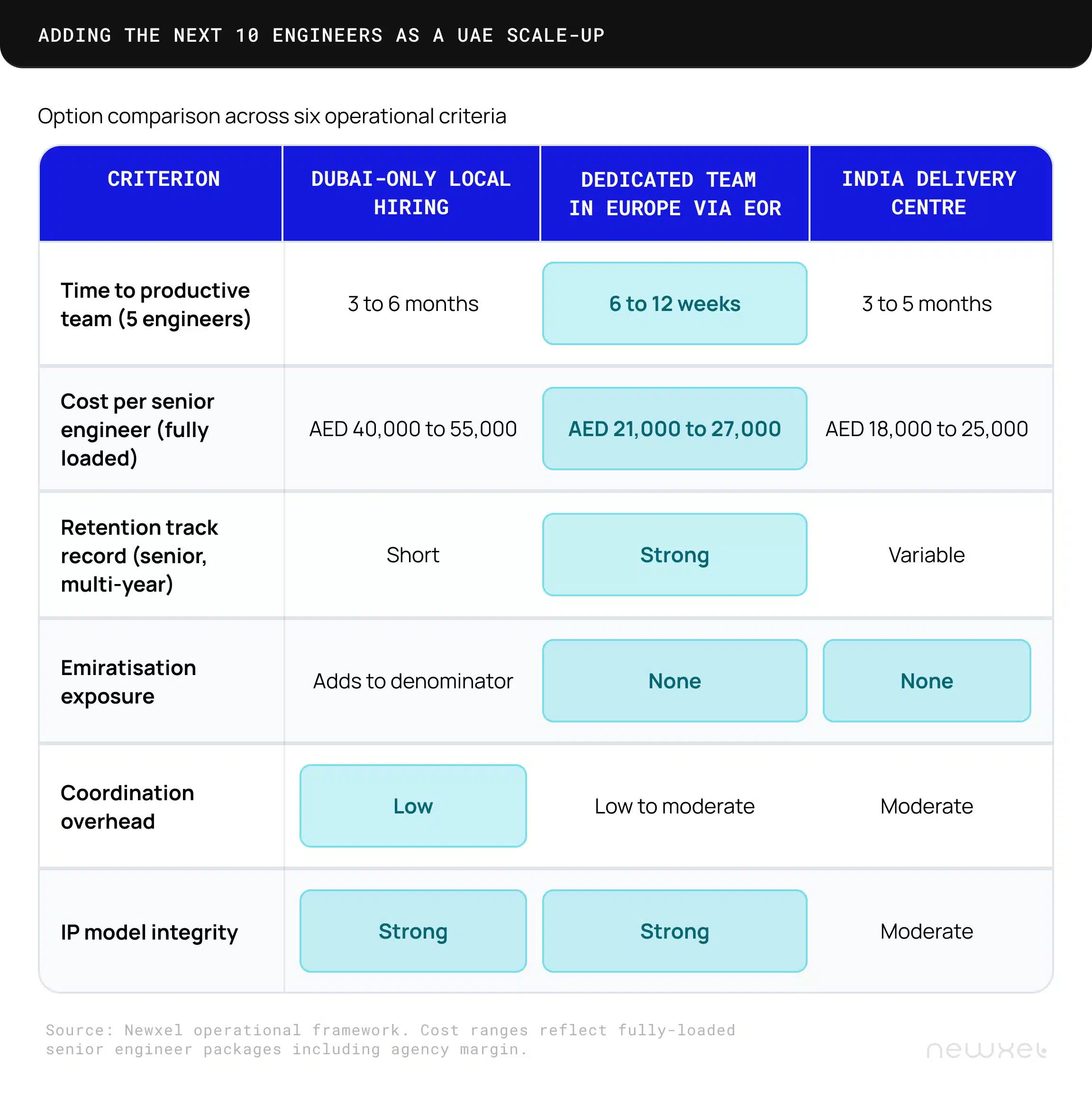
Figure 3. Adding the next 10 engineers as a UAE scale-up: option comparison. Source: Newxel operational framework.
Three things worth naming honestly.
Distributed engineering management is a skill, and not every team has it built up. If your current engineering culture runs on hallway conversations and undocumented decisions, extending to Europe will surface those weaknesses immediately. The failure mode is under-investment in written documentation, ambiguous decision rights, and reliance on informal coordination that does not scale across a time zone gap. This is a management-practice issue, and it is fixable, but it takes intent. Most of our clients invest in async documentation tooling and rituals early, and it pays back within two sprints.
Some product areas benefit from local proximity. Compliance-heavy work with UAE regulators, some parts of customer success engineering for large local enterprise clients, and any security or infrastructure work that has to be done from inside a specific network perimeter. These are the roles that should stay in Dubai. The rest of the engineering organisation has more flexibility.
Founder credibility signal. Some UAE enterprise customers, particularly government and semi-government, place weight on a visible local engineering presence as a signal of long-term commitment. This matters less than most UAE founders assume, because those customers rarely see or care about where the code is written. It matters more if your commercial team shrinks alongside the engineering shrink. Keep the commercial, leadership, and customer-facing presence in the UAE robust and this is a manageable question. Let it hollow out and it becomes a problem.
None of these is fatal. All of them are the questions the leadership team should be asking in the quarterly planning cycle, and the ones the CFO should not be discovering in the middle of a board meeting.
If the split model depends on an EOR-based partner running the European engineering piece, that partner’s quality matters more than most founders realise. A few things to look for.
Real employment infrastructure in the jurisdictions where you want to hire. Ask which countries the partner directly employs in, and how long they’ve been operating in each.
Client-managed team model as the default. You want engineers reporting to you, not a project manager reporting to you on behalf of engineers. The distinction affects everything from how quickly issues surface to how quickly they get resolved.
Retention track record measured over multi-year engagements. Anyone can hold engineers for the first 12 months. The signal is what happens in years two and three, and whether the partner can point to named engagements that have run at scale for that long.
Transparency on cost. You should see salary, statutory contributions, partner fee, and total cost, itemised. Opaque monthly rates usually mean the largest margins and the least accountability when something goes wrong.
Willingness to say no. A partner that will accept any brief and promise any timeline is not managing your risk. A partner that will push back on a hiring spec that does not match the market, or a timeline that does not match a realistic ramp, is doing the work you’re paying them for.
The single insight worth leaving with: Dubai’s tech talent market has a scaling ceiling, and hitting it harder is the most expensive way for a UAE scale-up to work through it. Build the engineering capacity you need in the European hubs where senior density and retention are structurally deeper, run it as a dedicated team through EOR-based staff augmentation, keep your leadership, commercial, and customer-facing presence in Dubai robust, and watch the Emiratisation obligation get lighter as a side effect.
If you’re a UAE tech founder or CTO working through this scaling question, Newxel would be glad to sit down with your leadership team and work through what the split would look like for your specific product roadmap and hiring plan.
This article is not legal, tax, or immigration advice. UAE labour, tax, and Emiratisation obligations change. Confirm current requirements with MOHRE, the Federal Tax Authority, and qualified UAE counsel before acting on any specific structural decision.
We already have 20 engineers in Dubai. Does adding a European team disrupt them? Not in the experience of the clients we work with, if the split is designed properly. The Dubai team keeps their scope and typically shifts toward the roles that benefit from local presence: leadership, architecture, security, DevOps, and customer-facing engineering. The European team takes on parallel workstreams. Nobody’s job gets smaller. What changes is that you stop losing sleep about hiring the next backend engineer in three months.
Can we keep our CTO and VP Engineering in Dubai while the majority of the team is in Europe? Yes, and this is the standard configuration. The reporting line runs from the European team leads to the CTO in Dubai, on the same tools you already use.
How does this affect our Emiratisation number? It reduces your skilled headcount denominator on the UAE payroll, which reduces the absolute number of Emirati hires you need to make to hit the 10% quota. It also lets you place those Emirati hires in commercial and compliance roles where the fit is strategic and where Nafis wage support is most effective.
What if we later want to move some engineering back to Dubai? The model supports it. Engineers hired through a dedicated team in Europe can be transitioned to direct UAE employment when specific business reasons justify it, and the engineering leadership decisions about who sits where stay with your team.
How does the cost compare to setting up in India? Similar order of magnitude for base salary in mid-tier Indian hubs, with differences in retention, senior density in specific stacks, and time zone. India is roughly 90 minutes ahead of Dubai (a smaller overlap adjustment than Europe), which some CTOs prefer. Europe generally has deeper senior tiers in specific areas including cloud infrastructure, backend distributed systems, and certain regulated-industry specialisations. The right answer depends on your product and your team.
What’s the fastest we can have a five-engineer team operational in Europe? For most stacks and most European hubs, 6 to 12 weeks from signed engagement to a full team ramped and merging code. Common stacks in Poland, Romania, and Bulgaria run at the faster end.