Software Development Staff Augmentation: How to Scale Your Team Efficiently
20 min
· February 19, 2026

The global IT staff augmentation market is on pace to blow past $300 billion in 2026 alone , with the broader staff augmentation and managed services space projected to reach roughly $318 billion this year, growing at a steady 9% CAGR. Behind that number is a simple truth: companies can no longer hire their way out of the talent shortage fast enough. The average time to fill a specialized technical role now sits at 88 days, an eternity when your roadmap runs in two-week sprints.
The question isn’t whether staff augmentation works. It’s how to do it right – who to hire, where to look, and how to keep your new engineers as invested as your founding team. Here’s the playbook.
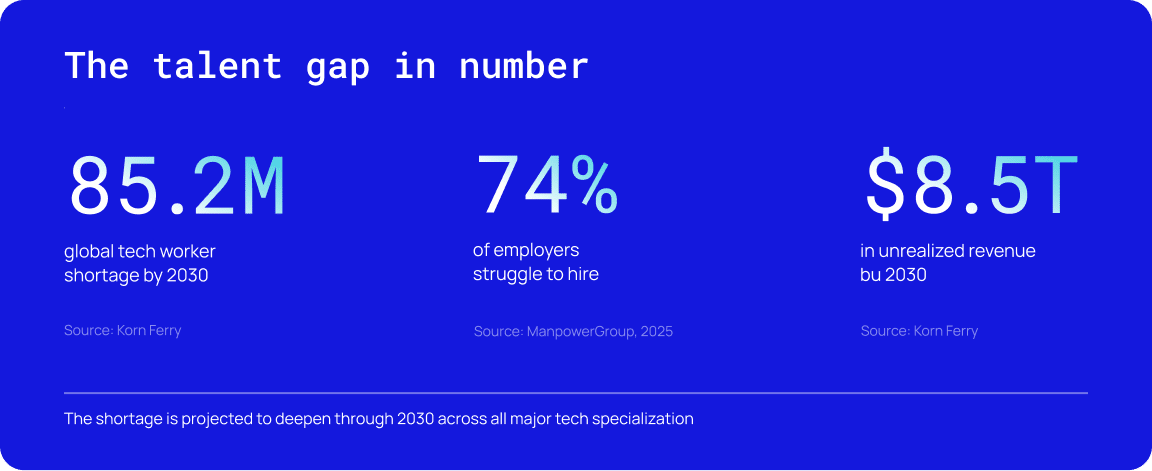
The numbers tell the story clearly. The U.S. Bureau of Labor Statistics projects software developer employment to grow 15% from 2024 to 2034 – well over double the rate for the general workforce¹. Korn Ferry’s workforce modeling estimates a global shortage of 85.2 million tech workers by 2030, which could translate to $8.5 trillion in unrealized revenue². In the United States alone, the tech sector faces a projected deficit of more than 1.2 million software and IT professionals by 2026². ManpowerGroup found that 74% of employers worldwide report difficulty finding people with the right skills³.
The pain concentrates in specific areas. Cybersecurity has roughly 4.8 million unfilled positions that is a 47% gap between the workforce companies need and the one that exists. AI demand nearly doubled in a single year, with 51% of business leaders reporting they cannot find enough qualified people. Cloud, DevOps, and data engineering sit right behind. IDC estimates this talent gap will cost the global economy $5.5 trillion by 2026 in delayed projects, missed opportunities, and weakened competitive positions⁴.
And here is what makes it worse: the average time to fill a position is 44 days according to SHRM, and technical roles regularly exceed 60⁵. Add onboarding and ramp-up, and you are looking at four to six months between spotting a gap and having a productive team member. That is an eternity when your sprint cycles are two weeks long.
This is why the IT staff augmentation market, valued at $299.3 billion in 2023, is projected to surge to $857.2 billion by 2031, growing at a compound annual rate of 13.2%⁶. Companies are not adopting software development staff augmentation because someone sold them on it. They are adopting it because they ran out of other options that work fast enough.
There is a persistent confusion between augmentation and outsourcing, so let us clear it up with a simple test. If the external team manages itself and delivers a finished product, that is outsourcing. If external developers join your team, attend your standups, use your Jira board, push to your repos, and take direction from your engineering lead – that is software team augmentation as engagement model.
The analogy I use: outsourcing is hiring a catering company for your event. Augmentation is adding two experienced cooks to your kitchen staff because you took on more dinner reservations than your current crew can handle. They cook your recipes, with your ingredients, following your standards. You just have more hands.
With software development team augmentation, the developers become part of your daily workflow. They participate in code reviews, join architecture discussions, and commit to the same repositories as your full-time engineers. The practical difference is that the augmentation partner handles everything behind the scenes: employment contracts, payroll, taxes, benefits, compliance with local labor laws, workspace if needed. You manage the work; they manage the employment.
This matters most for companies that want to hire in other countries but have no intention of registering a legal entity there. If you are a US-based company and you need five Java developers based in Eastern Europe, you do not need to set up a subsidiary, figure out Ukrainian labor law, or run foreign payroll. The partner absorbs all of that. Your developers show up on Monday, log into your systems, and start working.
A few models exist within this framework. Short-term augmentation (3 to 6 months) fills a specific capacity gap: you need extra hands for a release, a migration, or a spike in QA work. Long-term augmentation is the more interesting play: developers stay for years, build deep knowledge of your product, and become functionally indistinguishable from permanent hires. Then there is full team building, where the partner helps you establish an entire development center in another region, staffed and operated under their umbrella but wholly dedicated to your work.
The reasons companies reach for development team augmentation vary a lot depending on the industry. Here is what we see across the sectors we work with most.
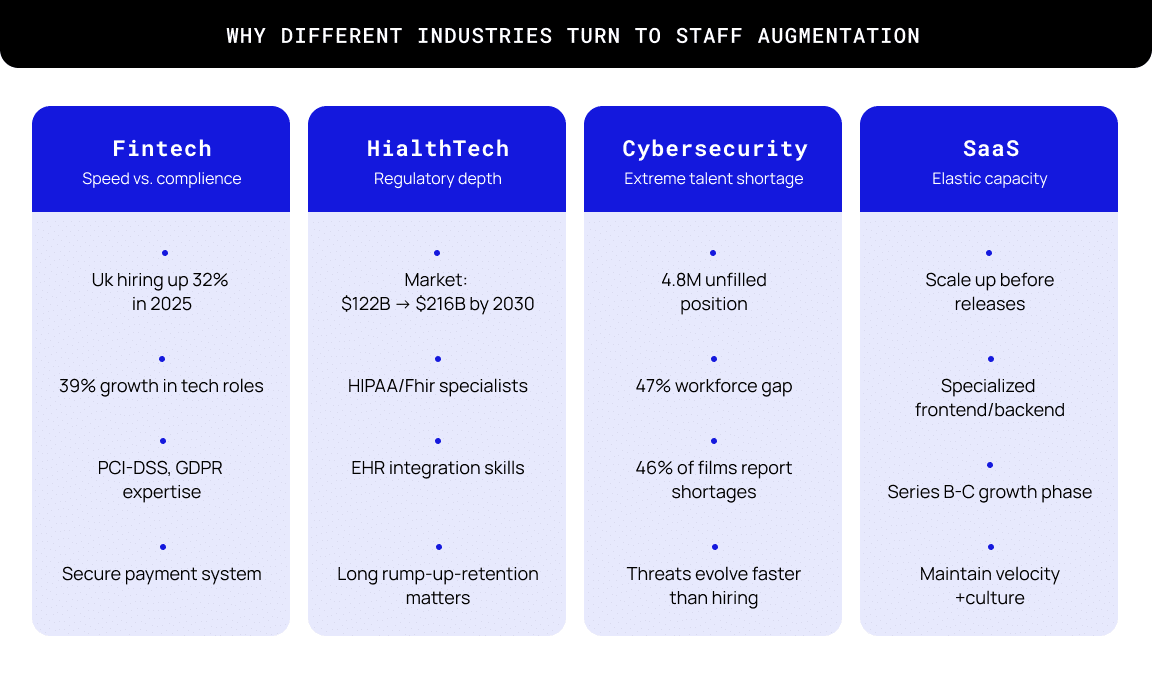
Fintech is one of the hungriest consumers of staff augmentation for software development, and the numbers explain why. UK fintech hiring projections jumped 32% in 2025, with technology roles expanding 39% – mostly in engineering, development, and cybersecurity⁷.
The challenge in fintech is that speed and compliance pull in opposite directions. You need to ship before the competition does, but every feature touches regulated financial data. PCI-DSS, GDPR, SOC 2, anti-money laundering rules – the list keeps growing. You cannot throw junior developers at this; you need people who have built payment systems before and understand why certain architectural shortcuts will cost you later.
Finding those people in Tel Aviv, London, or New York means competing with banks, big tech, and every other fintech for the same small pool. Augmenting your team with experienced developers from Eastern Europe, where fintech project experience is widely available, cuts the timeline from months to weeks. What we typically see: a company starts with two or three augmented backend developers. Six months later they have eight, because the people proved themselves and the arrangement works.
The healthcare staff augmentation market is projected to grow from $122.5 billion in 2025 to $216.8 billion by 2030⁸. That growth is driven by something very specific: you cannot build a health data platform with developers who have never worked with HIPAA, FHIR, HL7, or clinical workflows. The learning curve is steep, and cycling through short-term contractors who each need weeks to understand the regulatory context is expensive and slow.
This is where long-term software staff augmentation earns its keep. Instead of explaining your compliance requirements to a new contractor every quarter, you build a dedicated team that accumulates domain knowledge over time. The developers learn not just the code, but the reasoning behind your data handling decisions. For healthtech startups that lack the brand to compete with major hospital systems for local talent, this model is often the only realistic path to building a strong engineering team.
If there is one field where the talent shortage has gone from “annoying” to “genuinely dangerous,” it is cybersecurity. Roughly 4.8 million positions are unfilled worldwide — a gap of about 47% of the workforce that is needed⁹. CIOs consistently rank it as their top concern, and 46% of businesses report they cannot find enough security specialists³.
Building a permanent, in-house security team that covers penetration testing, DevSecOps, threat modeling, incident response, and compliance auditing is something only the largest enterprises can afford. For everyone else, development team augmentation is how you get access to senior security engineers without maintaining a full department. The augmentation model fits cybersecurity particularly well because threats change constantly — the ability to adjust your team composition as new risks emerge is more practical than trying to predict what you will need two years from now.
SaaS companies have the most natural fit with software team augmentation, because their engineering needs are inherently uneven. You scale up before a major release, need specialized frontend work for a UI redesign your backend team cannot handle, or suddenly need mobile developers when the roadmap shifts. Series B and C companies face this most acutely: they have proven the product works, they have funding to grow, and the only thing holding them back is engineering capacity. They cannot hire fast enough in their local market. Augmentation keeps their velocity up without forcing them to compromise on who they bring onto the team.
Knowing what to expect removes the guesswork and helps you tell a thorough partner from a careless one. Here is how a well-run engagement unfolds.
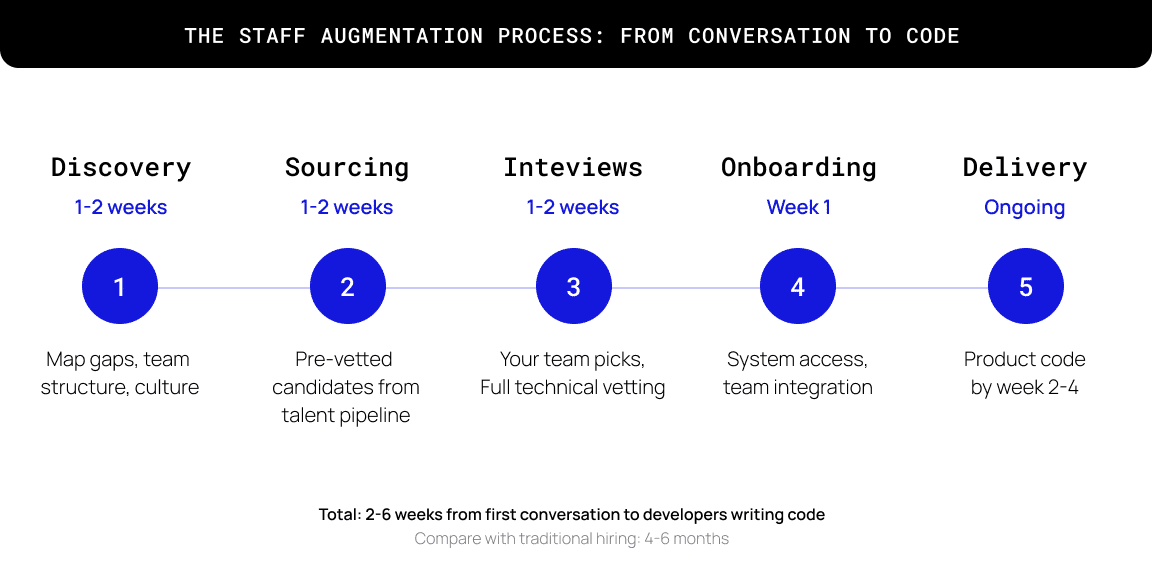
A good partner won’t ask for a shopping list of technologies and seniority levels and call it done. They dig into context: what your team looks like, how you run sprints, which time zones matter, what domain knowledge is non-negotiable, and what’s driving the urgency. This typically takes one to two weeks. Skip this step and jump straight to emailing CVs, and you’ve learned something about how the rest of the engagement will go.
This is where depth shows. A strong partner doesn’t post your job on local boards and hope for the best — they maintain a pre-vetted pipeline across specializations, seniority levels, and tech stacks, and can typically present qualified candidates within one to two weeks. Work with a partner operating across multiple European hiring hubs, and that pipeline spans countries too: a DevOps engineer from Poland, backend developers from Ukraine, a QA specialist from Romania, all under one relationship.
You retain full control over who joins your team. The partner presents pre-screened candidates; your engineering leads run the technical interviews, assess how the person thinks and communicates, and make the final call. Anyone who insists you accept whoever they assign isn’t a partner worth keeping.
This is the phase that decides whether the engagement works or becomes a “we tried it, it was disappointing” story. Onboarding for augmented developers should mirror onboarding for full-time hires: access to every system they need, introductions to team norms, clear initial tasks, a buddy for the small questions. A good partner handles the friction behind that — resolving infrastructure access, coordinating with local HR, providing a point of contact — so your engineering managers aren’t buried in admin.
The work doesn’t stop once someone’s coding. Ongoing support covers all employment administration — payroll, taxes, benefits, local labor-law compliance — plus HR support, equipment, workspace logistics, and an escalation path when something goes sideways. It’s what lets you focus on engineering and risk management instead of figuring out tax obligations in another country.
When companies start looking at where to source augmented developers, Eastern Europe appears in almost every serious evaluation. Not because it is cheap (the “cheap offshore labor” era is over) but because the combination of quality, cost, and working compatibility is hard to beat elsewhere.
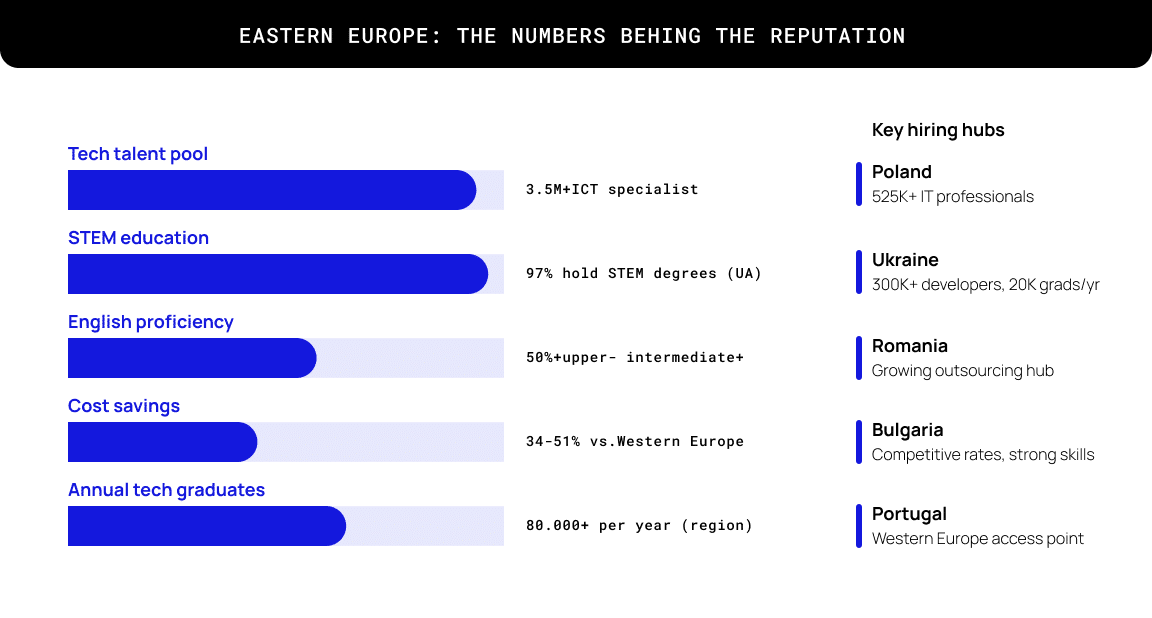
As of 2025, Eastern Europe has over 3.5 million employed ICT specialists which is the largest tech talent pool of any subregion, larger than Latin America (roughly 1 million) or India (roughly 2.5 million)¹⁰. Poland alone has over 525,000 IT professionals. Ukraine produces approximately 20,000 tech graduates each year and maintains a workforce of over 300,000 developers, with 97% holding STEM degrees¹¹.
On cost: senior developers in Ukraine typically earn $40,000 to $50,000 per year, compared to $120,000 to $180,000 or more in the US¹². Across the region, companies report 34% to 51% savings compared to Western European hiring¹³. But the money is not the main reason people stay with Eastern European teams. Three other things matter more.
Time zone overlap. For companies on the US east coast, in the UK, or in Israel, Eastern European developers share enough working hours for real-time collaboration. You can pair-program, troubleshoot together, and have actual conversations instead of leaving comments and waiting twelve hours for a reply.
Education depth. The World Economic Forum reports that Eastern Europe has among the highest shares of STEM graduates globally¹⁴. In Ukraine, over half of developers have upper-intermediate or advanced English. These are not people who learned to code in a bootcamp last year: most are in their early thirties with years of production experience.
Working style. This one is harder to quantify but easy to feel. Eastern European developers generally share the Western expectation of ownership, direct communication, and initiative. They push back when a spec does not make sense. They flag technical debt before it becomes a fire. They suggest better approaches instead of quietly implementing whatever they are told. That is the difference between adding capacity and adding capability.
This is where we move from “what is this” to “how do I not get burned.” These are the questions that separate companies that get real results from those that end up writing off the experience as a failed experiment.
Get this in writing before anyone touches a keyboard. In a properly structured software development staff augmentation agreement, everything the augmented developers create belongs to you. Full stop. Your contract should include explicit IP assignment clauses, and the augmentation partner should have matching agreements with the developers. If a potential partner gets vague when you ask about intellectual property, that conversation is over.
This question reveals whether you are talking to a real partner or a body shop. A strong augmentation provider actively manages developer satisfaction, career growth, and competitive compensation. They track market rates and adjust proactively. They build local community and professional development opportunities. They have retention programs that go beyond a paycheck. Ask for their retention numbers. Anything under 90% for long-term engagements should make you nervous.
Flexibility is supposed to be one of the main reasons you chose augmentation over direct hiring. Make sure the contract backs that up. Your agreement should spell out notice periods for reducing team size (typically 30 to 60 days) and any costs involved. A partner that makes it painful to scale down is not offering flexibility: they are offering a contract with a lock-in.
This varies wildly and is where hidden costs live. A truly full-service partner handles employment contracts, payroll, taxes, benefits, workspace, equipment, local legal compliance, and HR administration. You should not need to register a legal entity, hire a local accountant, or learn another country’s employment law. If the provider’s “comprehensive service” still leaves gaps that your operations team needs to fill, the real cost of the engagement is higher than the invoice suggests.
Resumes and coding tests tell you what someone knows. They tell you nothing about how they work. The best software development team augmentation partners evaluate communication style, problem-solving under ambiguity, ability to work without constant direction, and cultural compatibility with your specific team. Ask what their vetting process looks like beyond the technical screen. If the answer is “we give them a HackerRank test,” that is probably not enough for someone who will be embedded in your critical path.
Staff augmentation isn’t the right answer for everything. Here’s when it works, and when something else fits better.
If you need a finished product delivered with minimal involvement from your team, classic outsourcing is probably the better fit. You write the requirements, they build it, you receive the output. The trade-off: less visibility into how the work gets done, and your team learns little from the engagement.
If you’re planning to hire hundreds of people in another country and want full operational control, setting up your own legal entity may be worth the investment despite the setup costs and legal complexity. But for most companies in the 50-to-500-person range, the overhead of a foreign subsidiary is wildly disproportionate to the benefit.
Staff augmentation works best when you need to expand your existing team with specific skills while keeping direct management over everyone, need to move in weeks rather than months, want to hire internationally without building international employment infrastructure, and want the option to adjust team size as your needs change. Many companies start with augmentation and later evolve into a dedicated team model, where the partner helps build and run an entire development center in another region. It’s a natural progression: start with a few people, prove the model works, then scale it into something more permanent.
Let’s set honest expectations here, overselling this wouldn’t do you any favors. Done properly, staff augmentation shows measurable results in four to eight weeks: augmented developers contributing real, reviewed, merged code within the first two weeks, and working at full speed by week six to eight.
The compression compared to traditional hiring is significant. Instead of four to six months from identifying a need to having a productive person, you’re looking at two to four weeks to see qualified candidates, and another two to four weeks to full output.
Partners operating across multiple European hiring hubs add something extra: if one market tightens or a specific skill becomes scarce locally, sourcing shifts to another location without disrupting the team, a kind of redundancy that’s hard to build with direct hiring.
The companies that get the most out of this share a few habits. They treat augmented developers as full team members: same access, same communication, same inclusion in decisions. They invest in onboarding properly instead of expecting the partner to handle it alone. And they treat the relationship as a long-term partnership, not a vendor transaction.
There’s no single number here, but there is a formula. Four factors drive what you’ll actually pay.
Junior developers run cheaper but need more oversight; mid-level engineers hit the sweet spot for most teams; senior specialists cost more per hour but ship faster and need less hand-holding. In practice, seniority alone can swing the rate by 2–3x within the same country.
Geography remains the biggest lever. US-based developers typically run $85–150+/hr. Eastern European engineers, Ukraine, Poland, Romania, land in the $30–70/hr range depending on seniority, while still offering strong English proficiency and EU-aligned working practices. Asian and African markets can go lower, but the savings often get eaten up elsewhere (more on that below).
Short-term engagements carry a premium, the partner is absorbing more sourcing and ramp-up risk for less payoff. Longer commitments (six months plus) typically unlock better rates, since the partner can plan capacity instead of scrambling to staff a two-month gap.
This is the part people forget to ask about. Most staff augmentation partners charge a markup over the developer’s base rate to cover recruitment, HR administration, compliance, and their own margin. That markup usually runs 20–50%. A transparent partner shows you this breakdown; one that only gives you a single blended number is hiding something.
The headline hourly rate is not the total cost of engagement. Add in management overhead, onboarding ramp-up time, and the cost of any misalignment or rework, and a cheaper rate on paper can end up more expensive in practice. This is exactly why so many companies land on Eastern Europe as the balance point: rates low enough to matter, without the hidden costs that come from communication gaps or quality issues eating the savings.
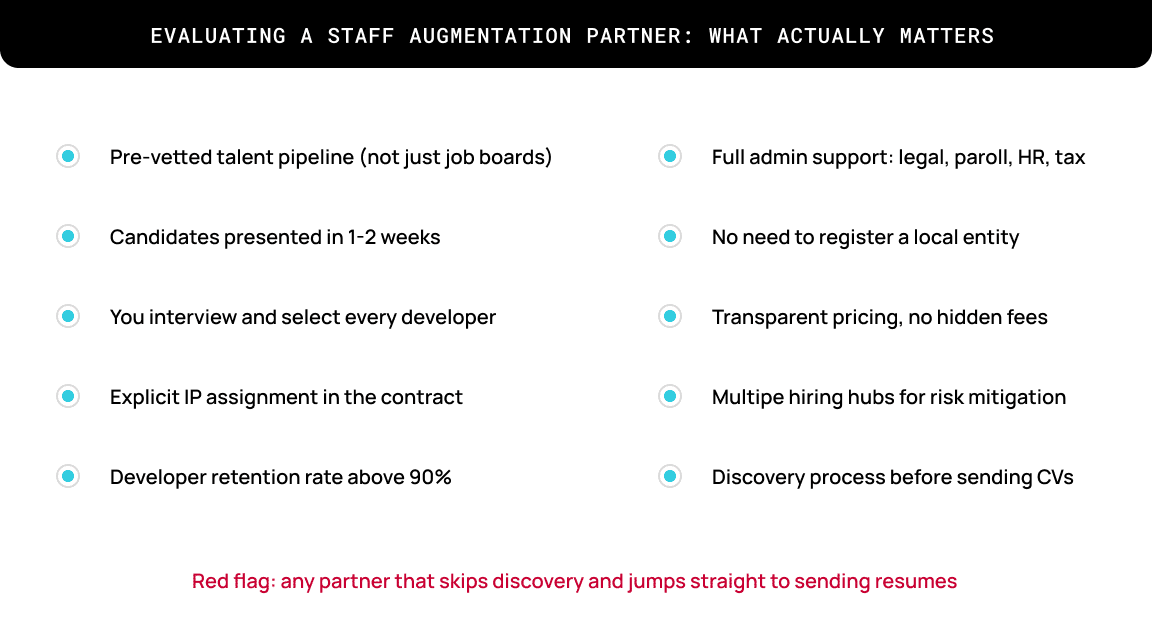
Not all partners are created equal, and the difference usually shows up in four places. We highlight key provider selection factors:
If you want a shortlist to start from, this roundup of top IT staff augmentation companies is a useful starting point for comparing providers against these criteria.
Before you sign anything, run through this checklist:
Done right, staff augmentation gives you senior engineering capacity in weeks instead of months, without the overhead of building international infrastructure yourself. If you’re ready to see what that looks like for your team, our IT staff augmentation services page walks through how the model works in practice.
If you have read this far, you are probably past “should we consider this?” and into “how do we do it well?” Here is a practical starting point.
Map your real talent gaps. Not just the positions on your careers page, but the skills you will need in six to twelve months based on where your product roadmap is heading. Staff augmentation for software development works much better as a planned move than as a panic reaction.
Talk to 2 or 3 augmentation partners. Evaluate them on their specific experience in your industry, how deep their talent network runs in your required specializations, their retention numbers and how happy their developers seem, whether their administrative support is comprehensive (legal, finance, HR – all of it), and whether they feel like a partner you would enjoy working with or a vendor trying to close a deal.
Start small. A pilot with two or three developers on a defined project gives you real data without a big commitment. If it works, you scale. If it does not, you have learned something useful at low cost.
The companies that will scale their engineering teams most effectively over the next few years will not be the ones with the largest local recruiting budgets. They will be the ones that figured out how to work with talented people regardless of where those people happen to live, while keeping their engineering culture intact across borders. Software development staff augmentation, done properly, is one of the most practical ways to get there.