Outsourcing vs Outstaffing: What is the Difference and What Model to Choose?
25 min
· February 26, 2026
Last updated: October 15, 2026
This guide is built on Newxel’s 8 years of hands-on experience matching Eastern European engineering talent with global technology companies. The insights, frameworks, and recommendations here come from our internal research, proprietary hiring data, and the real decisions our clients make every quarter.
At some point in every growing technology company’s life, the engineering hiring plan starts outpacing the local talent market’s ability to fill it, and that gap between what the product roadmap demands and what the current team can deliver is usually what sends a CTO or VP of engineering down the path of researching remote hiring for the first time. Within minutes, 2 terms dominate every search result: outsourcing and outstaffing.
Most of the content out there treats outsourcing and outstaffing as variations of the same thing, which is a mistake that can cost you months of lost productivity and hundreds of thousands of dollars in misallocated budget. The model you choose will shape how much control you retain over your codebase and architecture decisions, how deeply new engineers integrate with your existing culture and workflows, how your legal and financial obligations are structured across borders, and whether the engagement ultimately feels like a natural extension of your own team or a transactional relationship with a vendor who disappears once the contract ends.
The global IT outsourcing market reached $588.38 billion in 2025, and it is projected to grow at an annual rate of roughly 8.28% through 2029.1 At the same time, 74% of employers worldwide report difficulty finding skilled talent, more than double the figure from a decade ago.2 These 2 forces, a booming services market and a persistent talent shortage, explain why so many technology leaders are evaluating offshore models for the first time.
This article will walk you through both models in detail: how they work operationally, where each one fits, what the real tradeoffs are, and what questions you should ask before signing anything. By the end, you will have a practical decision framework you can apply to your own situation, whether you are a CTO scaling a product, a VP of engineering filling a specialized role, or an HR director exploring remote team options for the first time.
Let’s start with the basics.
In the outsourcing model, you hand over an entire project or a clearly defined scope of work to an external company. That company takes responsibility for planning, execution, delivery, and quality assurance. They assign their own project managers, engineers, and QA specialists. You communicate primarily with a single point of contact, usually a project manager on the vendor’s side, and you receive progress reports, demos, or milestone deliverables according to an agreed schedule.
Think of it this way: you describe what you want built, agree on a timeline and a price, and the outsourcing partner figures out the how. You step back from the day-to-day engineering decisions and let the vendor’s team run the project.
Outsourcing tends to work well in a few specific situations. If you have a standalone project that sits outside your core product, say a mobile app for an internal tool or a data migration that requires a skill set your team does not have, outsourcing allows you to get it done without pulling your engineers off their primary work. It also works when you need speed and you can define deliverables clearly upfront. Companies with no in-house technical leadership sometimes choose outsourcing because the vendor provides the management layer they lack.
Short-term engagements with a fixed scope and clear acceptance criteria are the natural territory for outsourcing. You know what the output should look like, you just need someone reliable to build it.
Minimal management overhead. The vendor handles team coordination, task assignment, and daily standups. Your involvement is limited to reviewing progress and providing feedback at key checkpoints.
Access to a ready-made team. You do not need to recruit, vet, or onboard individual engineers. The outsourcing company already has people with the right skills on staff and can spin up a team quickly.
Predictable budgeting. Many outsourcing contracts are structured around fixed milestones or sprints, which makes it easier to forecast costs. You negotiate a price for a defined deliverable.
Focus on core business. Because you delegate the execution, your internal team can concentrate on the work that directly drives your product strategy and revenue.
Limited visibility and control. This is the single biggest tension in outsourcing. Once the project is underway, you are relying on the vendor’s processes, their code quality standards, and their interpretation of your requirements. You will see demos and milestone reviews, but the day-to-day engineering decisions are not yours to make.
Knowledge stays with the vendor. When the project ends, the institutional knowledge about the codebase, the architectural decisions, and the reasoning behind them walks out the door with the vendor’s team. Knowledge transfer is possible, but it is never as complete as having the people who built the product remain on your team.
Communication friction. Going through a project manager on the vendor’s side adds a layer of indirection. Requirements can get lost in translation. Feedback loops are longer. If something needs to change quickly, the process for making that change involves more steps than it would with an internal team.
Harder to course-correct. If your product direction shifts mid-project (and it often does), renegotiating scope with an outsourcing partner can be slow and expensive. Fixed-scope contracts are inherently rigid.
At Newxel, many of our clients come to us after an outsourcing engagement that started well but became frustrating as their product evolved and they needed more control over the direction of development. It is a pattern we see regularly: the project outgrows the outsourcing model, and the company realizes it needs people who are embedded in its culture and processes, not just executing a brief.
Outstaffing, also called IT staff augmentation, is a fundamentally different arrangement. Instead of handing over a project, you bring individual engineers (or a team of them) into your existing structure. They work under your management, follow your processes, attend your standups, use your tools, and are dedicated exclusively to your project. The outstaffing provider handles everything on the administrative side: employment contracts, payroll, taxes, benefits, office space, and equipment. But the work itself is directed entirely by you.
The simplest way to think about it: outstaffed engineers are functionally part of your team. They just happen to be employed by a company in another country that takes care of all the logistics you do not want to deal with.
The outstaffing model excels in situations where you already have a technical team and a clear development process, but you need more capacity. Maybe your backend team is strong but you need 2 more frontend engineers. Maybe you are entering a new platform and need someone with deep expertise in a specific framework. Maybe you simply cannot find the right people locally at a reasonable salary.
Outstaffing is especially powerful for long-term engagements. When engineers stay on your project for months or years, they accumulate deep knowledge of your architecture, your codebase, and your product context. That knowledge compounds over time in a way that is impossible to replicate with short-term outsourcing contracts.
Full control over the team and project. This is the defining advantage. You assign tasks, set priorities, and run the development process exactly the way you would with a local hire. There is no intermediary between you and the engineers doing the work.
Your outstaffed engineers actually become part of the team. When done right, outstaffed engineers participate in your team rituals, understand your product vision, and build relationships with your in-house people. At Newxel, we invest significant effort in this integration phase. We screen not only for hard skills but also for cultural fit, communication style, and soft skills. We have found that technical ability without cultural alignment leads to friction that undermines productivity, so our hiring process evaluates both dimensions with equal weight.
Long-term team stability. Because outstaffed engineers are dedicated to one client, they develop ownership of the work. They are not rotating between projects every few weeks. This stability translates directly into higher code quality, better architectural decisions, and faster onboarding of new features. Newxel maintains a 98% retention rate across its outstaffed teams, which means the people you invest in training and integrating will actually stay.
No legal entity required. This is a practical detail that trips up many companies exploring offshore hiring for the first time. If you hire directly in another country, you need to register a legal entity, navigate local labor law, handle tax filings, and manage HR in a language and regulatory framework you may not understand. With outstaffing through a provider like Newxel, none of that applies. We are the legal employer. We handle payroll, taxes, benefits, compliance, office space, and equipment. You get the talent without any of the administrative overhead.
Transparent cost structure. Unlike outsourcing, where you are paying for a packaged deliverable and the vendor’s margin is buried in the project price, outstaffing gives you clear visibility into what you are paying for. You know the rate for each engineer, and there are no hidden markups on management layers or overhead you did not ask for.
You need to manage the team. Outstaffing assumes you have the technical leadership to direct the work. If you do not have a CTO, a senior architect, or at least a strong lead developer who can assign tasks and review code, the model will not work well. This is not a flaw in the model. It is a prerequisite.
Initial integration takes effort. Bringing new engineers into an existing team always requires an investment of time: sharing context, documenting processes, getting people familiar with the codebase. The first few weeks will be slower. However, in our experience at Newxel, this ramp-up period is significantly shorter when the outstaffing provider actively supports integration rather than simply handing over a resume and stepping back. We work with our clients during onboarding to make sure new team members understand not just the technical requirements but the broader product goals, the team dynamics, and the communication norms.
Time zone management. If your team is in San Francisco and your outstaffed engineers are in Eastern Europe, you will have a few hours of overlap each day. This is manageable (and thousands of companies do it successfully), but it requires intentional planning around meetings, code reviews, and synchronous collaboration windows.
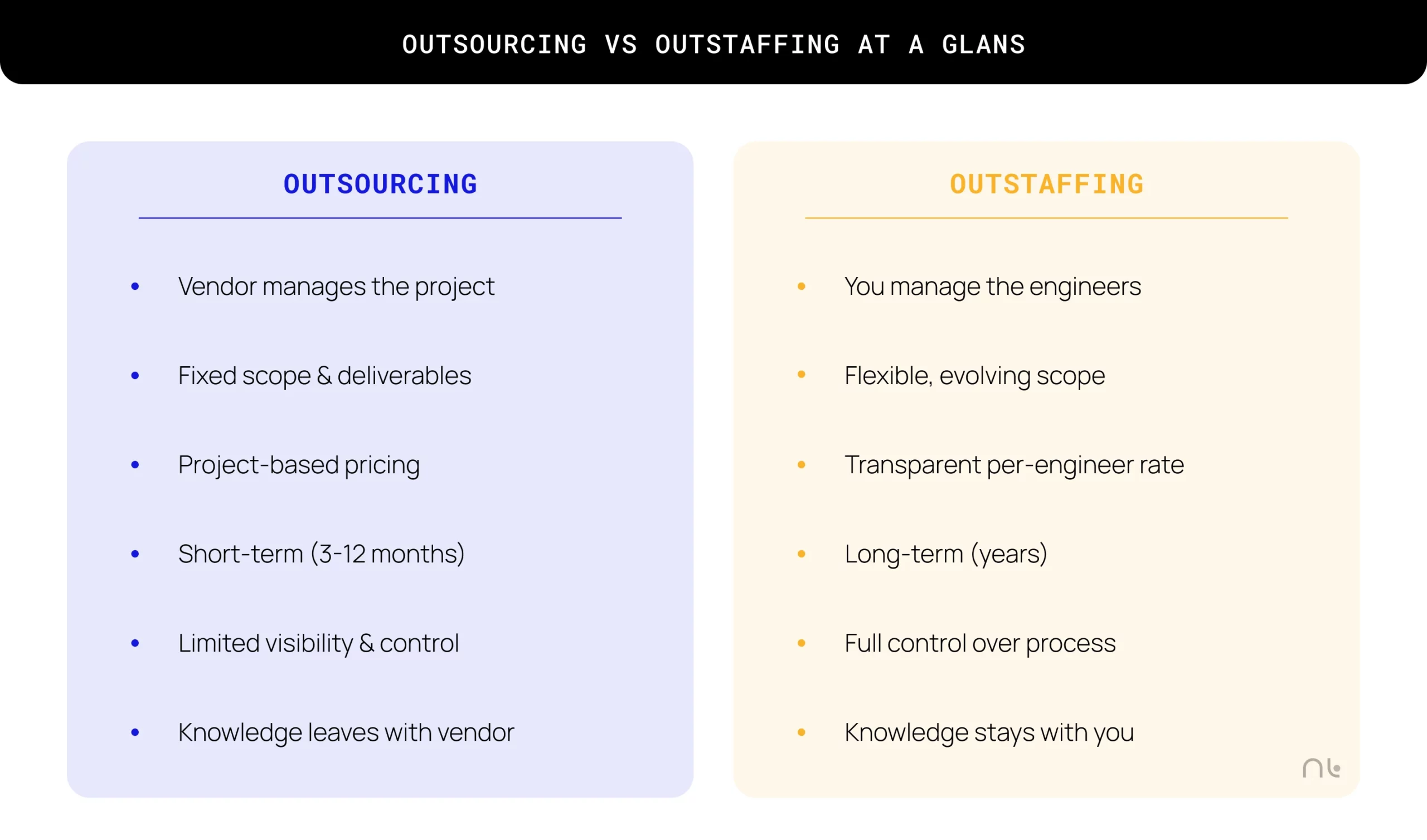
When comparing IT outsourcing vs IT outstaffing, the differences go beyond surface-level definitions. To truly understand outstaffing and outsourcing, you need to look at the dimensions that matter most to decision-makers.
| Dimension | Outsourcing | Outstaffing |
| Project control | Managed by the vendor. You provide requirements and review deliverables. | Managed by you. Engineers report directly to your team leads. |
| Team integration | Separate team. Limited interaction with your internal staff. | Fully integrated. Engineers join your standups, use your tools, follow your processes. |
| IP and knowledge | IP is yours contractually, but knowledge leaves with the vendor when the project ends. | IP and knowledge stay with your team. Engineers build context over time. |
| Legal and admin | Vendor handles everything. You have a single contract. | Outstaffing provider handles employment, payroll, taxes, and compliance. No legal entity needed. |
| Cost structure | Fixed price or milestone-based. Vendor margin included in the price. | Transparent per-engineer rate. You see exactly what you are paying for. |
| Best for | Short-term projects, non-core work, clearly defined deliverables. | Long-term team building, scaling capacity, retaining IP, maintaining control. |
| Flexibility | Scope changes require contract renegotiation. | You can shift priorities as often as needed. The team adapts in real time. |
| Duration | Typically project-based (3 to 12 months). | Ongoing. Many outstaffing engagements run for years. |
The comparison reveals a pattern. If your primary need is getting a defined piece of work completed without building internal capacity, outsourcing serves that purpose. If your goal is to grow your engineering team with people who think, work, and communicate like your own employees, outstaffing is the stronger fit. Understanding the nuances of outsourcing and outstaffing at this level of detail is what separates a successful engagement from a costly misstep.
This is one of the most common questions decision-makers ask when evaluating outstaffing and outsourcing cost structures, and the answer is not as straightforward as most vendors would have you believe.
With outsourcing, you typically pay a project fee that includes not only the engineers’ time but also the cost of project management, QA, internal coordination, and the vendor’s profit margin. The per-hour cost may look competitive on paper, but the total cost of the project often ends up higher than expected, especially when scope changes trigger additional charges.
With outstaffing, you pay a monthly rate per engineer. That rate covers the engineer’s salary and the provider’s fee for administrative services (legal, HR, payroll, etc.). Because the cost structure is transparent, you can model your budget accurately. There are no hidden project management fees, no surprise charges for scope changes, and no markup on services you did not request.
Based on Newxel’s internal cost analysis across 20+ client engagements between 2022 and 2025, companies that transitioned from outsourcing to outstaffing for ongoing development work saw a 20% to 35% reduction in their total monthly engineering spend, while gaining more control over priorities and higher retention of institutional knowledge.3
The real cost comparison, though, is not just about the monthly bill. It is about the total cost of knowledge. When an outsourcing engagement ends and a new one begins, the new vendor has to learn your codebase from scratch. That ramp-up cost is invisible but very real. With a stable outstaffed team, knowledge accumulates and compounds over time, making every subsequent sprint more efficient than the last.
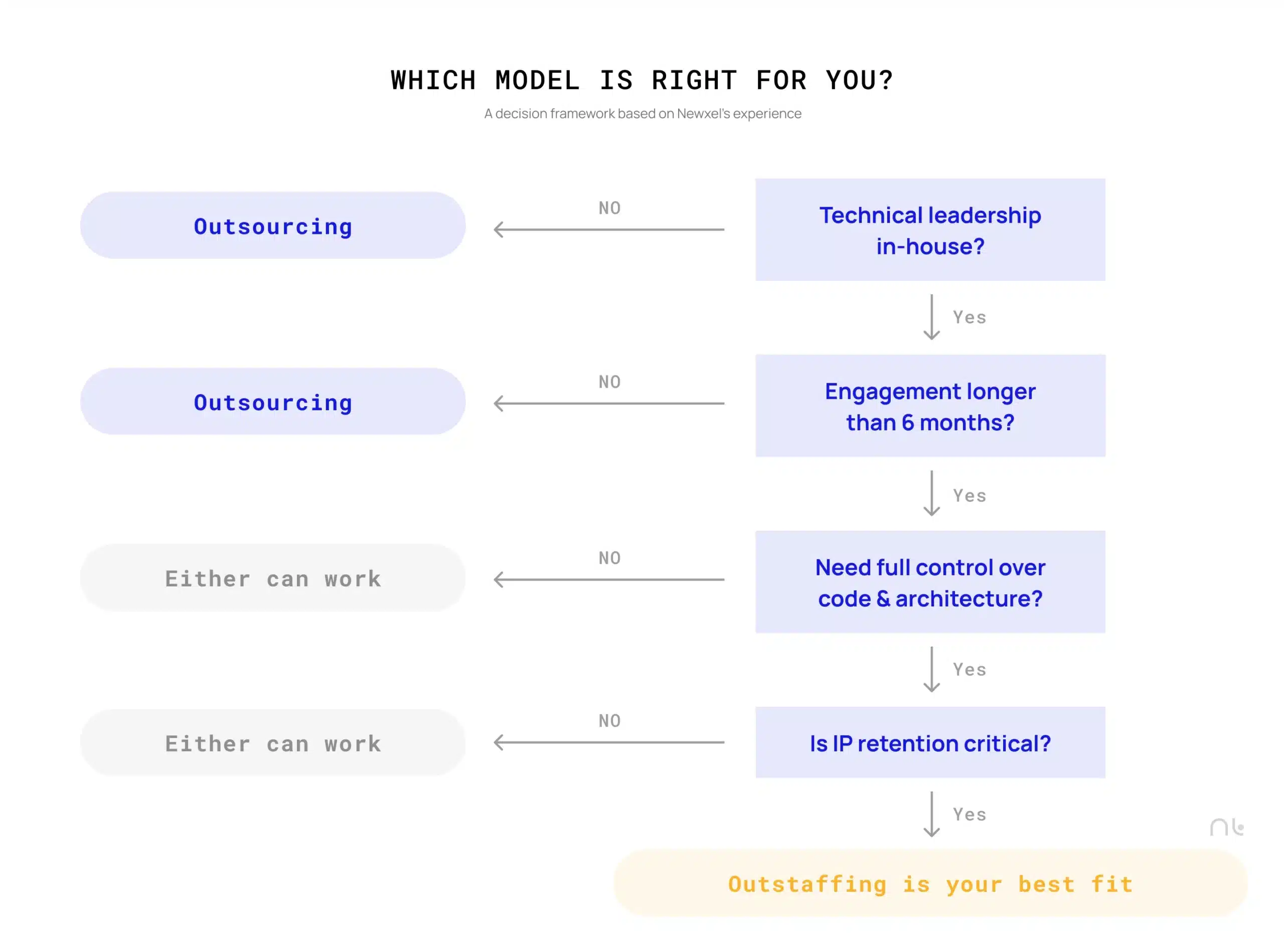
When it comes to outstaffing vs outsourcing, there is no universal answer to which is better. The right choice depends on your specific situation. Here is a framework we have developed at Newxel based on working with technology companies across 8 years.
If you have a CTO, a VP of engineering, or strong tech leads who can direct engineering work on a daily basis, outstaffing will serve you well. If you do not have technical management and cannot provide day-to-day direction, outsourcing may be the safer starting point.
For a one-off project with a clear end date (say, 3 to 6 months), outsourcing can work. For anything longer, and especially for ongoing product development, outstaffing is almost always the better investment. The longer the engagement, the more value you extract from having engineers who deeply understand your product.
If you are building a core product and need to direct every sprint, every architecture decision, and every code review, you want outstaffing. If you are delegating non-core work and care primarily about the outcome, outsourcing may be sufficient.
Fixed-budget, fixed-scope projects lend themselves to outsourcing. If your budget is structured around monthly engineering headcount costs (which most product companies use), outstaffing aligns better.
If IP retention is critical, and for most technology companies it is, outstaffing reduces risk. The engineers become part of your team, the knowledge stays with you, and you are not dependent on a vendor to transfer documentation at the end of a project.
We see a clear pattern across our client base as they weigh outstaffing and outsourcing options. Here are 3 scenarios drawn from real engagements (details changed for confidentiality):
Scenario A: A Series B fintech startup in Tel Aviv had a strong backend team but needed 3 React Native engineers for a new mobile product. They initially considered outsourcing the mobile app to a vendor. After we walked them through the tradeoffs, they chose outstaffing instead. The reason? Their product requirements were evolving week to week as they tested with early users, and they needed engineers who could pivot on a day’s notice. 9 months later, those 3 engineers are still on the team and have shipped 4 major releases.
Scenario B: A large enterprise needed to build a data analytics dashboard that would be used internally but was not part of their core product. The requirements were well-defined and unlikely to change. They chose outsourcing, and the project was delivered on time and on budget. The model was the right fit because the scope was fixed and the deliverable was clear.
Scenario C: A mid-stage SaaS company in the US was paying premium rates for local contractors who kept rotating off the project. Every new contractor needed weeks to get up to speed on the codebase. The company was spending more on ramp-up costs than on productive development. They switched to outstaffing through Newxel, hired 4 engineers who committed to long-term engagement, and within 3 months their velocity doubled. The engineers understood the product, contributed to architecture discussions, and started mentoring newer team members.
Explore how Newxel set up IT Outstaffing services in Ukraine.
There are many outstaffing providers in Eastern Europe. The region now accounts for nearly 40% of the global software outsourcing market,4 with Poland, Ukraine, and Romania leading the way. So what makes one provider different from another?
The honest answer is that the quality gap between providers is enormous, and it is not always visible from the outside. Here is what we do differently at Newxel, and why it matters for your results.
End-to-end administrative support
When we say we handle the administrative burden, we mean all of it. Legal compliance with local labor law, employment contracts, payroll processing, tax filings, office space or remote work infrastructure, equipment procurement. If an engineer needs a new laptop, we handle it. If there is a question about local employment regulation, our legal team resolves it. You never have to think about any of this.
This matters more than it sounds. We have seen companies try to set up direct employment in Eastern Europe on their own, and the legal and administrative complexity catches them off guard every time. Different countries have different labor codes, tax structures, and compliance requirements. A single misstep can result in fines, back taxes, or employment disputes. Newxel eliminates that risk entirely.
Hiring for cultural fit, not just technical skills
Any staffing company can send you resumes of engineers who pass a coding test. That is the easy part. The hard part is finding people who will actually work well with your team.
At Newxel, every candidate goes through a multi-stage evaluation that includes technical assessment, English proficiency, communication skills, and cultural fit. We look at how they collaborate, how they handle feedback, how they communicate uncertainty, and whether their working style aligns with your team’s norms. In our experience, the engineers who fail in remote engagements almost never fail because of technical skill. They fail because of communication gaps or cultural misalignment. Our screening process is designed specifically to prevent that.
Active onboarding and integration support
We do not hand you a resume and disappear. Once you select an engineer, Newxel outstaffing company works actively with both sides to make the first weeks productive. We facilitate introductions, help establish communication cadences, and check in regularly during the first 90 days to catch any friction early.
We also coordinate on logistics that clients often underestimate: setting up access to tools and repositories, aligning work hours, establishing status reporting formats, and making sure the new team member has context on the product, the team structure, and the development workflow. These details sound small, but they make the difference between an engineer who feels like part of the team from day one and one who spends the first month feeling like an outsider.
Ongoing HR care and retention
Keeping great engineers is harder than finding them. Newxel invests in retention because turnover destroys the knowledge continuity that makes outstaffing valuable and beneficial. We offer competitive compensation benchmarked against the local market, professional development budgets, and regular satisfaction reviews. Our team maintains a direct relationship with every outstaffed engineer, making sure they feel supported and engaged, not just placed and forgotten.
This is why our retention rate sits at 98%. It is not an accident. It is the result of deliberate investment in the people who make our clients’ projects succeed.
Eight European hiring hubs
Newxel IT outstaffing operates across 8 locations in Eastern Europe, which gives us access to a broad and diverse talent pool. If you need a specific skill set that is rare in one country, we can source from another without starting a new vendor relationship. This geographic reach also means we can build teams with time zone overlap that suits your working hours, whether you are based in the US, the UK, or Israel.
Based on the questions our clients ask during sales calls and the search queries we see in the market, here are the most common outstaffing vs outsourcing topics, answered with the depth they deserve.
Is outstaffing the same as staff augmentation?
Yes, in practice these terms refer to the same model. Outstaffing is the term more commonly used in Eastern Europe and the CIS region, while staff augmentation is the preferred term in North America and Western Europe. The mechanics are identical: you bring in engineers through an external provider, they work under your management, and the provider handles employment logistics. At Newxel, we use both terms interchangeably depending on the audience.
Can I combine outsourcing and outstaffing?
Absolutely, and some of our clients do exactly this. A common pattern is to outsource a specific standalone project (like a mobile app or an integration module) while outstaffing engineers for your core product team. The key is to be intentional about which work goes where. Core product development that requires ongoing iteration, deep product context, and close collaboration with your team should be outstaffed. Discrete, well-scoped projects with clear deliverables can be outsourced. The ability to combine outsourcing and outstaffing gives companies the flexibility to match the right model to each type of work.
How do I protect my intellectual property with outstaffed engineers?
IP protection in outstaffing is actually stronger than in outsourcing, for 2 structural reasons. First, the engineers are working exclusively on your project, so there is no risk of shared resources or cross-pollination with other clients’ codebases. Second, you retain direct control over access permissions, code repositories, and security protocols, just as you would with any internal employee. At Newxel, every engagement includes NDAs and IP assignment agreements that cover all parties. We also support clients in implementing their own security policies across the outstaffed team.
What happens if an outstaffed engineer leaves?
This is a legitimate concern, and the answer depends heavily on your provider’s retention practices. With a provider that treats engineers as replaceable commodities, turnover is a real risk. With Newxel, turnover is rare (our 98% retention rate speaks for itself), but when it does happen, we begin sourcing a replacement immediately and work with your team to make the handoff as clean as possible. The key is that we maintain a continuous pipeline of vetted candidates, so you are never starting from zero.
How quickly can I scale an outstaffed team?
At Newxel, we typically present qualified candidates within 2 to 3 weeks of receiving a role brief. Onboarding and integration take an additional 1 to 2 weeks depending on the complexity of your tech stack and the level of the role. For urgent needs, we can sometimes accelerate this timeline by drawing from our existing talent network. Scaling down is equally straightforward: you are not locked into long-term contracts that force you to keep engineers you no longer need.
Is outstaffing only for large companies?
Not at all. In fact, the IT outstaffing model can be even more valuable for startups and mid-size companies that cannot afford to hire senior engineers at US or Western European rates but still need top-tier talent. Many of Newxel’s clients are Series A through Series C startups that use outstaffing to build their entire engineering function at a fraction of the cost of local hiring, without sacrificing quality.
After working with hundreds of clients, we have noticed a set of questions that separates experienced buyers from first-timers. These are the questions that protect you from mistakes.
What is the provider’s actual retention rate, and how do they measure it? A lot of providers claim high retention without providing specifics. Ask for the number, the methodology, and the time period it covers. If they cannot give you a straight answer, that tells you something.
What happens during the first 90 days? The onboarding period is where most outstaffing engagements succeed or fail. Ask the provider exactly what they do to support integration during this window. If the answer is “we introduce the engineer and then step back,” that is a red flag. You want a provider who stays actively involved during the critical early weeks.
How does the provider handle underperformance? No screening process is perfect. What matters is what happens when an engineer is not meeting expectations. Does the provider have a performance improvement process? Can you replace someone without penalty? At Newxel, we address performance concerns proactively and will facilitate a replacement if needed, with no disruption to your project timeline.
What is included in the monthly rate, and what is extra? Some providers quote a low rate and then add charges for equipment, office space, HR support, or even onboarding. Make sure you understand the full cost picture before committing. At Newxel, our rate includes everything: salary, administrative services, equipment, and workspace. There are no hidden fees.
The global IT outsourcing market is projected to grow at 8.28% annually through 2029,5 and Eastern Europe is capturing an outsized share of that growth. Poland, Ukraine, Romania, and Bulgaria collectively represent nearly 40% of the global software outsourcing market in 2025.6
There are structural reasons for this. Eastern European engineers are known for strong computer science fundamentals, typically holding university degrees in STEM fields from institutions with demanding curricula that emphasize math and algorithms. English proficiency is high and improving year over year. Time zone overlap with Western Europe is full, and with the US East Coast there are 4 to 6 hours of shared working time, which is enough for real-time collaboration while also enabling asynchronous productivity.
Compensation in the region remains significantly lower than in the US or Western Europe, but this is not about “cheap labor.” The cost advantage exists because of differences in local cost of living, not because of lower quality. The engineers you hire through an Eastern European outstaffing provider are working at the same level of skill and professionalism as their counterparts in Silicon Valley or London. You are simply paying a fair rate for the local market rather than an inflated rate driven by a housing crisis in San Francisco.
Meanwhile, the talent shortage in the US and Western Europe continues to intensify. ManpowerGroup’s 2025 survey found that IT and data skills are among the hardest to fill globally,7 and 90% of companies now recognize cloud computing as a critical enabler of their outsourcing strategy.8 These trends are pushing more companies to evaluate outsourcing and outstaffing models beyond their local markets, and Eastern Europe is where many of them land.
The outstaffing and outsourcing debate is important, but it is not the only decision you need to get right. The model you choose sets the structure. The partner you choose determines the outcome.
If you are building a core product, if you need engineers who will stay with you for the long haul, if you want full control over your development process, and if you are looking for a partner who handles the administrative complexity of international hiring so you can focus entirely on building great software, outstaffing is the model that fits. And Newxel is built to deliver exactly that.
We have been doing this since 2017. We operate across 8 European hiring hubs. We put the same effort into evaluating cultural fit as we do into technical screening. We do not stop at hiring. We support onboarding, integration, retention, and every administrative detail in between.
If you are evaluating whether outstaffing could work for your team, we are happy to walk you through what an engagement would actually look like for your specific setup, including timeline, cost structure, and the kind of talent available for your stack. Reach out whenever it makes sense.
Get in touch with Newxel expert for more details.
References
1 Statista, IT Outsourcing market worldwide, 2025 forecast. https://www.statista.com/outlook/tmo/it-services/it-outsourcing/worldwide
2 ManpowerGroup, 2025 Talent Shortage Survey, January 2025. https://go.manpowergroup.com/talent-shortage
3 Newxel internal data. Cost analysis based on 20+ client engagements (2022–2025) comparing monthly engineering spend before and after transitioning from outsourcing to outstaffing for ongoing product development.
4 Dreamix, 2025 Software Outsourcing Market Size by Country. Eastern Europe collectively represents nearly 40% of the global software outsourcing market. https://dreamix.eu/insights/2025-software-outsourcing-market-size-by-country/
5 Statista, IT Outsourcing market, projected CAGR 8.28% annually from 2025 to 2029. https://www.statista.com/outlook/tmo/it-services/it-outsourcing/worldwide
6 Dreamix, 2025 Software Outsourcing Market Size by Country.
7 ManpowerGroup, 2025 Global Talent Shortage Survey. IT & Data, Engineering, and Sales & Marketing among hardest-to-fill skills. https://go.manpowergroup.com/talent-shortage
8 Deloitte Global Outsourcing Survey, 2025. 90% of surveyed companies listed cloud computing as a key enabler of outsourcing.