How to Build an Offshore Team for AI Development
22 min
· April 2, 2026
Most companies discover the AI talent problem the hard way. They post an ML engineer role on LinkedIn, wait 6 weeks, and watch the 2 qualified candidates who made it through screening take counteroffers from companies with deeper pockets. The product roadmap stalls, the role stays open, and someone on the leadership team starts wondering whether there’s a fundamentally different way to staff this.
The numbers tell a consistent story. IDC research projects that over 90% of global enterprises will face critical skills shortages by 2026, with AI roles hit harder than any other technical discipline. McKinsey’s global survey found 87% of companies either face AI skill gaps right now or expect them within 2 years. And Gartner’s analysis showed that while nearly 90% of organizations use AI in some form, only 9% have reached what they’d call true AI maturity. There’s a massive distance between wanting to do AI and being able to put the right people on it.
For a growing number of companies, building an offshore AI development team has shifted from cost conversation to a staffing necessity. But setting up an offshore team for AI and ML work is a genuinely different exercise from spinning up a remote frontend or backend group.
We’ve built dozens of offshore engineering teams across European talent hubs at Newxel, and the patterns that come out of that experience look nothing like what most guides describe. This article covers how offshore AI teams work operationally, where companies get stuck, and why some teams ship production models while others never graduate from notebook experiments.
The terminology around offshore AI teams is messy enough to cause real confusion, so it’s worth being precise.
An offshore AI development team is a group of AI and ML specialists who work as a dedicated extension of your company, employed full time, reporting into your engineering or product org, using your tools, pushing to your repos. The “offshore” part is just geography: they sit in a different country, usually somewhere with a deeper talent pool or more favorable economics. What makes it an AI team is the role composition: data scientists, machine learning engineers, MLOps specialists, and data engineers, not general-purpose developers who picked up a TensorFlow tutorial.
The distinction from outsourcing plays out differently for AI work than for general software. Outsource an AI project and you hand requirements to a vendor, then wait for deliverables. The vendor picks the frameworks, decides how to structure the data pipeline, and allocates whoever’s available. You don’t see how the model was trained or what tradeoffs got made along the way.
With a dedicated offshore team, you own all of it. The team is yours. They attend your standups, push to your repos, and build on your infrastructure. For AI projects, where iteration cycles are long and the gap between a working notebook prototype and a production model can be months of engineering, that level of integration is the entire reason you’d go this route instead of outsourcing.
If you’ve hired software engineers before, the surface mechanics of building an AI team will feel familiar: post roles, screen candidates, run technical interviews, onboard. But underneath that familiar process, the dynamics work differently in ways that catch people off guard. Companies that approach AI hiring the way they’d hire for a backend team tend to burn through months wondering why nothing’s clicking.
In standard software development, if you assign a competent engineer to build a login page, you will get a login page. Maybe it will take longer than estimated. Maybe the code needs refactoring. But the outcome is predictable. In ML, you can invest 3 months of a data scientist’s time into a recommendation model and discover that the available data simply doesn’t support the accuracy you need. That’s not failure; that’s how the discipline works. ML development is exploratory. The teams you build need room to run experiments that don’t pan out, because that’s where the learning happens.
Most companies that struggle with AI think they have a talent problem. Often, they have a data problem wearing a talent mask. Your newly hired data scientist can’t build a fraud detection model if the transaction data is spread across 4 systems, none of which have consistent schemas, and half the labels are wrong. Before hiring an offshore ML team (or any ML team), the question isn’t whether you can find good people. It’s whether your data infrastructure can support the work they’d be doing.
A lot of companies trip up on this distinction. A data scientist who can build an excellent model in a Jupyter notebook is doing different work from an ML engineer who can take that model, optimize it for inference speed, wrap it in an API, and deploy it with monitoring. Some people span both roles, but most don’t, and the expectation that a single hire will do research and production work is one of the most common staffing mistakes in AI.
Training a model isn’t like compiling code. A single training run might take hours, sometimes days, depending on dataset size and what you’re trying to do. Then there’s feature engineering on top of that. Hyperparameter tuning. Retraining after data updates. Each of these adds weeks to a cycle, not days. If your company is used to 2-week sprints where every sprint ends with something shippable, you’ll need to recalibrate those expectations pretty significantly. AI teams work in longer arcs, and sprint velocity is the wrong lens for measuring whether they’re making progress.
An AI team looks nothing like a standard engineering squad in its composition, and getting the role mix wrong early on is expensive. Here’s how the roles break down in practice.
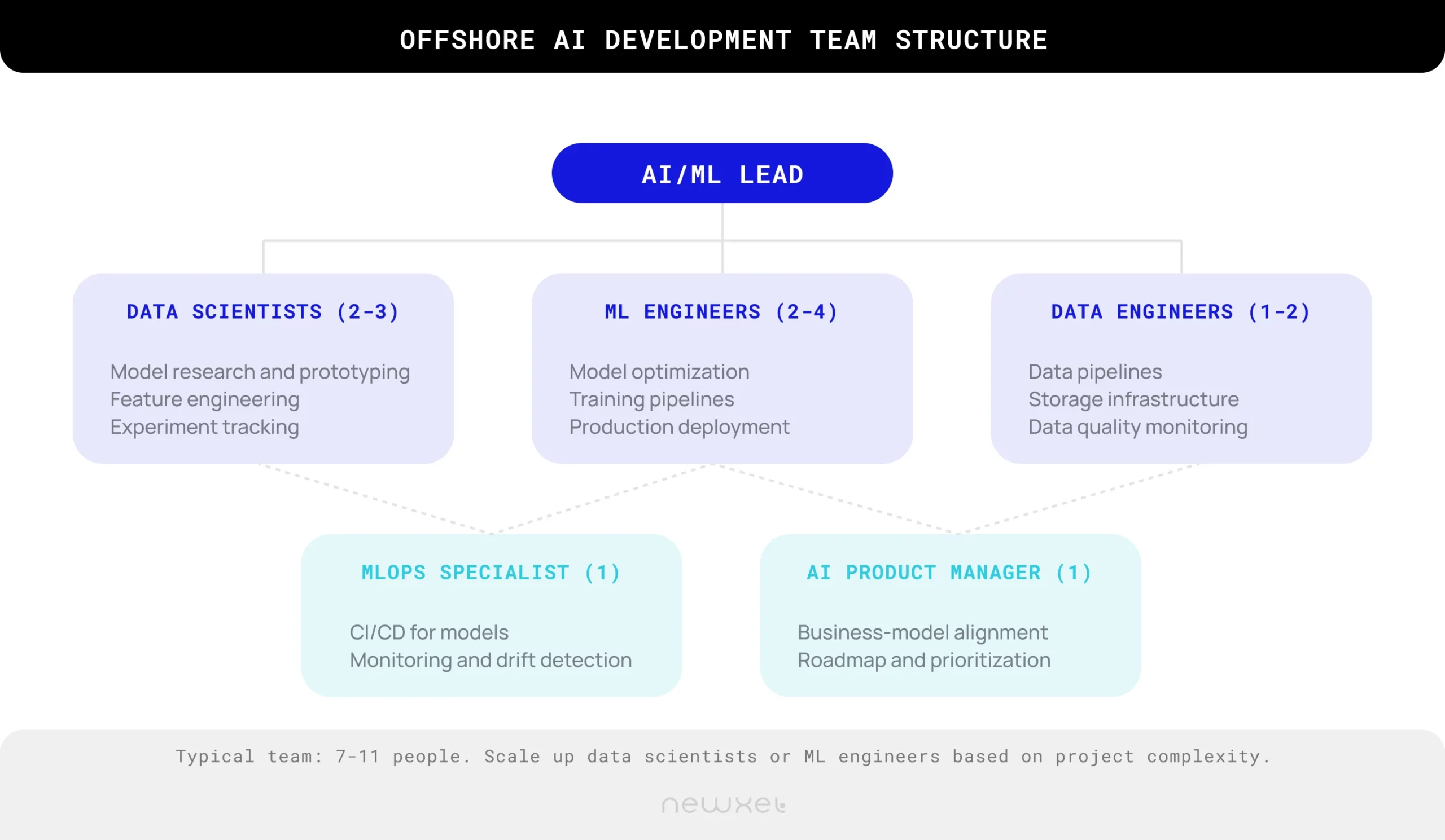
Offshore AI development team structure showing data scientists, engineers, and MLOps roles
These are the people who define the modeling approach, run experiments, engineer features, and evaluate whether a particular ML technique can solve the business problem at hand. In a well functioning offshore AI team, they spend most of their time in notebooks and experiment tracking tools, not in production code. Their output is validated hypotheses, not deployed models.
ML engineers are the ones who take a model out of a notebook and get it running in production. That means optimizing performance, building training pipelines, handling model versioning. They also write the inference code that serves predictions in real time. On most teams we’ve built, this is the bottleneck role. Good ML engineers who can move between research and production contexts are extremely scarce. PwC’s 2025 AI Jobs Barometer found that AI-exposed roles command an average 56% wage premium over comparable positions, and the engineering side of ML sits at the top of that pay scale.
Data engineers build the plumbing. They’re the ones setting up the pipelines that feed data into training and inference, managing where and how that data is stored, keeping an eye on data quality. It’s not glamorous work, but without it your data scientists will spend something like 70% of their time wrangling CSVs and debugging schema mismatches instead of building models. We’ve found that one of the most reliable early warning signs for an AI team that’s going to underperform is missing data engineering support.
MLOps sits somewhere between ML engineering and DevOps, and it’s the role most companies forget to hire for until it’s too late. The work involves building CI/CD pipelines that can deploy models (which is different from deploying regular software), setting up monitoring so you catch model drift before customers do, and automating retraining so your predictions don’t slowly degrade while nobody notices. For some context on how underserved this function is: the MLOps market is projected to grow from about $4 billion in 2025 to nearly $90 billion by 2034. If your offshore AI team doesn’t have someone in this role, expect your models to get stuck in staging.
The AI PM is the person who keeps the AI team’s work connected to what the product org needs. In practice, that means translating business requirements into modeling objectives (which is harder than it sounds, because product people and data scientists often speak completely different languages about what “good” looks like). It also means prioritizing which experiments to run and managing expectations, since ML timelines are inherently less predictable than software timelines. In most hybrid setups we see at Newxel, the AI PM sits onshore, close to the product org, but talks to the offshore team daily.
The typical team size for a functional offshore ML team is 7 to 11 people. Smaller teams struggle to cover the full lifecycle from data to deployment. Larger teams introduce coordination overhead that needs its own management layer.
Before we get into the step-by-step of how to build an offshore AI team, it helps to understand what the work itself looks like day to day. Because the lifecycle of an AI project is fundamentally different from standard software, and if you structure your team without understanding this lifecycle, you’ll hire the wrong mix of people.
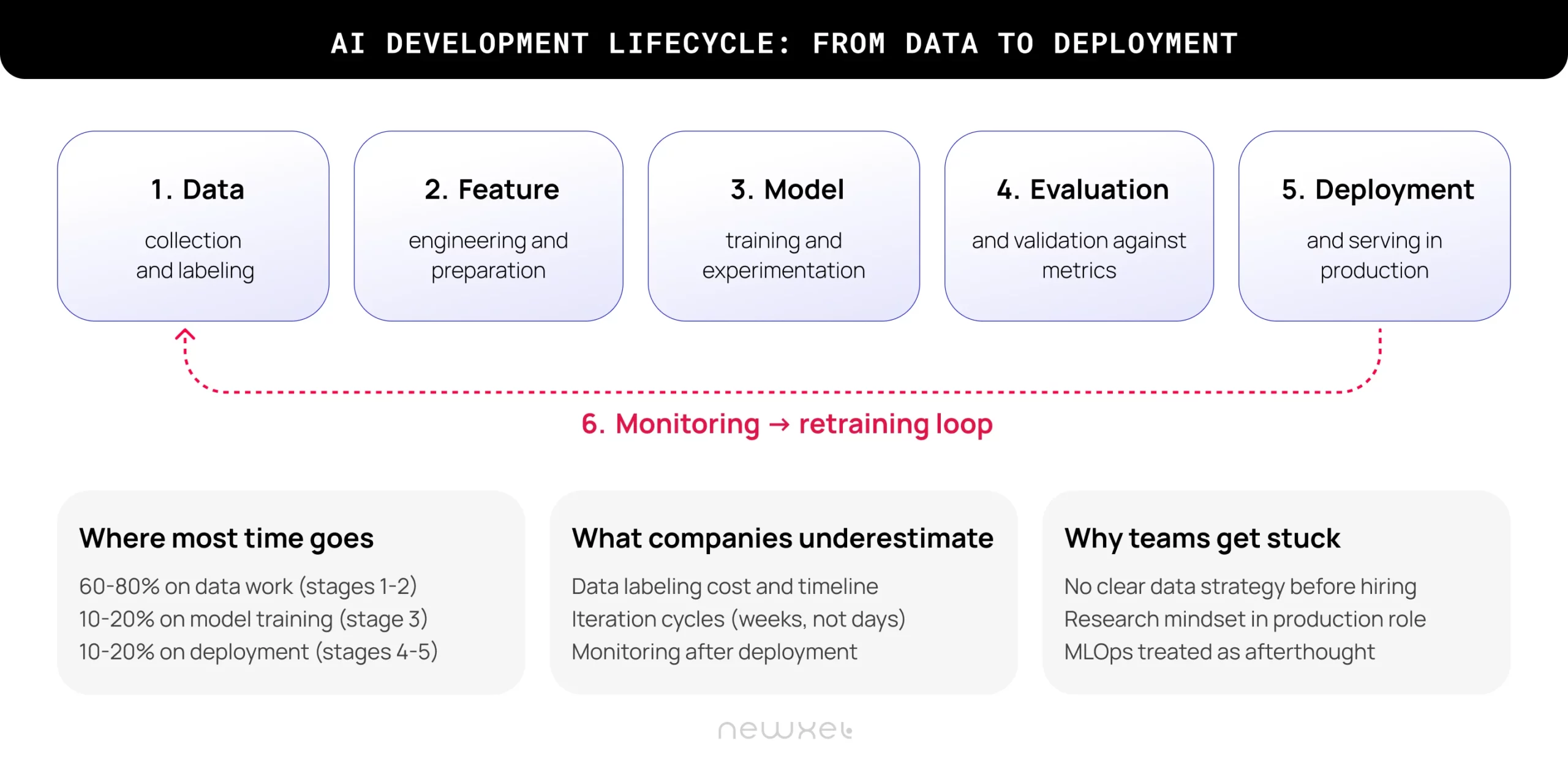
AI development lifecycle from data collection to model deployment and monitoring
The image above shows the standard flow, but what diagrams don’t capture is that in practice, AI teams spend 60 to 80% of their time in stages 1 and 2, data collection and feature engineering. The modeling itself, the part that gets all the attention, usually occupies 10 to 20% of the effort. And deployment plus monitoring, the part that determines whether the model creates business value, is where most teams stall.
The role mix drives all of this. If you staff an offshore team with 4 data scientists and no data engineers or MLOps people, you’ll produce a lot of interesting experiments and very few production models. We’ve seen this pattern repeatedly across client engagements at Newxel: the companies that ship real AI products are the ones that invest as heavily in the engineering and operations side as they do in the research side.
This framework comes from dozens of AI team builds at Newxel, for companies ranging from seed stage startups to established software businesses expanding into ML.
It sounds obvious, but a surprising number of companies come to us saying they want to build an AI team without being able to articulate what that team will work on in the first 6 months. “We want to use ML” is not a hiring brief. “We need a recommendation engine for our e-commerce platform that can process 50,000 daily transactions and improve conversion by 10%” is a hiring brief. The specificity of your business objective determines the skills you need, the team size, and the seniority mix.
Before building an offshore machine learning team, do a hard assessment of your data. Is the data you need for your use case available? Is it labeled? Is it stored in a format and system that ML pipelines can access? Is there enough of it? Companies that skip this step hire data scientists who then spend their first 3 months discovering that the data doesn’t exist or isn’t usable. A 2 week data audit, often done by a senior data engineer or consultant, can save you 6 months of misallocated team effort.
There are 3 common models for structuring AI teams, and each works differently with offshore setups.
Centralized AI team works as an internal service. Product teams submit requests, and the AI team prioritizes and executes. This model works when you have multiple AI use cases across the organization but want consistent standards. It’s the easiest model to run offshore because the team operates semi-autonomously.
Embedded AI team places ML engineers directly into product squads. This gives each product team its own AI capability but requires more coordination and makes the offshore model harder because the ML people need to integrate with onshore product teams on a daily basis.
Hybrid model keeps an AI lead and AI PM onshore while placing the execution team (data scientists, ML engineers, data engineers, MLOps) offshore. This is by far the most common structure we see working at Newxel. Onshore leadership maintains alignment with business goals. The offshore team does the building.
At this stage, the question of outsourcing vs building a dedicated offshore team becomes a practical decision. Outsourcing can work for projects with a clear finish line, where you can write specs upfront and the team doesn’t need to be deeply embedded in your product. If someone needs a chatbot wrapper around a 3rd-party API, outsourcing is probably fine for that.
But proprietary models are a different story. If you’re working with sensitive data, if the AI capabilities you’re building will be core to your product for years, the knowledge that builds up inside that team becomes organizational knowledge. Domain understanding, the specific quirks of your data, which features turned out to matter and which didn’t. When an outsourced engagement wraps up, all of that walks out the door with the vendor’s people.
Integration is where offshore AI teams either work or don’t, and it has less to do with tools than with habits.
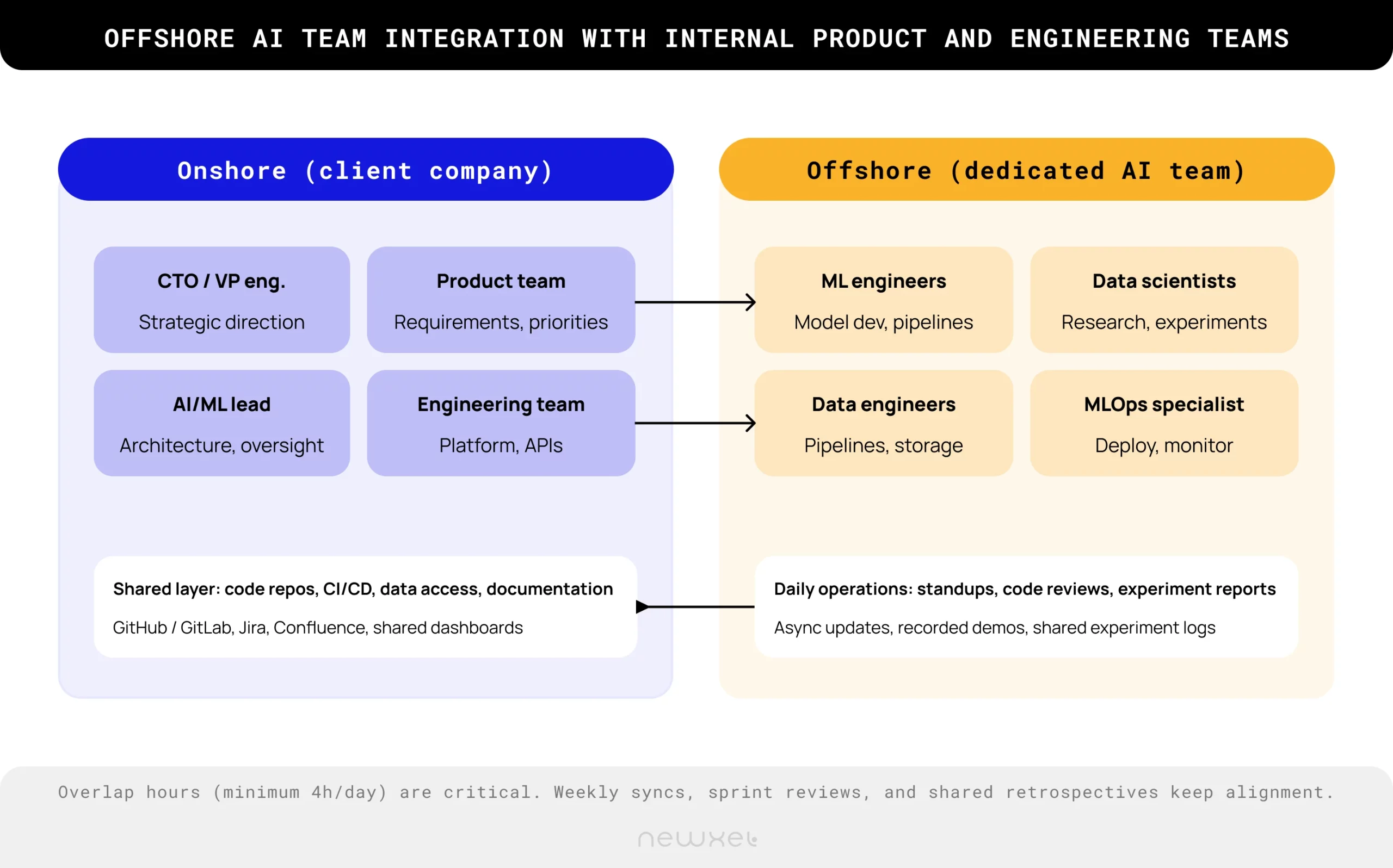
Offshore AI team integration with internal product and engineering teams
4 hours of overlapping working time per day between onshore and offshore is the non-negotiable minimum. What you do with that overlap matters more than the tools you use. We recommend a daily standup or at least an async status update. Shared access to whatever experiment tracking tool the team uses, whether that’s MLflow or Weights & Biases or something else. A weekly model review where data scientists walk through what they tried and what they found. And some kind of shared wiki or knowledge base where the team captures data assumptions and modeling decisions, because those details get lost fast when people work in different time zones.
The biggest integration failure we see, by far, is when companies treat the offshore team as a delivery shop. The onshore AI lead assigns work, then checks back in a week later. What you get is technically correct output that misses the product context. Offshore AI teams that work well operate as a single unit with their onshore colleagues, not as 2 separate groups lobbing deliverables across a wall.
Managing ML teams is different from managing software engineering teams and doing it across time zones adds another layer of complexity.
Synchronous standups are fine for status updates, but the most valuable conversations on an AI team are about experimental results, data anomalies, and modeling tradeoffs. These need longer format, and they need to happen regularly. We’ve found that a weekly 60-to-90-minute model review, where data scientists walk through their experiment logs and the team discusses what to try next, is the single most impactful meeting an offshore AI team can have. Everything else can be async.
Standard velocity metrics don’t work for ML. Sprint points completed tell you nothing about whether the model is getting better. What you want to track instead is closer to this: how many experiments did the team run this week? Is the primary evaluation metric improving over time, even slowly? How long does it take to get a validated model from staging into production? And what percentage of models ever make it to production at all versus staying in notebooks forever? These are lagging indicators, so don’t expect weekly wins. Monthly or quarterly reviews are more appropriate for judging whether an offshore ML team is producing value.
Good AI teams, the ones we’ve seen ship consistently, run structured experiments with a clear hypothesis before they start, a tracking tool that logs what they tried and what happened, and defined success criteria so there’s no ambiguity about whether an experiment worked. For offshore teams this matters even more, because it creates a transparency layer across the time zone gap. If your onshore AI lead can open an experiment tracker Monday morning and see exactly what the offshore team tested last week, why they chose those experiments, and what the results mean for next steps, the distance stops feeling like a communication problem.
We hear this question in almost every initial conversation with companies exploring AI offshore development, and the differences show up most clearly across a few specific dimensions.
Control over process. When you outsource, the vendor picks the frameworks, decides how to set up the data pipeline, makes training tradeoffs you may never hear about. With your own offshore team, those decisions stay with you. In AI work, where a small choice during model training (say, how you handle class imbalance or which features to include) can move accuracy by 10 percentage points, that control matters more than it would on a typical software project.
Knowledge retention. AI projects build up institutional knowledge in ways that software projects don’t. Think about a recommendation model: its performance depends on someone understanding your specific user behavior data, knowing that one particular data pipeline has a 3 hour lag on weekends, remembering which domain-specific features turned out to matter and which looked promising but didn’t. An outsourced team takes all of that context with them when the contract is done. A dedicated team keeps it, and it compounds over time.
Integration depth. Outsourced AI work typically happens on the vendor’s infrastructure, with periodic deliverables. A dedicated offshore team works on your infrastructure, in your repos, with your monitoring tools. When something breaks in production at 2 AM, they have the context and access to debug it.
Cost structure. Outsourcing looks cheaper on paper because you pay per project. But AI projects are rarely one-and-done. They involve ongoing retraining, data pipeline maintenance, and model monitoring. The total cost of a series of outsourced engagements over 2 to 3 years typically exceeds the cost of a dedicated team that builds cumulative expertise.
We usually tell clients something like this: if the AI work is going to be core to your product and you’ll need people on it for years, build a dedicated team. If it’s a 1-off analytics project, or you’re testing whether an ML approach is even viable before committing headcount, outsourcing can be a reasonable starting point. But be honest with yourself about which category you’re in, because most companies that start by outsourcing AI work end up needing to rebuild everything when they bring it in-house later.
These come up repeatedly.
“We want to use TensorFlow” or “we want to build with LLMs” is a tool decision, not a problem definition, and we see it all the time. A company picks the technology first, then tries to find a business problem to justify it. What you end up with is a team building something that looks impressive in a demo but doesn’t move any metric the business cares about. Start from a concrete product problem or an operational pain point. Let the team figure out which tools fit.
We mentioned this earlier but it’s worth repeating because of how often we see it. A company hires 3 data scientists and doesn’t have a data pipeline yet, no labeled datasets, no clear data governance policy. Those data scientists spend their first quarter frustrated, doing work that a data engineer should be doing, and the company wonders why there’s no model in production. The data infrastructure needs to be in place before you hire the people who’ll use it.
Some companies assume that finding the right offshore AI specialists is the hard part and everything else falls into place. It doesn’t. Plan for 2 to 3 months of real onboarding. That means giving the team access to every system they’ll need, walking them through how your data works (and where it’s broken), explaining the business context behind the product, and building the collaboration habits that will keep things running later. Shortcutting onboarding saves a few weeks now and costs you months of rework down the line.
You see this when companies apply the same sprint cadence as the web team, same estimation methods, same definition of “done.” It creates friction that never goes away, because ML work doesn’t fit that mold. Some weeks you’re running experiments that produce negative results, and negative results in ML are valuable information, not wasting time. Story points don’t capture that. Adapt your project management approach to how ML work moves before you start wondering why the team seems slow.
This may be the most expensive mistake on the list. Plenty of companies build offshore AI teams with data scientists and ML engineers, get a model working in a notebook, and then discover that nobody knows how to deploy it, monitor it, or retrain it when the data changes. MLOps is the function that determines whether your AI work produces business results or stays in a research sandbox and treating it as a luxury you add later is how models get stuck.
Building an offshore AI team involves a lot of moving parts beyond finding the right people. Newxel handles the operational side so companies can focus on what their AI team builds rather than the logistics of how it runs day to day.
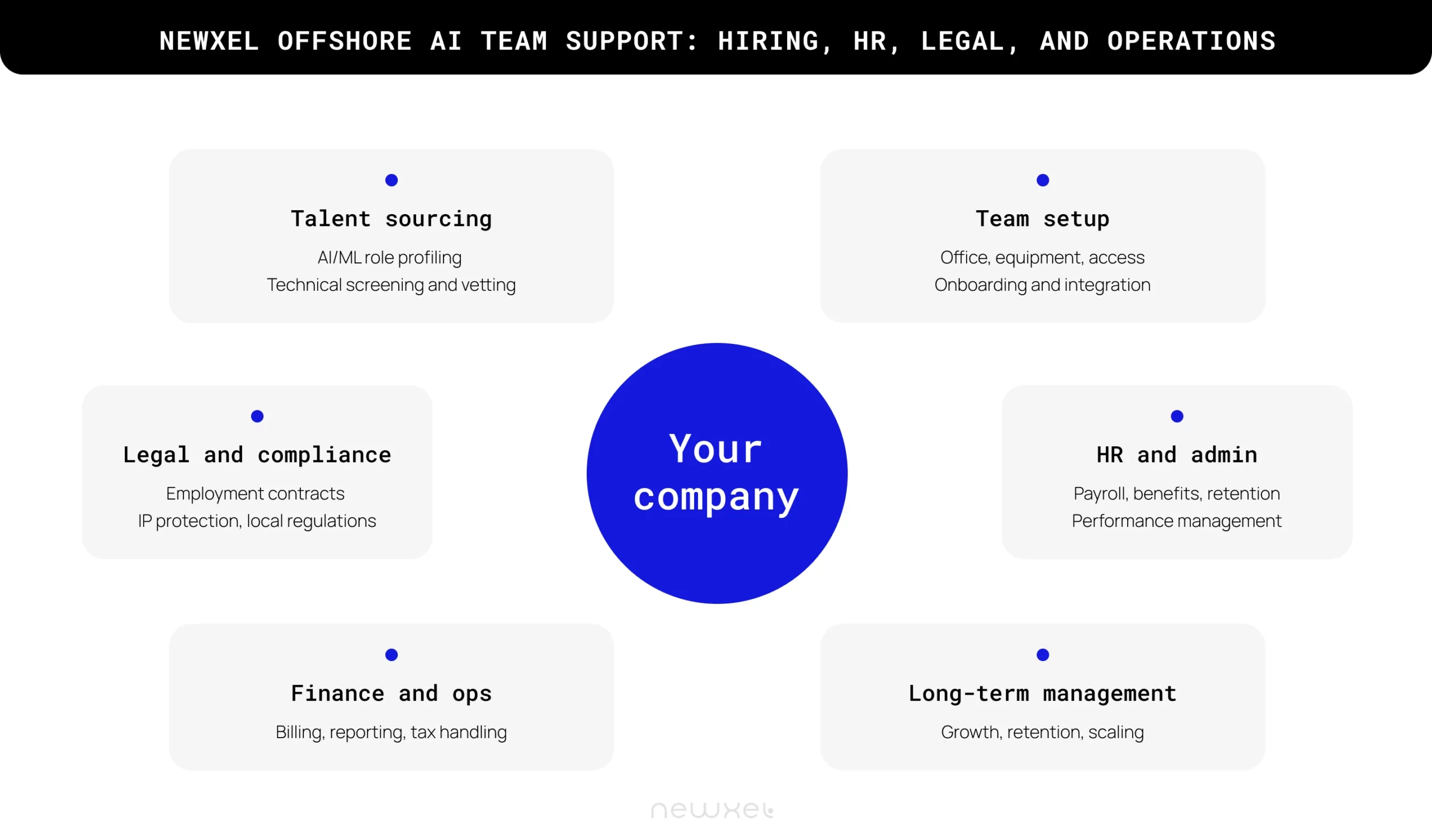
Newxel offshore AI team support including hiring, HR, legal, and operations
Sourcing AI talent is a different game from sourcing general engineering talent because the pool is smaller, the skills are more specialized, and evaluating whether a candidate can do the work requires technical depth that most general recruiters don’t have (you can’t screen for MLOps experience the same way you screen for React experience). Newxel’s recruitment teams use dedicated AI role profiles and technical screening frameworks built specifically for ML and data engineering. We source from talent pools across European hubs: Ukraine, Poland, Romania, Bulgaria. For a typical offshore AI team of 7 to 10 people, our average assembly time runs 4 to 8 weeks.
Once people are hired, there’s still the question of making the team operational. Newxel handles office space and equipment, gets network and security configured, and takes care of the onboarding logistics that would otherwise eat into your engineering lead’s time. For AI teams specifically, that includes making sure cloud infrastructure access is set up correctly and that dev environments can handle ML workloads, which is a different configuration than what a typical backend developer needs.
Employing people in another country comes with a long list of things you don’t want to figure out on your own: local labor law, tax regulations, IP protection, data privacy rules that vary by jurisdiction. Newxel acts as the legal employer, so we handle contracts, payroll, benefits, all the regulatory compliance. For AI projects where the team works with sensitive data (and most do), we also help with data processing agreements and cross-border data transfer, which has gotten more complicated in the last few years with evolving EU regulations.
Keeping AI people is harder than finding them. ML engineers with 3 or more years of production experience get pinged by recruiters constantly, and the offers are aggressive. Newxel’s HR teams run engagement programs and career development planning alongside regular compensation benchmarking against market rates, because if you fall behind on salary in this market, you lose people fast. Our client teams tend to hold onto their AI staff at rates well above what’s typical for the industry, which we attribute mostly to the combination of interesting work, competitive pay, and not treating people like interchangeable resources.
Building an offshore AI development team is a strategic decision that demands the same seriousness you’d apply to a domestic AI hire. The companies that do it well define business objectives before they write a single job description, audit whether their data can support the work, hire the right mix of roles, and invest in integration rather than assuming it happens on its own.
Companies that struggle tend to skip the data groundwork, staff the team like it’s a web dev squad, or use the same project management playbook for ML that they use for everything else.
The AI talent gap isn’t going away. The World Economic Forum reports that 94% of leaders face AI-critical skill shortages today, with around a third reporting gaps of 40% or more. For most companies, the choice isn’t between building a local AI team or an offshore one. It’s between building an offshore AI team or not building one at all.
We’ve watched teams built this way, with the right structure, data readiness sorted before team readiness, roles spanning the full spectrum from data engineering through MLOps, and the offshore team treated as colleagues rather than contractors, perform at the same level as co-located ones. Repeatedly. The capability works when companies take the execution seriously instead of treating it as a hiring problem that money alone can solve.