Nearshore Software Development Romania: Complete Guide for 2026
19 min
· April 8, 2026
Last updated: August 28, 2026

We work with engineering leaders across Europe and Israel, and the same pattern shows up in most first conversations: they’ve got budget, a clear backlog, and clients waiting, but their local recruiter has been searching for senior developers for four or five months with nothing to show for it. The product roadmap slips by a quarter, competitors ship first, and somewhere in the middle of that frustration, someone on the leadership team suggests looking at Romania.
The usual question that follows is whether nearshoring to Romania is worth the coordination overhead, or whether it’s just another name on a list of lower cost hiring markets that’ll create more problems than it solves. The answer depends on what you need and how you structure the engagement. Romania has specific advantages that make it one of the stronger nearshore options in Europe for outstaffing. It also has constraints that are getting worse, not better, and that most content about the country doesn’t mention. We’ll cover both sides here, drawing on what we see across our European hiring operations.
Nearshoring in Romania means outsourcing software development work to Romanian teams or vendors that operate in a similar or overlapping time zone to your own, typically for Western European (and to a lesser extent UK) companies, since Romania sits within 1–2 hours of most EU business hours.
The “near” distinguishes it from traditional offshoring (e.g., hiring in India or the Philippines, where time zones barely overlap): with Romania, clients get real-time collaboration, overlapping working hours for daily stand-ups and calls, and closer cultural and business-practice alignment with the EU, while still paying meaningfully less than hiring locally in Germany, France, or the UK.
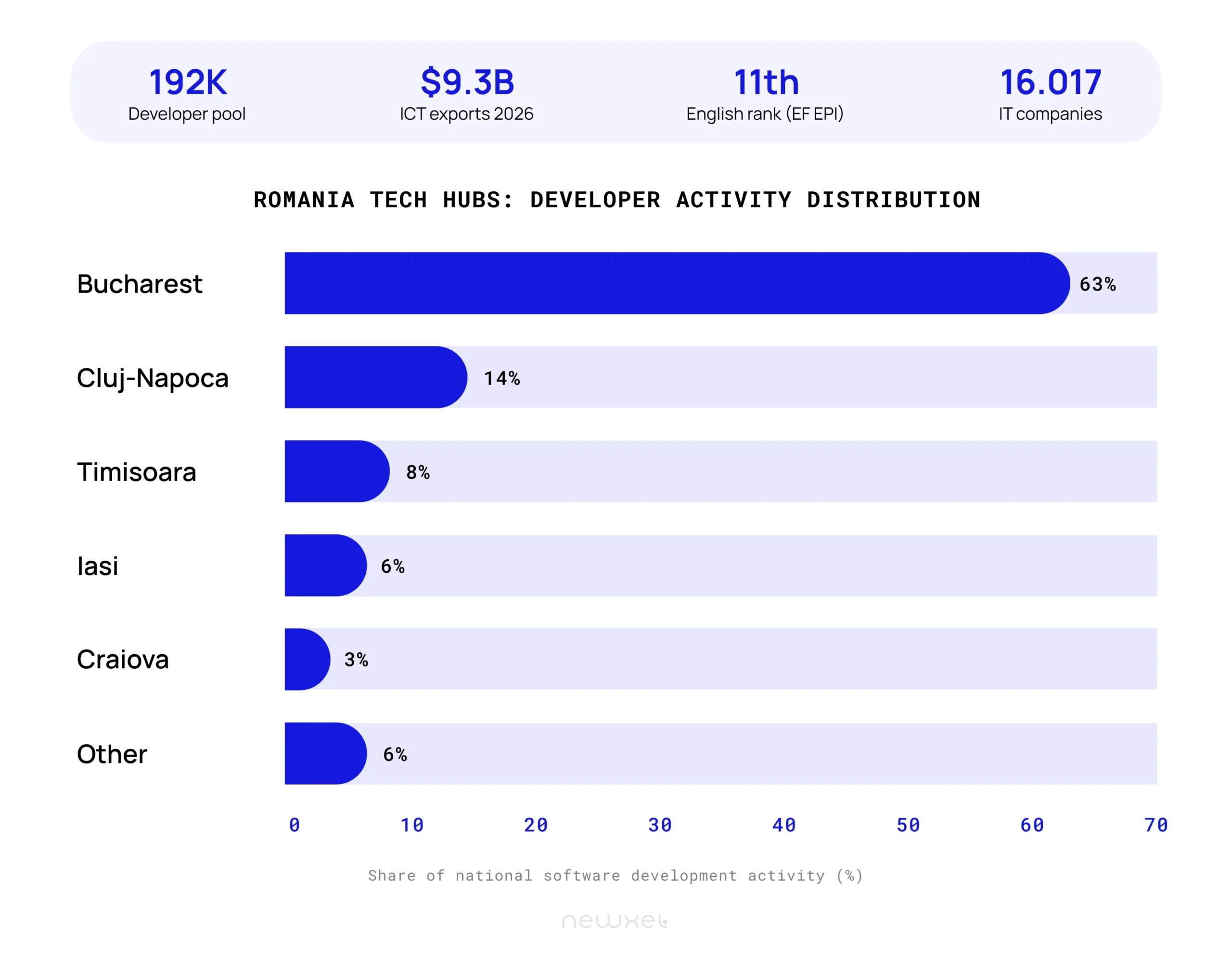
Figure 1: Romania tech ecosystem. Developer distribution across four major hubs, with key market metrics.
Most of our clients evaluate three or four locations before settling on one. These comparisons come up in almost every conversation, so we’ll walk through what we’ve seen.
Romania vs. Poland. Poland’s pool is bigger, 400,000-plus ICT professionals, and its enterprise software operations are more established, especially anything Java or .NET. You’ll pay more for Polish developers, particularly if they’re based in Warsaw or Krakow. Where Romania has an edge is pricing (narrowing, but still there) and English proficiency, where it consistently outscores Poland on standardized measures. If you’re building enterprise Java or .NET, Poland has deeper bench strength. For full-stack, mobile, or QA work, Romania is just as competitive.
Romania vs. Ukraine. Ukraine’s developer workforce is the largest in the region at around 340,000. Senior rates sit between $40,000 and $50,000, so you’re saving $5,000 to $10,000 compared to Romania on a per-person basis. If you need people who can own distributed systems or do serious AI/ML work, Ukraine’s bench is deeper in those areas. Yes, the geopolitical situation means contingency planning, but Ukrainian IT firms still fulfilled 95% of signed contracts through 2023 and 2024, which we think is an underreported fact.
Romania vs. Latin America. LATAM’s selling point is timezone. If you’re on the US west coast, developers in Brazil, Argentina, or Colombia are on your clock. Hard to argue with that. The tradeoff is depth. When a client comes to us looking for someone who knows PCI-DSS inside and out, or who can own a complex system architecture without hand-holding, we find those profiles faster in Eastern Europe than our counterparts in LATAM typically can. Romania included.
Romania vs. Portugal. Portugal has gotten popular with European companies, and for good reason: strong English, product-oriented developers, and a quality of life that helps with retention. Salaries run higher than Romania and they’re climbing faster. Romania’s advantage is pool size and cost. The retention question cuts both ways though, and we’ll get into Romania’s specific challenges with that further on.
| Factor | Romania | Poland | Ukraine | LATAM |
| Developer pool | ~192,000 | ~400,000+ | ~340,000 | ~700,000+ |
| Senior annual salary | $45,000-$55,000 | $50,000-$70,000 | $40,000-$50,000 | $45,000-$65,000 |
| English proficiency (EF EPI rank) | 11th | 15th | Not ranked (high in IT) | Moderate to high |
| EU membership | Yes | Yes | No | No |
| US east coast overlap | 5-7 hours | 5-7 hours | 5-7 hours | 6-8 hours |
| Nearshore for EU/UK | Yes | Yes | Yes (non-EU) | No |
The process itself isn’t complicated, but it rewards companies that treat it like a proper hiring exercise rather than procurement.
Step 1: defining the need. “We need three senior backend developers” tells us almost nothing. The engagements that go well are the ones where the client walks us through the architecture, the stack, who the new hires will report to, what good performance looks like at the 90-day mark, and where they’re unwilling to compromise on domain experience. We treat this phase as the foundation because a vague brief produces a weak pipeline. Every time.
Step 2: sourcing across the market. Bucharest and Cluj-Napoca have more open roles chasing senior developers than there are senior developers to fill them. A partner who only recruits in one Romanian city is going to plateau quickly. We pull from eight European hubs. If a specialization is thin on the ground in Romania, we widen to Poland or the Baltics under the same contract. For Romania-specific searches, qualified shortlists land within two to four weeks.
We didn’t always know the city-level breakdown as well as we do now. After years of sourcing there, the pattern is clear. Bucharest runs on enterprise Java, fintech, and cybersecurity because that’s what Oracle, IBM, and the financial services firms brought in. Cluj-Napoca grew up differently, more startup DNA, more full-stack generalists, engineers who’ve worked in five-person teams and shipped under pressure. Need QA or testing engineers with automotive experience? Look at Timisoara, where Bosch, Continental, and Hella have had operations for years. Getting this wrong, searching Bucharest for a profile that sits in Timisoara, can cost you three or four weeks of dead-end sourcing.
Step 3: your team interviews and selects. You retain full control over who joins your team. We present pre-screened candidates, your engineering leads run technical interviews, and they make the final call. If a provider selection insists on assigning developers without your input, that’s an outsourcing operation wearing a different label.
Step 4: onboarding and integration. This phase makes or breaks the engagement. Onboarding for nearshored developers should look like onboarding for anyone else on your team: full system access, introduction to how your team scaling works, a clear first task, someone to ask when they’re stuck. We handle the logistics on our end, resolving access issues, coordinating with our local team, so your engineering managers aren’t spending their first week on admin.
Step 5: ongoing employment support. Our work doesn’t stop once someone starts coding. We run payroll, handle taxes and benefits, stay on top of Romanian labor law changes, sort out equipment and workspace. You get one invoice per developer per month. Your HR team keeps doing what it should be doing instead of figuring out how Romanian social contributions work.
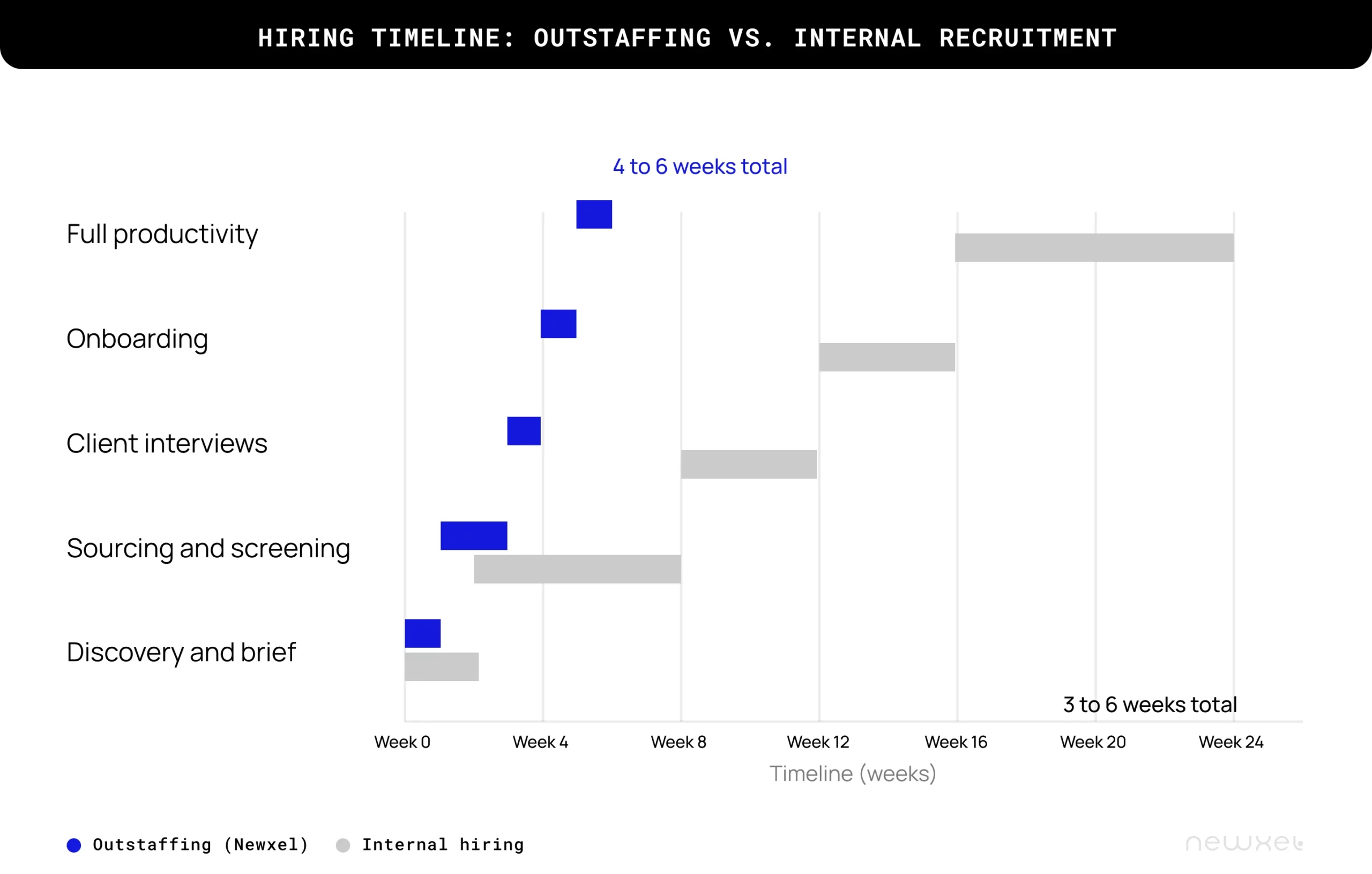
Figure 5: How long each phase takes when hiring through outstaffing versus doing it internally. The full cycle compresses from 3 to 6 months down to 4 to 6 weeks.
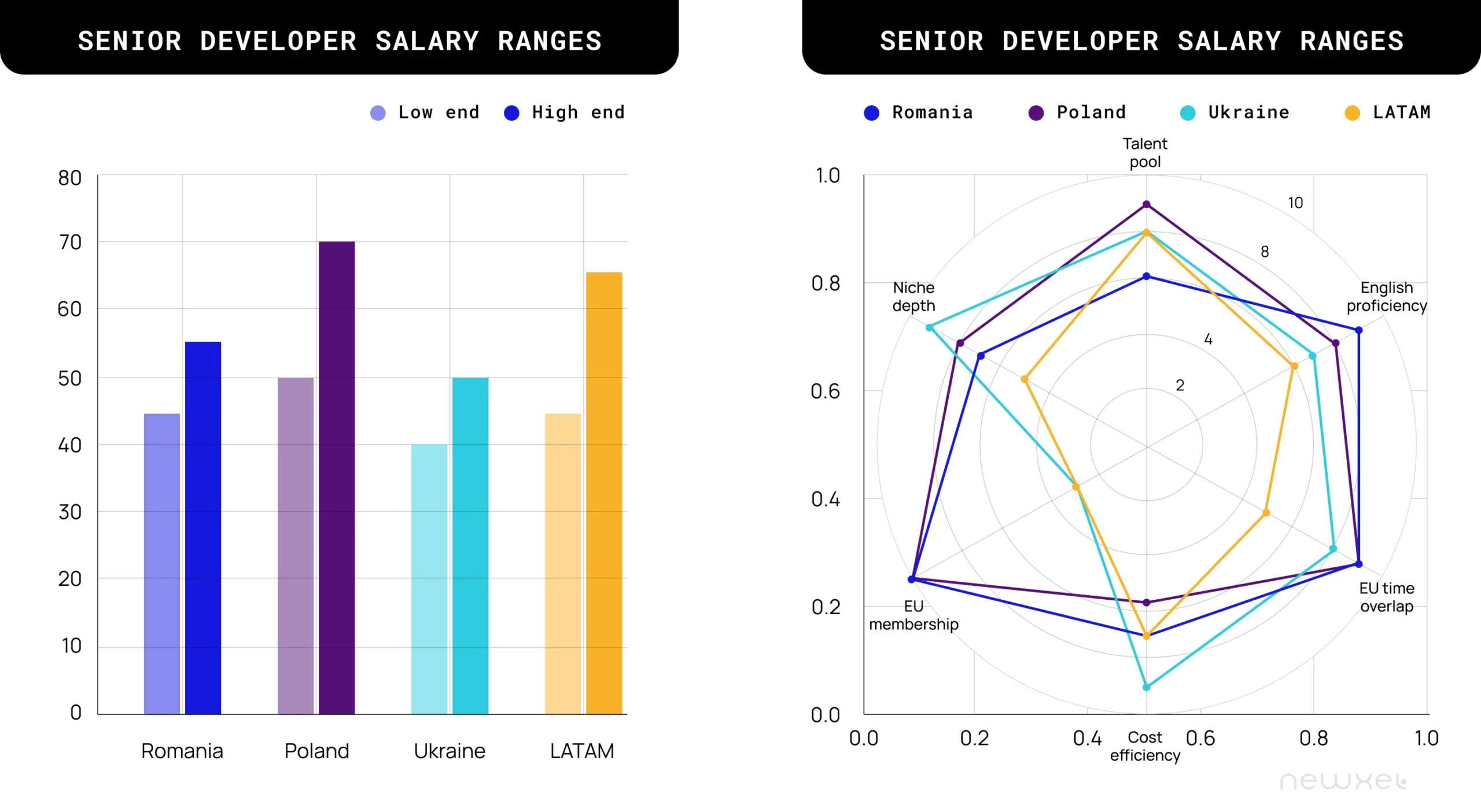
Figure 2: Nearshore Romania location comparison. Senior developer salary ranges and radar chart comparing Romania, Poland, Ukraine, and LATAM across six key dimensions.
Most articles about nearshoring in Romania recycle the same five points. These are the ones we’ve seen make a measurable difference in how our engagements perform.
Hiring speed that keeps up with the roadmap. Internal hiring for senior engineering roles takes three to six months in most competitive markets. Through a nearshore staff augmentation partner with existing pipelines in Romania, that drops to four to six weeks from brief to production code. When your sprint cycles are two weeks long and you’re already behind, that compression is what keeps the product moving.
No legal entity required. We work with a lot of companies that initially planned to open their own entity in Romania. Almost all of them underestimated what’s involved: registering the company, figuring out Romanian labor law, running local payroll, staying on top of tax filings, and then absorbing regulatory changes like the 2025 tax exemption removal when they happen. For most companies in the 50 to 500 employee range, the overhead is wildly disproportionate to the benefit. The outstaffing model removes all of it. You don’t register anything, you don’t hire a local accountant, and you don’t learn another country’s employment law.
Scale flexibility without layoff risk. If your product roadmap shifts and you need fewer developers, a properly structured staff augmentation agreement lets you scale down with 30 to 60 days notice. Try doing that with direct hires in a European country with strong labor protections and you’ll understand why this matters. The ability to adjust team size without the legal and emotional complexity of layoffs is something most engineering leaders don’t appreciate until they need it.
Talent diversification. When your entire engineering team is in one city, you’re at the mercy of that city’s job market. Salary expectations spike, a competitor opens a flashy new office, the local government changes tax rules, and suddenly your hiring plan is underwater. Having a nearshore presence in Romania means you’ve got a second market to pull from. If it gets too competitive in one place, you shift sourcing to another without touching the existing team.
Transparent cost structure. In outsourcing, the vendor’s margin is somewhere inside the project price, and you’ll never know exactly where. The outstaffing engagement model works differently: you see a per-developer rate, and that’s what you pay. No management layers you didn’t ask for, no surprise overhead. After the 2025 tax changes, our clients building nearshore teams in Romania through staff augmentation still see 40 to 60% total savings compared to hiring the same roles in Tel Aviv, San Francisco, or London.
EU regulatory alignment. If you’re in fintech and need to comply with DORA, or in healthtech handling patient data, having your developers employed inside the EU isn’t a nice-to-have. It’s a compliance requirement that simplifies conversations with your own regulators and clients. Romania’s EU membership means GDPR applies by default, from the day your first developer starts.
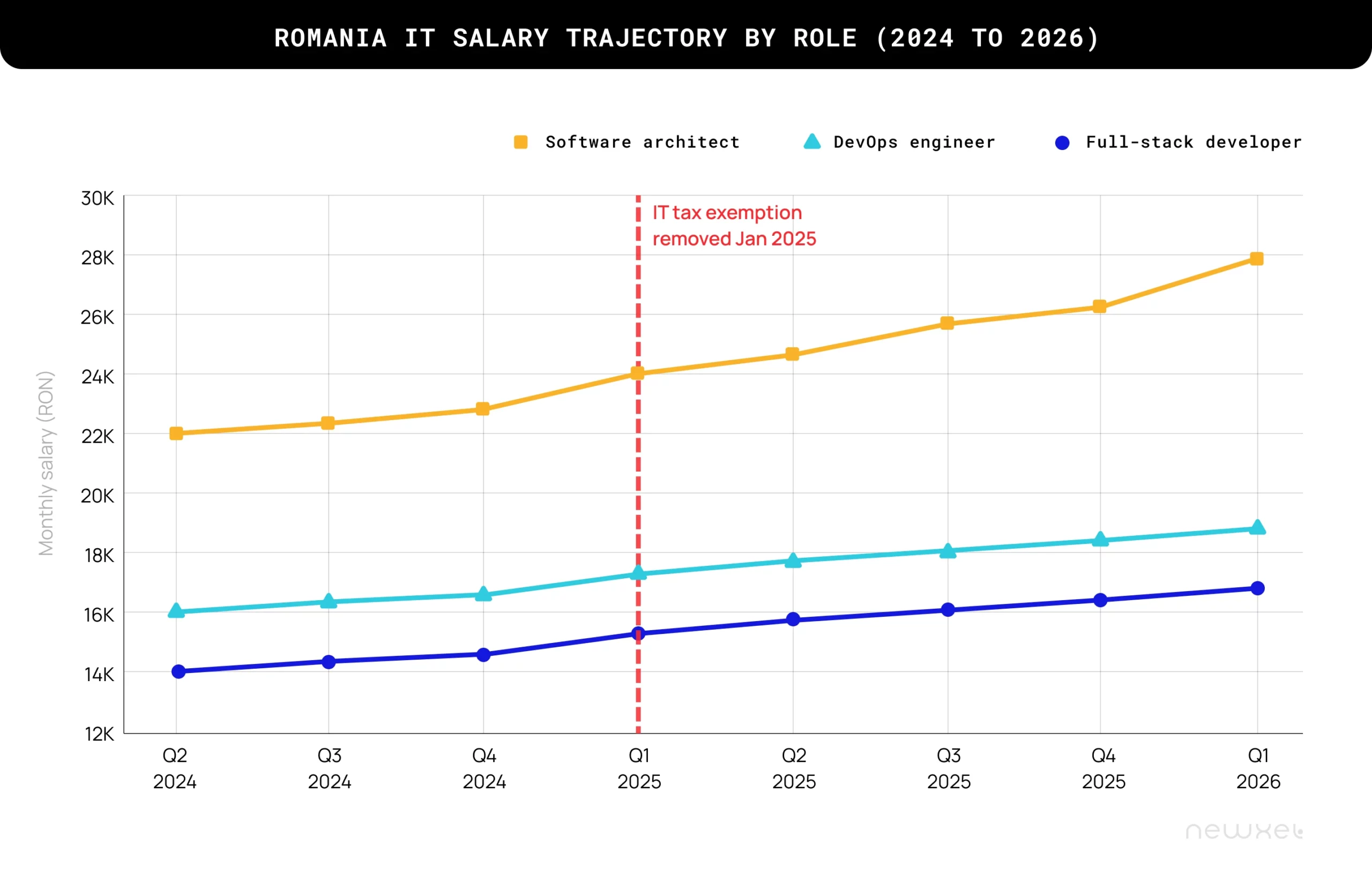
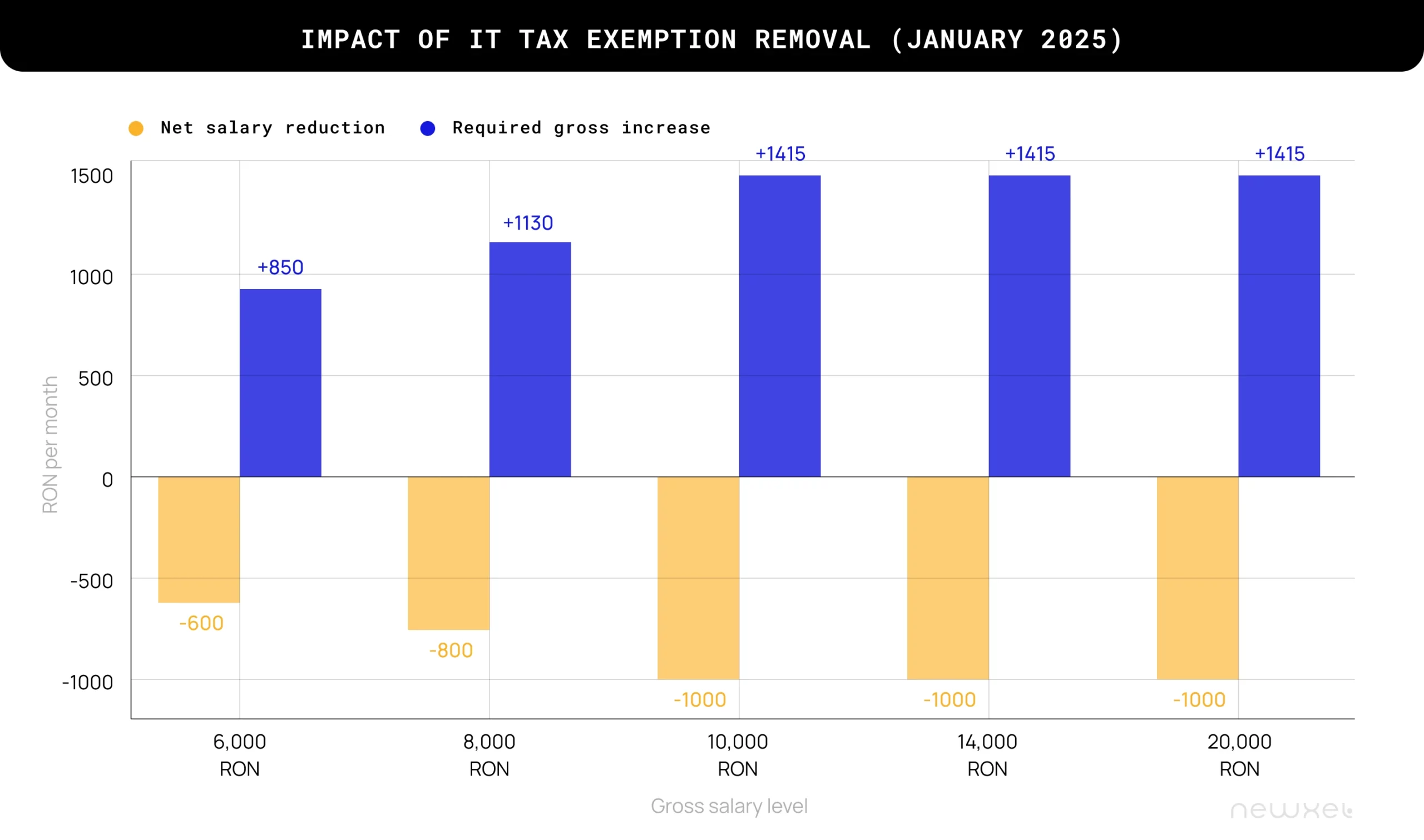
Figure 3: Romania IT salary trends and 2025 tax impact. Salary trajectory by role from Q2 2024 to Q1 2026, plus the estimated net salary reduction and required gross compensation adjustment following the removal of IT tax exemptions.
Romania nearshore software development works well in a few specific scenarios.
You’re a European company that needs same-timezone engineering capacity. Based in London, Berlin, Amsterdam, or Tel Aviv? Romania is in your workday. Standups, pair programming, code reviews, all synchronous. No one’s setting alarms for 6 AM or waiting half a day for a reply.
You need to build a team, not finish a project. Got a defined deliverable with a clear endpoint? Outsourcing might be simpler. But if you’re building permanent engineering capacity that’ll grow with the product, outstaffing in Romania gets you there without registering a foreign entity.
You’re looking for QA, testing, or full-stack depth. Romania’s testing, QA, cybersecurity, and full-stack bench is deeper than most of Eastern Europe, a legacy of the automotive and enterprise companies that have operated there for years. Backend infrastructure and distributed systems are a different story. For those profiles, Ukraine and Poland tend to have more candidates with the right depth.
You want EU data compliance without building the infrastructure yourself. EU membership means GDPR applies by default in Romania. For fintech, healthtech, or anything where your clients’ compliance teams ask where your developers are employed, having the answer be “inside the EU” makes the conversation a lot shorter.
Newxel is a European IT staff augmentation and team extension company. We place dedicated engineering teams from talent hubs across Ukraine, Poland, Romania, Bulgaria, and other European markets with client companies, mostly in Israel, the UK, and the US.
The operating model is straightforward: the client owns the team. Their engineering leads manage the developers directly. The developers join the client’s Slack, attend their standups, submit PRs through their review process, and work inside their tools. Newxel handles everything on the employer side, HR, payroll, legal compliance, benefits, equipment, and workspace, across all jurisdictions. There’s no project manager sitting between the client and their developers. No separate backlog. No handoffs.
Our track record: we deliver engineers within 2 to 4 weeks of a signed brief. Developer retention across our portfolio sits at 98%. The average client partnership lasts more than 5 years. We operate across 8 European hiring hubs, and our clients see 40 to 60% cost reduction compared to hiring the same roles in Tel Aviv, San Francisco, or London.
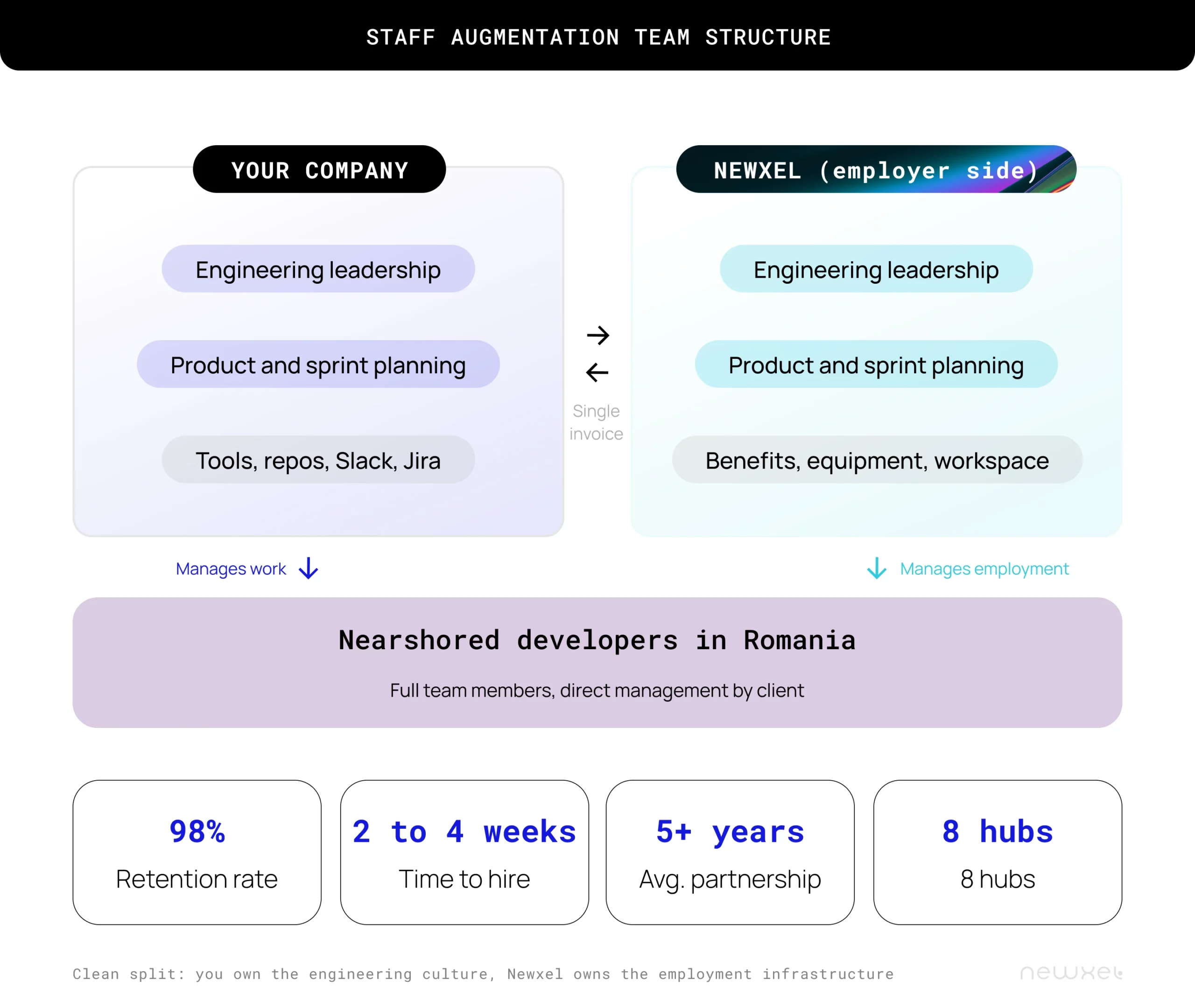
Figure 4: Newxel outstaffing support model. The split between client engineering management and Newxel employment infrastructure, with key performance metrics.
At this point, the question probably isn’t whether Romania makes sense for your team. It’s how to get started without burning the first three months on a poor setup.
First, map your talent gaps. Not the open positions on your careers page, but the skills you’ll need in six to twelve months based on where your product roadmap is heading. Staff augmentation works much better as a planned move than as a reaction to a missed deadline.
Second, talk to two or three partners. Ask about their experience hiring in Romania specifically. How deep is their network in Bucharest compared to Cluj? Can they show retention data that survives follow-up questions? And will they own legal, payroll, HR, and equipment from end to end, or is your ops team going to end up filling the gaps? Half an hour on a call is usually enough to tell the difference between a partner and a vendor.
Third, start small. Most of our successful engagements begin with two or three developers. Once the model proves itself, scaling to eight or ten happens naturally. Trying to build a team of fifteen from scratch in a new market is a recipe for integration problems that’ll sour the whole experience.
Romania’s tech ecosystem has measurable advantages for European companies. It also has constraints, rising salaries, the 2025 tax shift, ongoing brain drain, that are getting more pronounced, not less. The companies that do well with Romania nearshoring go in knowing what they want, put effort into integration, and let the partner absorb the employment complexity while they focus on building product.