How to Hire Developers in the UAE Without Missing the Emiratisation Quota: The Dedicated Team Model for Tech Companies at 50 Skilled Staff
20 min
· August 27, 2026
There’s a specific moment for tech companies trying to hire developers in the UAE where the spreadsheet stops balancing. It usually happens when the head of people brings a headcount plan to a board meeting and the CFO, quietly, does the maths in the margin. Skilled staff heading past 50. Senior engineer packages in Dubai climbing toward what SF cost two years ago. And a 10% Emiratisation target that, if missed, costs AED 9,000 per month for every unfilled Emirati position under the 2026 MOHRE schedule.
It’s not that any single line is a crisis. It’s that they all pull at the same budget line, and the founder’s assumption that we’ll figure out Emiratisation later doesn’t survive the CFO’s model.
We work with tech companies that hit this wall from both sides. Israeli and European firms expanding into the UAE, sizing their first commercial team and realising the quota starts sooner than they thought. UAE-headquartered startups scaling through Series A into B, watching the 50-employee threshold approach with an engineering roadmap that’s already stretched. In both cases, the reflex is to treat Emiratisation as a hiring problem inside the engineering org. It isn’t. And solving it as one is expensive.
This article is a practitioner’s take on the split-org model that keeps compliance genuinely covered and engineering capacity genuinely buildable. It’s written for CTOs, founders, and heads of people who’ve either just crossed the 50-headcount line on their mainland licence or can see it coming in the next hiring plan. We won’t sell you a workaround. We’ll show you the arithmetic and the operating model most of our UAE-facing clients have converged on, and where the boundaries are.
Based on Newxel’s experience supporting tech companies in scaling engineering teams across GCC markets.
The framework worth knowing, before anyone runs the numbers.
Under Federal Decree-Law No. 33 of 2021 and Cabinet Resolution No. 18 of 2022, mainland private-sector companies with 50 or more employees must increase Emirati representation among their skilled workforce by 2 percentage points each year, reaching 10% by 31 December 2026. That target is checked twice, not once. There’s a mid-year checkpoint on 30 June and a year-end checkpoint on 31 December, each carrying a 1% step.
Two numbers matter and they’re not the same. The threshold, whether you’re in scope at all, is based on total headcount registered in MOHRE’s system. Cross 50 total employees on a mainland licence and you’re in scope. The quota calculation, how many Emirati hires you actually need, is a percentage of your skilled workforce, defined as roles at Skill Levels 1, 2, and 3 under MOHRE’s occupational classification. That’s managerial, professional, and technical. Skill Levels 4 and 5, broadly unskilled labour, are excluded from both the numerator and the denominator.
For a tech company, this classification puts almost every role you care about in scope. Your engineers, product managers, designers, DevOps leads, technical managers, and most of your commercial team all sit in the skilled brackets. The quota moves with every skilled hire you make.
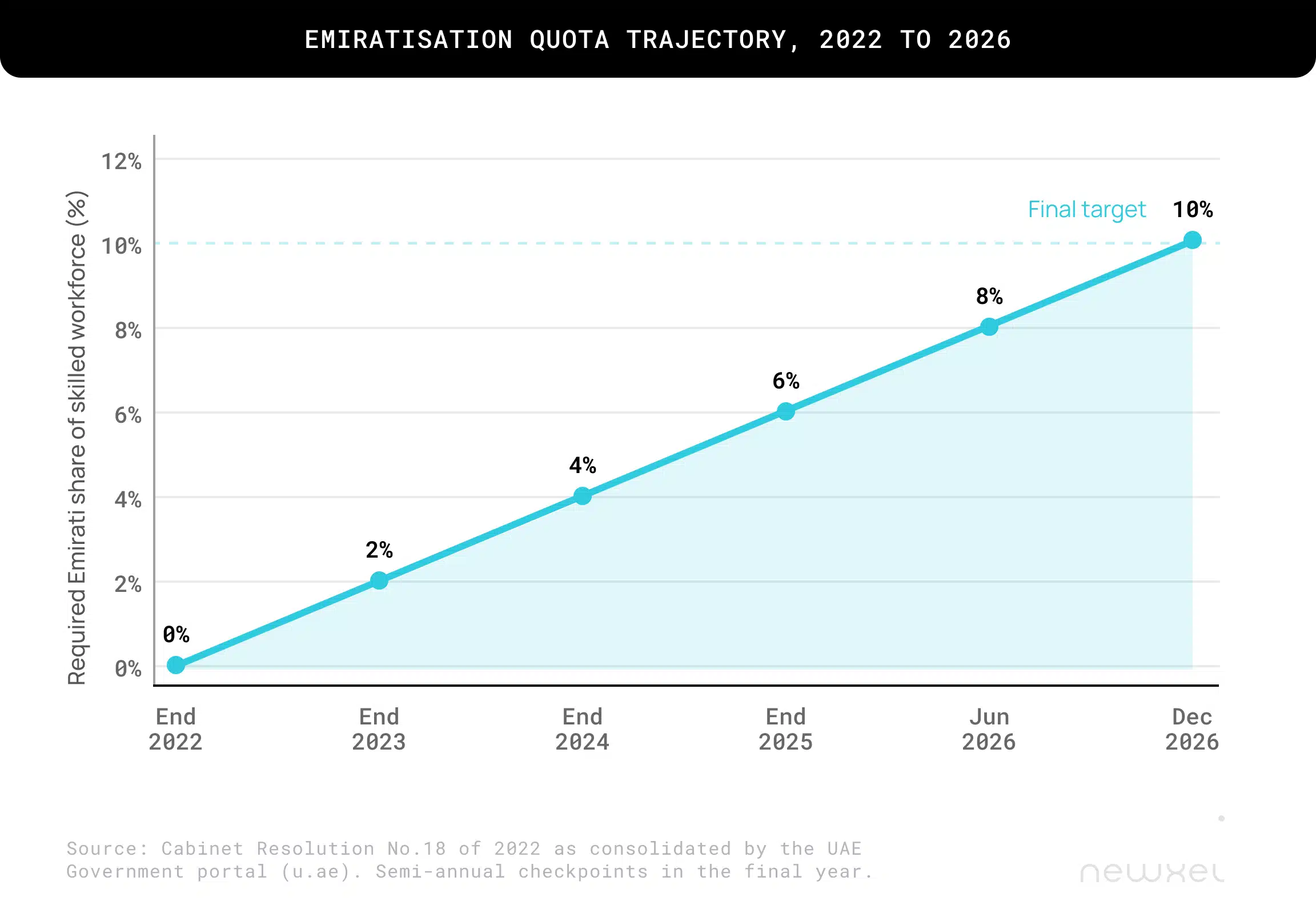
Figure 1. Emiratisation quota trajectory, 2022 to 2026. Source: Cabinet Resolution No. 18 of 2022 as consolidated by the UAE Government portal (u.ae).
The penalty side has been quietly compounding. Under MOHRE’s published escalation, the monthly fine per unfilled Emirati position was AED 6,000 in 2023, AED 7,000 in 2024, AED 8,000 in 2025, and stands at AED 9,000 in 2026. That’s AED 108,000 per year per missing hire. There’s also a separate rule catching smaller firms: under Cabinet Resolution No. 44 of 2024, companies with 20 to 49 employees in 14 strategic sectors, information and communications included, entered a compliance regime with annual contribution requirements per missing Emirati hire.
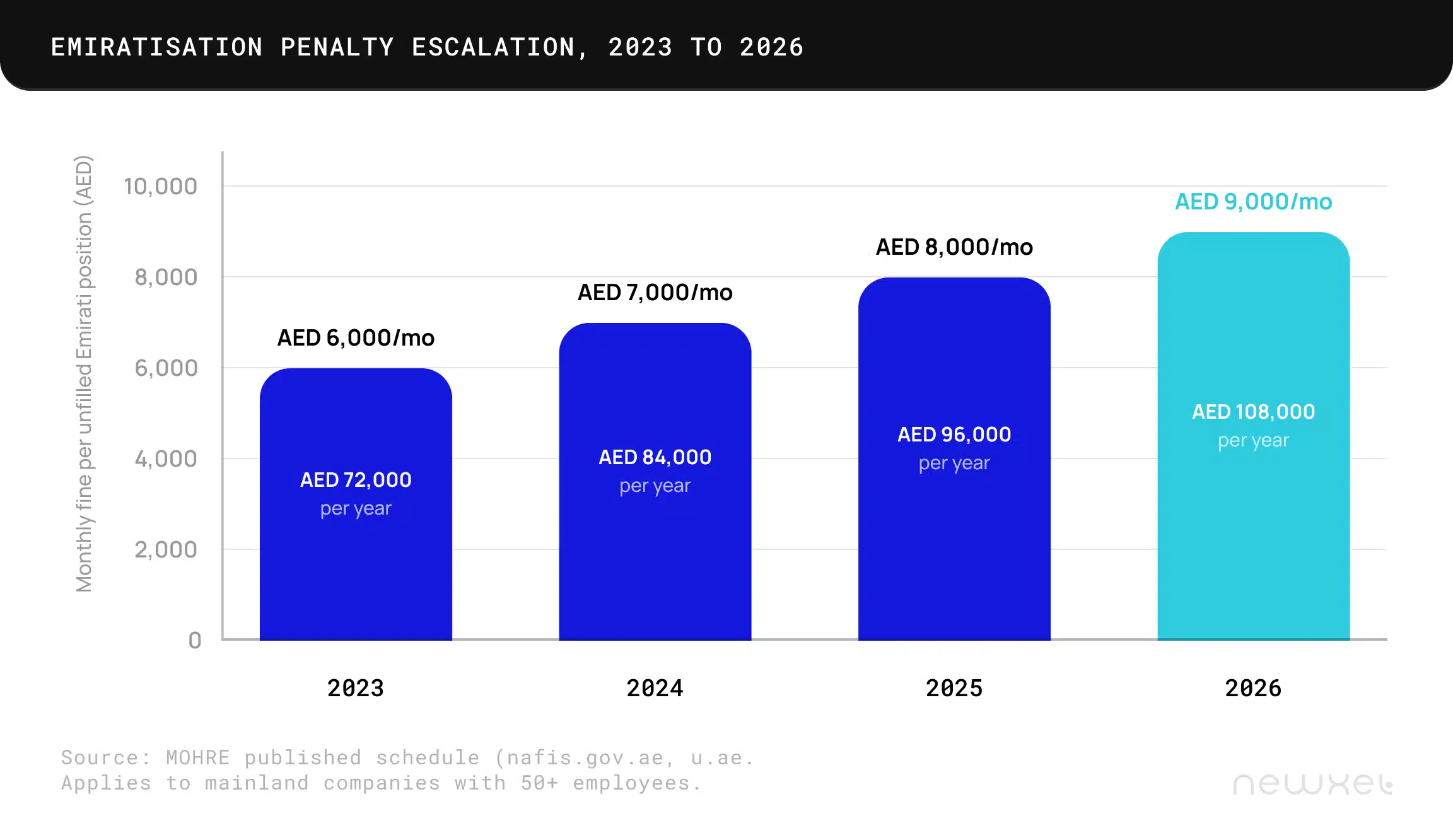
Figure 2. Emiratisation penalty escalation, 2023 to 2026. Source: MOHRE published schedule (nafis.gov.ae, u.ae).
Free zones sit in a slightly different position. Mainland MOHRE Emiratisation targets don’t automatically apply to employees sponsored by a free zone authority. But the exemption is a policy choice, not a permanent feature. Several free zones have introduced their own frameworks, and the federal government has signalled intent to extend the requirement more broadly. We wouldn’t build a five-year plan around the free-zone exemption standing still.
On the supply side, the government provides a genuine subsidy. Through Nafis, the federal Emiratisation programme managed by the Emirati Talent Competitiveness Council, the state contributes salary support of up to AED 8,000 per month per eligible UAE national placed in a private-sector role. That subsidy is designed to shift the economics of hiring Emirati nationals in favour of the employer, and it works. What it doesn’t do is manufacture supply. The pool of experienced Emirati tech professionals is small, and the largest local employers, banks, telecoms, government-linked entities, hire from it first.
This is the operational picture. Now the arithmetic.
Let’s work through a real case, using a composite of three engagements we ran in 2025 and 2026. A Series B fintech operating from a Dubai mainland licence, 42 skilled staff, planning to hit 65 by end of the following year through a mix of product, engineering, and commercial hires.
The founder walks into the annual planning meeting assuming Emiratisation is a two-hire problem. Two Emirati staff, some administrative overhead, done.
The head of people does the count. At 65 skilled staff, 10% is 6.5, rounded up to 7. They currently have 1 Emirati on the payroll. The gap is 6. If they miss the target for a full year, the penalty exposure is 6 multiplied by AED 9,000 multiplied by 12, or AED 648,000. That’s before the political cost of showing up in a MOHRE inspection register, and before the knock-on effects: MOHRE’s published enforcement includes work permit restrictions and Nitaqat-equivalent classification downgrades for repeat non-compliance.
The CTO then does his count. Of the 23 hires planned, 16 are engineering or product. Senior engineers in Dubai now command packages that, for AI, cloud, and cybersecurity specialisations, run in the AED 25,000 to 40,000 per month range and higher, before housing allowance, medical, and end-of-service liability. Under UAE Labour Law, gratuity accrues from day one at 21 calendar days of basic salary per year for the first five years, and 30 days thereafter. It becomes payable at 12 months of continuous service, but any competent finance function books the monthly accrual as a balance sheet liability from the start.
At the bottom of the spreadsheet, the CFO adds two numbers the founder hadn’t budgeted for. Emiratisation shortfall exposure. End-of-service accrual against the engineering hires that hadn’t happened yet.
The plan doesn’t fit the runway. Something has to give.
The reflex answer from most consultants is: hire more Emiratis for the engineering roles. And Emirati tech talent does exist. Khalifa University, American University of Sharjah, UAE University, and Zayed University all produce computer science and engineering graduates every year. Nafis-affiliated sourcing channels are active. But the market dynamic is what it is. Covered mainland companies must keep growing their Emirati share in skilled roles annually, and the banking sector in particular carries higher sector-specific targets set by CBUAE. That pulls a meaningful slice of the strongest Emirati graduates and mid-career technical hires toward large local employers, which leaves an even smaller pool for everyone else. If your competition for a senior Emirati engineer is First Abu Dhabi Bank or e& (formerly Etisalat), the compensation to land and hold that hire past year two is not what any startup CFO wants to see modelled.
Which is where most conversations get stuck. The founder is trying to solve two problems with the same lever, and the lever isn’t long enough to reach both.
Here’s the shift we spend most of our time explaining. Emiratisation is a workforce-composition obligation measured against a specific denominator. Engineering capacity is a delivery obligation measured against your product roadmap. They intersect on the org chart, but they’re not the same problem, and the solutions don’t have to sit on the same headcount.
We should acknowledge the counter-argument here honestly, because it’s a legitimate one. A UAE policy adviser would say the whole point of Emiratisation is to build local skill, and that separating engineering from the local workforce short-circuits the intended transfer. Fair. Our response is that skill transfer is real when it’s built on strategic fit, and thin when it’s forced by penalty arithmetic. The companies that build genuine long-term Emirati technical talent do it through university partnerships, Nafis-supported graduate tracks, and mentorship programmes attached to roles where those hires will actually compound over years. Those investments are stronger when they’re separate from the quarterly compliance number, not welded to it.
With that in mind, the structural options open up.
Where Emirati hiring genuinely lands well. Roles where local market knowledge, language, network, and cultural fluency compound with time. Government relations and public affairs. Compliance and regulatory liaison, particularly for fintech companies dealing with CBUAE, DFSA, or ADGM’s FSRA. Client-facing account management for local enterprise deals. Sales into the government and semi-government sectors, which is often the largest revenue opportunity in the market and the hardest for foreign firms to break into cold. These are roles where a strong Emirati hire outperforms a strong expat hire on the metric that matters, and where Nafis subsidy meaningfully offsets total cost of employment.
Where Emirati hiring is a poor fit for the immediate constraint. Pure engineering delivery. Backend, frontend, mobile, data engineering, ML infrastructure, DevOps. Not because Emirati engineers don’t exist or aren’t good, but because the intersection of a senior engineer in the specific stack you need, available now, willing to leave the government or bank job that already values them, is a very thin candidate pool being aggressively competed over. Trying to close the Emiratisation quota through the engineering line item is the most expensive path to the least strategic outcome.
Where the third bucket lives. Engineering capacity that isn’t tied to physical presence in the UAE at all. This is the part most founders haven’t thought through until we walk them through it. There’s nothing in UAE law that requires your engineering team to sit in the UAE. Your product runs where your servers run. Engineers can sit in Warsaw, Bucharest, Sofia, or Lisbon through EOR-based staff augmentation, and report directly to your CTO in Dubai over the same Slack and the same Jira as if they were three floors up in the office. What matters for the Emiratisation calculation is who’s on your UAE payroll. Engineers employed through an EOR structure in a European hub are not on your UAE payroll, and don’t affect either the numerator or the denominator of your quota.
We’ve watched this reframe change the entire planning conversation. The 16-person engineering hiring plan doesn’t need to happen inside the UAE at all. It can happen in the European hubs where senior density is highest and where the salary curve is flatter. The UAE headcount shrinks toward the roles that genuinely need to be there. The quota arithmetic gets easier because the skilled denominator is smaller. And the engineering roadmap stops competing with the compliance obligation for the same dollar.
This isn’t a workaround. It’s a legitimate organisational architecture that hundreds of tech companies operating in the region already use. The question is whether you build the split by design, or drift into it after paying two years of penalties and losing a product cycle to hiring delays.
There are essentially three architectures we see. Each is defensible for a different type of company.
Everyone on a UAE mainland contract. Engineers, product, commercial, compliance, all locally employed. You solve Emiratisation with a mix of Emirati hires and Nafis-supported placements. You accept that engineering hiring will be slower and more expensive than in comparable European hubs, and you build the cost into the pricing and the burn.
This works when your product is deeply UAE-specific and where physical proximity to customers, regulators, or government stakeholders is genuinely value-creating. Government tech, defence-adjacent, some healthcare, and some real estate platforms fit here. It also works for well-funded companies that can absorb the premium and treat the local team as a market-entry investment.
It doesn’t work for capital-efficient startups where the engineering roadmap runs global and the UAE is one market among several.
Sales, marketing, customer success, compliance, government relations, and executive leadership sit on the UAE payroll. Engineering, product, and design sit on staff augmentation contracts as a dedicated team, employed through Newxel’s EOR structure in one or more European hubs and working exclusively on your product. The UAE org stays lean, often below the 50-employee threshold for a longer runway. When it crosses, the skilled denominator is smaller and more Emiratisation-appropriate: commercial, compliance, and leadership roles where Emirati hires genuinely reinforce the business.
This is the model we’ve built for the majority of our UAE-active clients. It doesn’t require you to give up any control over engineering. The dedicated team reports to your CTO. They sit in your Slack, your GitHub, your standups. Newxel handles the employment infrastructure, HR, payroll, tax, and legal in each European jurisdiction. You handle the engineering. When founders ask us what a dedicated team in UAE product delivery actually costs and how long it takes to stand up, this is the architecture we’re describing.
The reason this works isn’t cost arbitrage, though the maths does help. It’s that you’re using each labour market for what it’s good at. UAE for market access, relationships, and regulatory presence. Europe for engineering depth at reasonable ramp-up speed.
Register in DIFC, ADGM, Dubai Internet City, or DMCC. Employees sponsored under free zone visas. Currently, no mandatory MOHRE Emiratisation quota. Bank the arbitrage.
This is the shortest-term option and the one we’re most cautious about recommending as a long-term plan. The exemption is a policy choice, and federal signals point toward broadening the regime. Free zone companies can trade with UAE mainland customers for B2B services and software, but face restrictions on some direct-distribution and B2C activities, which for certain deal structures matters more than founders initially assume.
The strongest use of this architecture is transitional. Enter through a free zone, prove the market, then re-domicile or add a mainland licence when the commercial case supports the compliance cost.
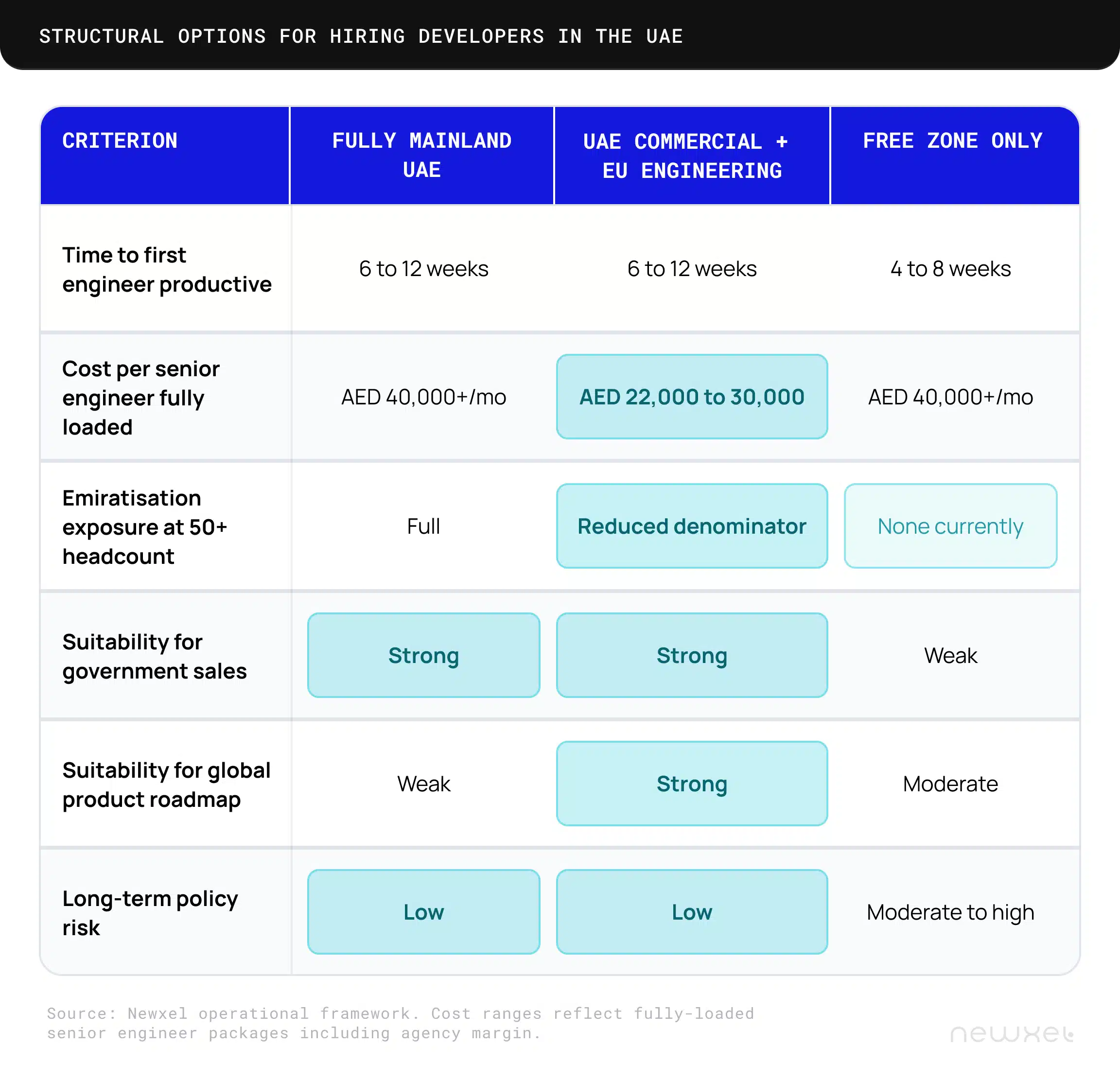
Figure 3. Structural options for hiring developers in the UAE at the 50-employee threshold. Source: Newxel operational framework.
The middle column isn’t a compromise. It’s the architecture that most cleanly separates two constraints that most tech companies conflate.
If the split-org model is the answer, the operational question is how staff augmentation actually runs on the engineering side, and how a dedicated team based in Europe stays close enough to your UAE operation to feel like part of it.
We hire the engineers you specify, in the European jurisdictions where the density is highest for the stack you need. They join Newxel’s local employment structure in that jurisdiction, which is a full employer of record setup: employment contracts under local labour law, statutory contributions, income tax withholding, mandatory benefits, and all the administrative machinery that comes with genuine employment. They don’t join a body-shop pool. They’re hired for you, they work only on your product, and they report to your engineering leadership.
From your side, the operating experience is close to identical to hiring locally. You define the role. You interview and approve every candidate. You set the working hours, the tech stack, the review process, the sprint cadence. You do the performance management, because you’re the one with visibility into the work. Newxel stands behind them as the legal employer, runs payroll on your behalf, handles every question of local employment compliance, and takes care of the situations that inevitably come up: parental leave, tax residency questions, benefits enrolment, contract renewals, offboarding when it happens.
Two questions usually come up here.
The first is about time zone. Our European hubs run between two and four hours behind Gulf Standard Time, depending on hub. Warsaw is three hours behind. Bucharest and Sofia are two. Lisbon is four. In practice, this means your Dubai team’s morning coincides with a productive block of the European team’s day, and your afternoon overlaps their late morning through early afternoon. The overlap window is generous enough to run standups, code reviews, and design sessions synchronously, and the async time is genuinely useful for deep work.
The second question is about compliance risk, specifically about contractor arrangements that have unravelled under scrutiny in other jurisdictions, UK IR35, US worker classification, ambiguous freelance structures across Europe. The EOR structure is designed to address exactly this. Each engineer is a bona fide employee of a properly registered Newxel entity in their country of residence, with all the tax and social security machinery running correctly. That eliminates the misclassification exposure specific to contractor setups. It doesn’t eliminate every question a tax authority could ever raise about a distributed operating model, but it removes the specific one that has cost other companies most.
Making the initial structural decision is the harder call. Once it’s in place, the operating rhythm settles quickly. But there are three things worth planning for.
Managing the quota against a growing skilled headcount. The number moves. Every commercial hire, every compliance officer, every technical manager on the UAE payroll adds to the skilled denominator. This means Emiratisation planning isn’t a one-time exercise. It should sit inside the quarterly hiring plan, with a running forecast of skilled headcount and required Emirati count six and twelve months out. The companies that get caught by MOHRE inspections aren’t usually the ones that ignore the quota. They’re the ones that hit it once and stop tracking.
Nafis-supported hires as a genuine strategy, not a subsidy grab. The Nafis wage support meaningfully changes the economics of Emirati hiring, particularly for early-career professionals. But the programme rewards genuine employment, not paper attachment. Under Cabinet Decision No. 43 of 2025, MOHRE penalties for ghost Emiratisation, registering Emiratis on payroll without genuine employment, run from AED 20,000 to AED 100,000 per case, alongside criminal referral. Over 1,300 companies have already been penalised. The right way to use Nafis is to identify roles where Emirati hiring is a strategic fit, then structure and support those hires properly. The wrong way is to backfill numbers on the payroll to close a spreadsheet gap.
Evolving the engineering side from team to embedded R&D. Most of our clients start with a specific team for a specific product area, a mobile team, a backend team, a data platform. Over 18 to 24 months, that team tends to grow and specialise. The engineering leadership in Dubai starts running the EU-based teams as a genuinely embedded R&D function, with tech leads, principal engineers, and cross-team architects sitting in Europe reporting up to the CTO. At that point, what started as staff augmentation for a specific team has become the engineering backbone of your UAE product business, without a single Emiratisation dirham of exposure on the engineering line.
Three things worth naming.
Policy risk on free zone exemption. If the government extends mandatory Emiratisation to free zone entities, the free-zone-only architecture becomes harder to defend. Companies using this as a bridge should keep a mainland conversion in scope rather than treat the exemption as permanent.
Perception risk on commercial credibility. Some UAE enterprise buyers, particularly government and semi-government entities, place weight on local employment as a signal of long-term commitment. A commercial team that’s visibly present in Dubai does the work here. If the UAE payroll shrinks too far, for example, if a founder tries to run the entire business with two commercial staff on the ground and everyone else in Europe, the credibility signal breaks, and it will cost you deals. The commercial and leadership presence in the UAE has to be genuine.
Operational risk on engineering coordination. The split-org model assumes your Dubai leadership can effectively run engineering teams they don’t share a kitchen with. Most CTOs already do this to some extent, but the ones who struggle are the ones who try to run distributed teams the same way they run co-located ones. The failure mode is under-investment in written documentation, async decision-making, and structured handoffs. This is a management-practice issue rather than a structural one, but it’s the single biggest reason distributed engineering set-ups underperform.
None of these is fatal. All of them are manageable. But they’re the questions the CFO should be asking in the quarterly review, not the founder discovering in the middle of a MOHRE audit.
If you go down the EOR-based path for the engineering side, the choice of partner is more consequential than most founders realise, because the partner is the legal employer of your engineers. A few things to look for.
Real employment infrastructure in the jurisdictions where you want to hire, not a paper entity or a resale of another provider’s platform. Ask which countries the partner directly employs in, and how long they’ve been operating in each.
Client-managed team model as the default, not a project-delivery model dressed up. You want engineers reporting to you, not a project manager reporting to you on behalf of engineers. The distinction affects everything from how quickly problems surface to how quickly they get resolved.
Retention track record measured over multi-year engagements, not a first-year number. Anyone can hold engineers for the first 12 months. The signal is what happens in years two and three, and whether the partner can show you named engagements that have run at scale for that length of time.
Transparency on cost structure. You should see the salary, the statutory contributions, the partner fee, and the total cost, itemised. Providers that bundle everything into an opaque monthly rate are often the ones with the largest margin and the least accountability when something goes wrong.
And finally, willingness to say no. A partner that will accept any brief and promise any timeline is not managing your risk. A partner that will push back on a hiring spec that doesn’t match the market, or a timeline that doesn’t match the realistic ramp-up, is doing the work you’re paying them for.
The single insight worth leaving with: Emiratisation and engineering capacity are two different constraints, and trying to solve them with the same headcount is the most expensive mistake we see UAE tech companies make. Split the org. Put Emirati hiring where it strategically compounds. Put engineering where senior density is deepest and ramp-up is fastest. The compliance obligation and the product roadmap both get lighter to carry.
If you’re approaching 50 skilled headcount and want to walk through what the split would look like for your specific hiring plan, we’re happy to sit down with your CFO and CTO and work through the model in a single planning session.
This article is not legal, tax, or immigration advice. Emiratisation obligations, penalty structures, and free zone frameworks change. Confirm current requirements with MOHRE and qualified UAE counsel before acting on any specific structural decision.