How to Organize an Effective Tech Startup Team Structure from Scratch
12 min
· February 26, 2026
Building a startup is like fixing a plane while flying it – you’re assembling a team, fixing bugs, selling a product, and keeping everything in the air at the same time. It’s chaotic, challenging, and exciting. But one mistake can be expensive: hiring the wrong person or designing the wrong startup team structure can drain time, money, and momentum.
In a tech startup, every hire matters. Poor decisions around roles in a startup, unclear responsibilities, or an overcomplicated company structure for startups can slow down development, frustrate employees, and confuse stakeholders.
We’ve spent 8+ years doing exactly this: building dedicated tech teams for startups and scale-ups across Europe, the US, and beyond. We’ve helped founders go from a two-person idea to structured, high-performing engineering organizations. We’ve seen what works, what doesn’t, and what quietly kills promising companies before they ever find their footing.
This guide brings together practical experience in building a startup team from scratch and shows how to design a scalable tech startup team structure that evolves as your company grows.
Let’s get started.

Most founders think about team structure when something breaks, when decisions stall, when two people are doing the same job, or when a key hire quits because nobody told them who they reported to.
In our work with founders, this moment usually comes too late: often around 10–15 employees, when fixing structural mistakes becomes expensive and disruptive.
A startup org structure is not about hierarchy for its own sake. It’s about clarity:
Without a clear startup org structure, founders often face:
A strong structure doesn’t slow startups down, it removes friction. It gives teams confidence, speeds up execution, and prevents avoidable people problems.
Before we move into how to organize an effective tech startup team, we first need to categorize the startup stage. Tech company organizational structure is not universal, it changes depending on where the company is in its journey.
Share your team requirements, and we’ll launch a ready-to-deliver team in just 2–4 weeks.
A startup isn’t one thing, it evolves. The roles in a startup that make sense on day one look completely different at year three. Trying to build a corporate hierarchy too early is as dangerous as staying completely flat for too long.
Here’s the model that actually works.
| Type | Foundation stage | Early stage | Growth stage |
| Stage | Idea → MVP | MVP → product-market fit | Growth → Expansion |
| Team size | 2–4 people | 5–15 people | 15+ people |
| Structure | Flat, no departments | Early department separation | Full hierarchy with managers |
| Focus | Validate idea, build MVP | Stabilize product, repeatable growth | Scale operations, maintain quality |
| Decision- making | Fast, informal | Light management layer | Structured, metrics-driven |
| Key hires | Co-founders | Developers, projects | Team leads, Heads of dept, HR, finance |
| Biggest risk | Over-engineering too early | Hiring too fast, losing focus | Bureaucracy, losing startup speed |
Team size: 2–4 people
Focus: Validate the idea. Build the MVP. Talk to real users. Survive.
At this stage, there’s no formal tech company hierarchy, and there shouldn’t be. Founders operate as C-Level and ground-level operators simultaneously. Everyone handles multiple responsibilities. Decisions happen in a Slack message or a 10-minute call, not a two-week approval process.
This is a flat structure by necessity. No departments. Minimal processes. Just fast iteration and relentless user feedback.
In many early-stage startups we’ve seen, founders write code, talk to customers, handle hiring, and manage operations all in the same week, and that’s normal at this stage.
What kills teams at this stage:
Hiring managers before you have a product. Over-engineering processes. Building for scale when you don’t yet have product-market fit. The goal here is survival and learning, not structure.
Team size: 5–15 people
Focus: Stabilize the product. Get to repeatable growth. Let founders breathe.
This is where a real startup org structure starts to take shape. You’re making your first critical hires, people who don’t just fill seats but expand what the team can do.
Typical hires at this stage include:
You’ll start seeing early department separation here, but keep it flexible. The onboarding process gets formalized, interviews become more structured, and talent quality matters far more than headcount. Don’t rush to add junior employees without mentorship in place, that’s a fast track to chaos.
What kills teams at this stage:
Hiring too fast. Losing focus on core metrics. Adding layers of management before the product has proven itself.
Team size: 15+ people
Focus: Scale operations. Maintain quality. Build something that lasts.
Now you need a real tech company hierarchy, defined departments, clear management layers, and systems that don’t rely on founders knowing everything.
New roles and departments that typically emerge:
This is also where founders make one of the hardest transitions: from doing the work to managing the systems and people who do the work. It’s a mindset shift as much as a structural one.
What kills teams at this stage:
Over-bureaucracy. Micromanagement. Losing the speed and culture that made the startup worth joining in the first place.
Once you know where your company is, the next question becomes how responsibilities should be distributed inside that tech startup team structure.
Regardless of stage, every startup eventually organizes work around the same core layers. What changes is when these layers appear, how formal they are, and how many people sit in each one. This is where clearly defined startup roles and responsibilities become critical.
In practice, these layers don’t appear all at once , they emerge gradually as the workload becomes impossible for one level to handle alone.
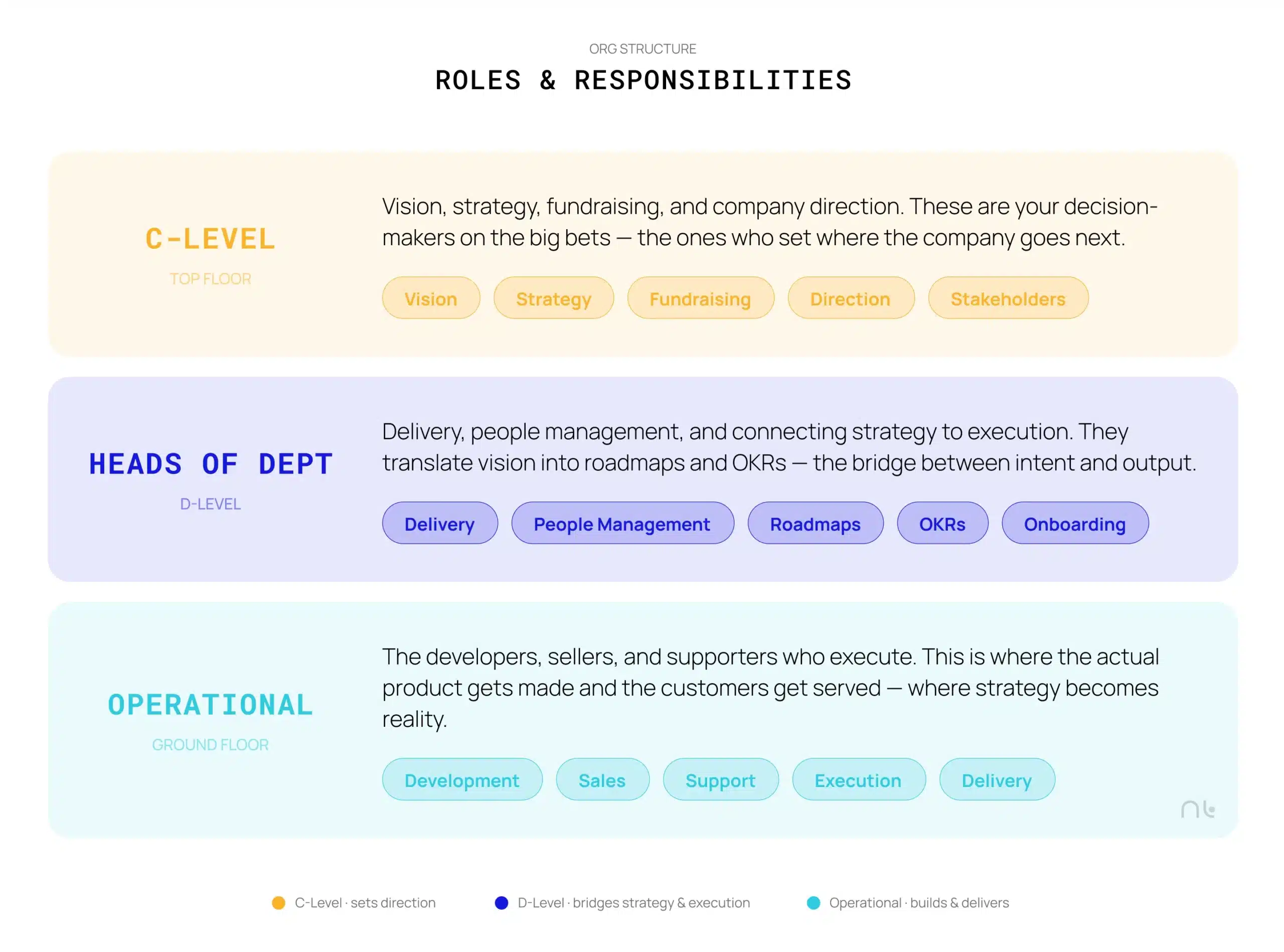
As you scale, startup roles and responsibilities naturally align across three levels:
C-Level: Vision, strategy, fundraising, and company direction. These are your decision-makers on the big bets.
Heads of departments: Delivery, people management, and connecting strategy to execution. They translate vision into roadmaps and OKRs.
Operational level: The developers, sellers, and supporters who execute. This is where the actual product gets made and the customers get served.
Getting these three levels aligned is what separates a company structure for startups that scales from one that implodes. Clear ownership at each level means fewer bottlenecks, faster decisions, and a team that knows exactly what winning looks like.
From our experience at Newxel building tech teams for startups across industries, a few additional points stand out:
1. Cross-functional awareness
Operational teams that understand high-level strategy deliver faster, anticipate challenges, and proactively suggest improvements to workflows and processes.
2. Flexible D-level leadership
Heads of Departments should adjust span-of-control depending on team size and project complexity, delegate effectively, and mentor their teams to handle increasing responsibilities.
3. Dynamic role definition
Early-stage startups benefit when C-Level and D-Level roles overlap temporarily, allowing faster execution, quick pivoting, and seamless knowledge transfer before formal processes are introduced.
4. Transparent communication channels
Regular check-ins, clear documentation, and open feedback loops reduce friction across levels, help identify bottlenecks early, and maintain alignment with company objectives.
5. Talent alignment with culture
Hiring for skill is important, but hiring for adaptability, resilience, and a startup mindset ensures the team can navigate uncertainty and remain motivated during rapid growth.
By combining clear hierarchical alignment with these practical insights from Newxel, startups can establish a tech startup team structure that is both scalable and flexible, minimizing risk while maximizing productivity and team engagement.
Now that we’ve covered the startup stages and clarified roles and responsibilities, we can move to the main part – building the structure itself.
Before you hire anyone or draw a single org chart, be honest about your current stage. Are you a pre-MVP with 2 founders and an idea? Or do you have paying users and a product that works? Your startup team structure has to match reality, not ambition.
Trying to build a scale team structure when you’re still a founders team is one of the most common, and expensive, mistakes in early-stage companies.
List everything that needs to get done to move the company forward. Product, engineering, sales, support, operations, all of it. Then figure out who currently owns what and where the gaps are.
At this stage, you’re not filling positions in a startup, you’re identifying which functions are covered, which are missing, and which a single person is currently handling alone. That last category is usually where burnout hides.
Once you know the gaps, prioritize ruthlessly. Not every gap needs a hire right now. Ask: what’s slowing us down the most? What’s creating the biggest bottleneck in delivery or growth?
For most early-stage startups, the first critical hires follow a predictable pattern, a strong senior developer, a product manager who can own the roadmap, and someone focused on growth or customer success. These are the key positions in a startup company that unlock the next phase.
From Newxel’s experience building a startup team across 8+ years, the most common tech startup team structure we see is: CEO + CTO + development team. We’ve seen this structure work across fintech, healthtech, SaaS, and marketplaces, especially before product-market fit.
It’s lean, it works, and there’s a clear reason why.
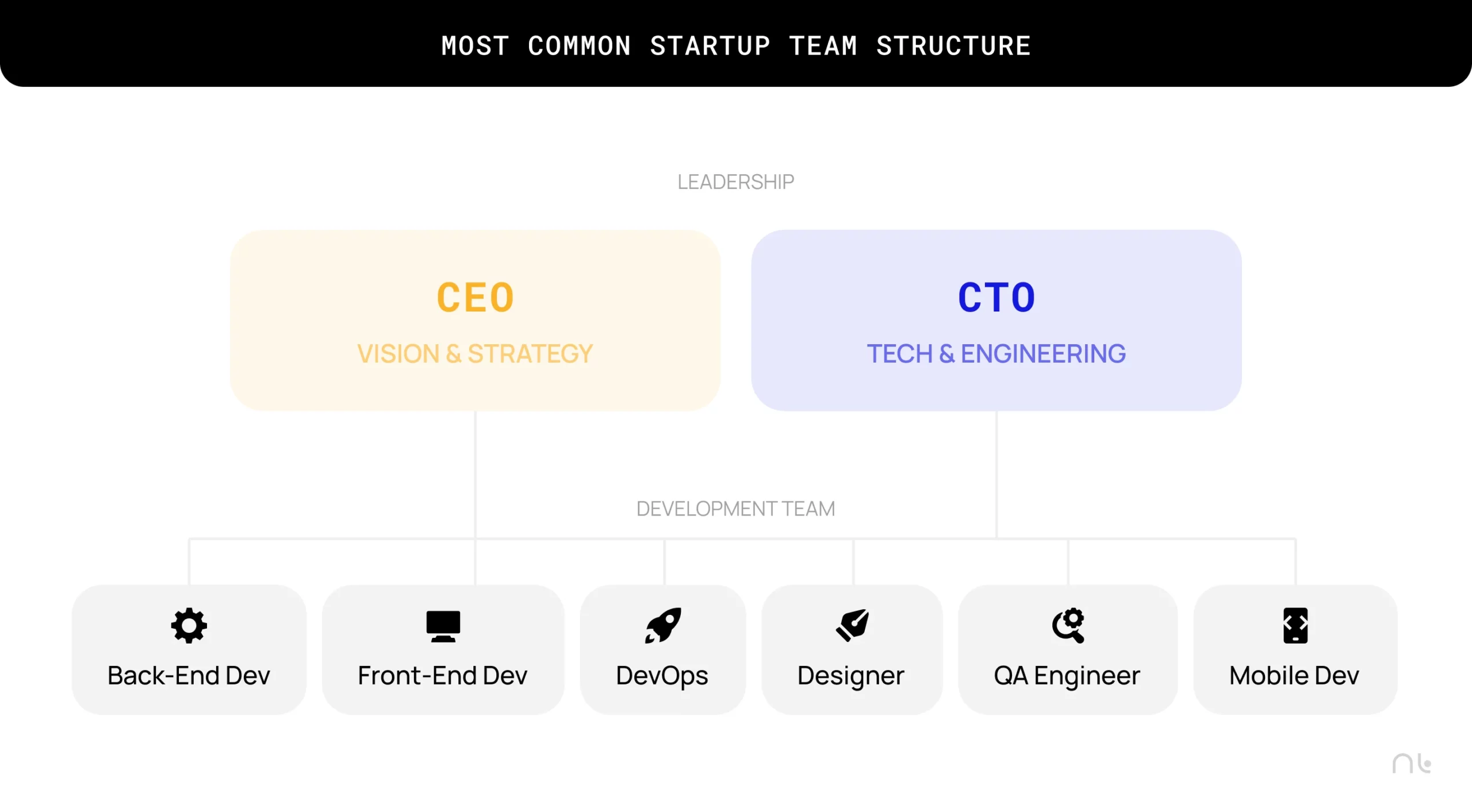
The CEO owns vision, fundraising, and stakeholder relationships. The CTO owns technical direction, architecture decisions, and engineering execution. The dev team, typically 2 to 4 engineers at this stage, builds the product. No redundant layers, no premature management overhead, just three distinct levels of ownership working in tight alignment.
This structure covers the two most critical functions of any early-stage tech company: building and selling. Everything else: HR, marketing, operations, can be handled by founders, outsourced, or added later once there’s proven traction to justify it.
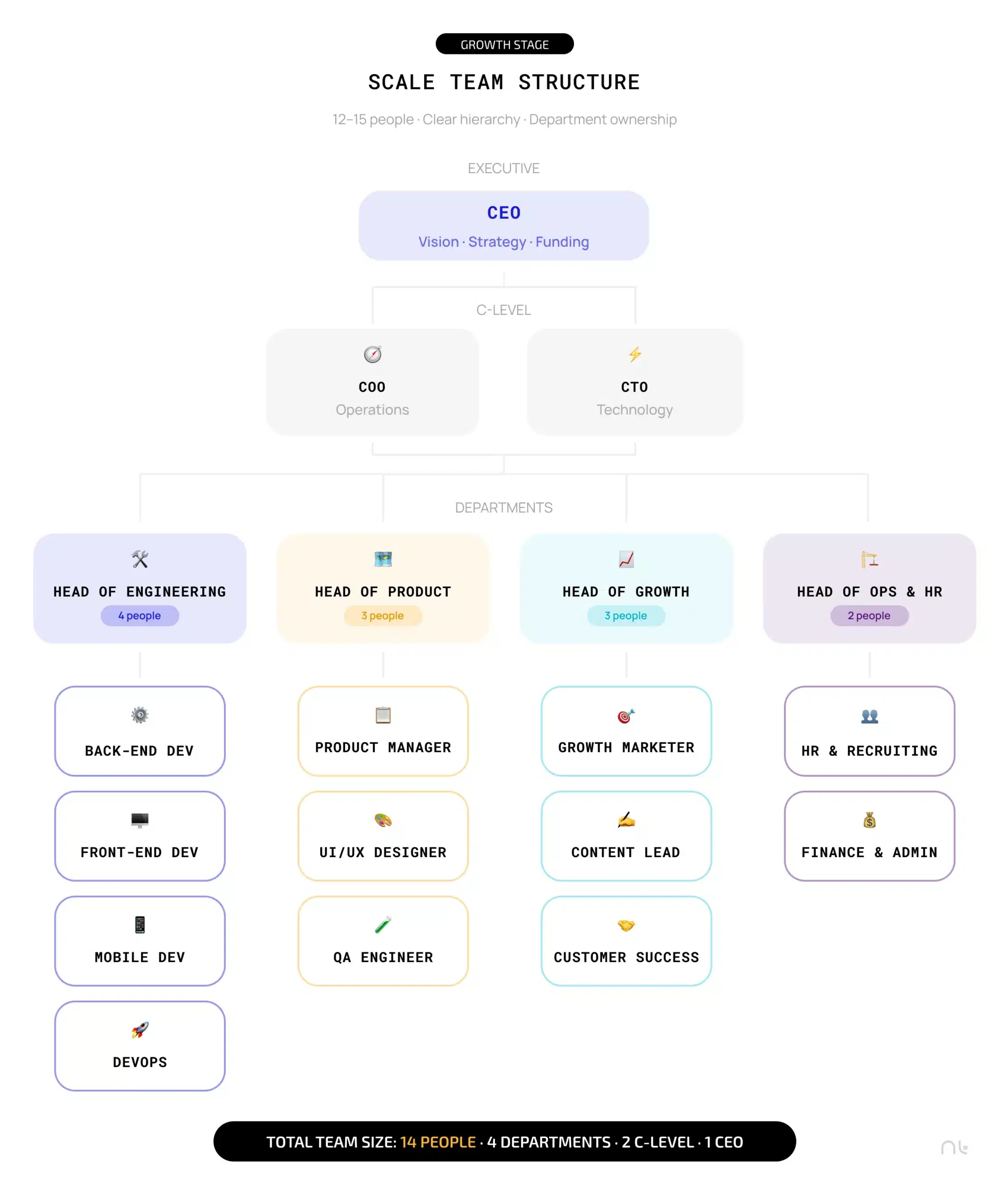
When your startup grows, the team becomes more structured. A simple setup looks like this:
Leadership: CEO to set vision and strategy, COO who manages operations and processes and CTO to lead technology and development
Engineering team: back-end developers, front-end developers, mobile developers
Product team: product manager (PM), designer and QA (quality assurance)
Growth team: marketer, content lead, customer success
People team: HR and finance managers.
Tech company hierarchy chart
This setup gives clear roles and responsibilities, making it easier to scale while keeping everyone aligned.
Before anyone joins, write down exactly what they own, what decisions they can make independently, and how their work connects to the company’s goals. This ensures clarity and prevents confusion later.
This doesn’t need to be a 10-page job spec. A clear one-page summary covering:
The point is that both sides, the hire and the company, know what winning looks like.
You can also check job descriptions for many roles on our career page to get inspiration and templates.
One of the biggest structural mistakes startups make is adding management too early. A team of 6 doesn’t need a middle management layer. A team of 20 probably does.
As a rule of thumb: when any individual at the operational level has more direct reports or workload than they can meaningfully support, it’s time to introduce a Team Lead or Head of Department. Not before.
Startup team structure isn’t just who reports to whom, it’s how information flows. As your team grows, informal Slack conversations stop being enough. Put simple systems in place: regular team check-ins, documented processes, and a structured onboarding flow for every new hire.
Good onboarding and clear communication channels aren’t bureaucracy, they’re what keep a growing team aligned without needing founders to be in every conversation.
A startup team structure isn’t a one-time decision. The lean startup organizational structure that worked at 5 people will start breaking things at 20. Schedule a structural review every time you hit a significant growth milestone, a new funding round, a major product launch, or a significant headcount increase.
The goal is a structure that evolves with the company, not one that holds it back
Newxel is a dedicated tech team building company helping startups and scale-ups hire, structure, and manage high-performing engineering teams in Eastern Europe. Since 2016, we’ve helped over 150 companies, from early-stage founders to Series B+ scale-ups, build the technical foundation they need to grow.
We don’t just place developers. We help clients design the right team structure from day one: the right roles, the right seniority mix, the right reporting lines. Whether a startup needs its first two backend engineers or a full cross-functional team of 20+, Newxel handles recruiting, HR, onboarding, and ongoing management, so founders can focus on the product and the business.
This guide is built on that experience. Eight years of watching startups succeed and stumble has given us a clear picture of what separates teams that scale cleanly from those that hit a wall at 10, 15, or 30 people.
If you’re ready to stop guessing and start building a tech team that actually scales – we’d love to help. Whether you’re hiring your first developer or restructuring a team of 20, Newxel can step in at any stage. Tell us where you are, and we’ll help you figure out where to go next.