How to Hire Polish Programmers: Skills, Costs and Process
19 min
· May 23, 2024
Last updated: October 26, 2026

Poland is emerging as a key hub for software development in Eastern Europe. According to Statista, it has the highest number of developers in the CEE region, with over 400,000 specialists. The industry is booming, too, with a projected market size of US$2.82 billion by 2028.
With these impressive figures, it’s clear why businesses are increasingly turning to Poland for top-notch software talent. Imagine the potential of harnessing the expertise of these experts in your next software project.
Read on as we explore the type of developers you can hire here. We’ll examine their technical expertise, highlight their key strengths, and explain what sets them apart in the global tech scene.
Poland is an established technology hub in Central and Eastern Europe, with a broad ecosystem of software developers, IT services companies, and international R&D operations. However, the size of its talent pool depends on how the workforce is defined: software developers are only one part of the wider ICT workforce, which also includes IT administrators, cybersecurity specialists, data professionals, and other technology roles.
According to Eurostat, ICT specialists accounted for 4.5% of total employment in Poland in 2025. This provides a consistent, dated indicator of the country’s technology workforce, although it should not be interpreted as the share of software developers alone.
For employers, the practical advantage is access to a mature technology ecosystem with experience across software engineering, enterprise systems, cloud infrastructure, and digital product development. Poland is worth considering when building an in-house engineering function, hiring individual specialists, or establishing a dedicated development team.
When evaluating market size, distinguish between the total number of ICT specialists, software developers specifically, IT services companies, and university students. These figures measure different things and should not be combined into a single estimate of available developers.
Hiring software developers in Poland involves more than finding the right technical skills. The employment model determines who manages the developer, who handles employment administration, how costs are structured, and how easily the team can scale.
The right approach depends on whether you need one specialist, several engineers working under your management, or an external team responsible for delivering a defined project.
Direct employment is suitable for companies that want to hire developers as employees and build a long-term engineering organisation. The employer manages the employment relationship, payroll, benefits, and applicable compliance obligations in Poland. This option provides a direct relationship with the developer but requires the appropriate local employment and administrative setup.
B2B contractors work under a business-to-business contract rather than a standard employment agreement. This model can suit independent specialists and project-based engagements. The parties should assess the actual working arrangement, contractual responsibilities, tax treatment, and the risk of misclassification under applicable Polish law rather than assuming that a B2B contract automatically removes employment obligations.
An employer of record (EOR) can employ a developer locally on behalf of a company that does not have its own Polish employing entity. The EOR typically handles employment administration, payroll, and related statutory processes, while the client directs the developer’s day-to-day work within the agreed arrangement. The precise division of responsibilities depends on the contract and local law.
Dedicated development teams are a good fit for companies that need several engineers working continuously on their product or roadmap. The team works toward the client’s priorities and can include developers, QA engineers, DevOps specialists, and technical leads. The provider generally supports recruitment and team administration, while responsibilities for technical leadership and delivery are agreed between the parties.
Project outsourcing suits businesses with a defined scope, deliverables, and acceptance criteria. The external provider takes responsibility for delivering the agreed work, usually with greater control over execution and team organisation. This can reduce the client’s need to manage individual contributors, but it requires clear requirements, delivery milestones, communication processes, and quality standards.
| Hiring model | Control | Administration | Cost structure | Best suited for |
|---|---|---|---|---|
| Direct employment | High | Managed by the employer | Salary, employer contributions, benefits and operating costs | Long-term internal teams |
| B2B contractors | Defined by the contract | Shared according to contractual responsibilities | Contracted fees and applicable business costs | Independent specialists and flexible engagements |
| Employer of record | Day-to-day direction generally stays with the client | Employment administration handled by the EOR | Contractor or employee compensation plus EOR fees, depending on the arrangement | Hiring locally without establishing an entity |
| Dedicated team | Shared, according to the operating model | Often supported by the provider | Agreed recurring team or service fees | Ongoing product development and scaling |
| Project outsourcing | Lower control over day-to-day execution | Primarily managed by the provider | Fixed price, milestones, or time-and-materials, as agreed | Defined projects and deliverables |
Actual costs and responsibilities vary by contract, scope, and legal arrangement. Compare the total cost of engagement, not just the developer’s quoted rate.
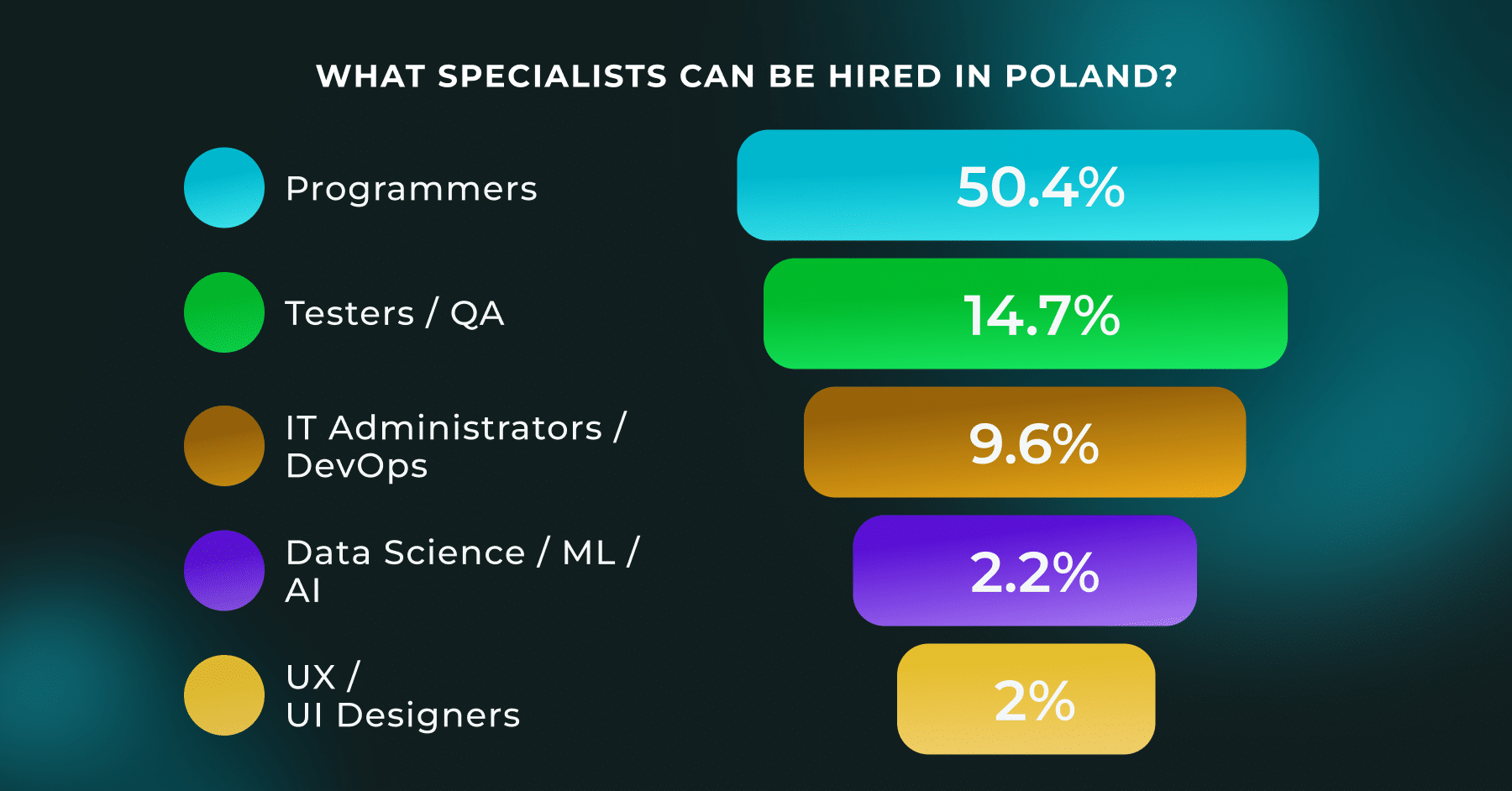
Poland’s technology workforce covers a wide range of software engineering disciplines, from web and enterprise application development to data engineering, cloud infrastructure, and quality assurance. Rather than choosing a developer based on location alone, assess how their experience aligns with your architecture, product stage, and delivery requirements.
A useful way to evaluate Poland’s talent pool is to look at the roles available across the software development lifecycle.
The proportions of these roles depend on the survey, year, and definition of an IT professional. Use a dated source such as the Polish IT Community Report 2025 when presenting survey-based workforce breakdowns, and label the figures as survey results rather than a complete national census.
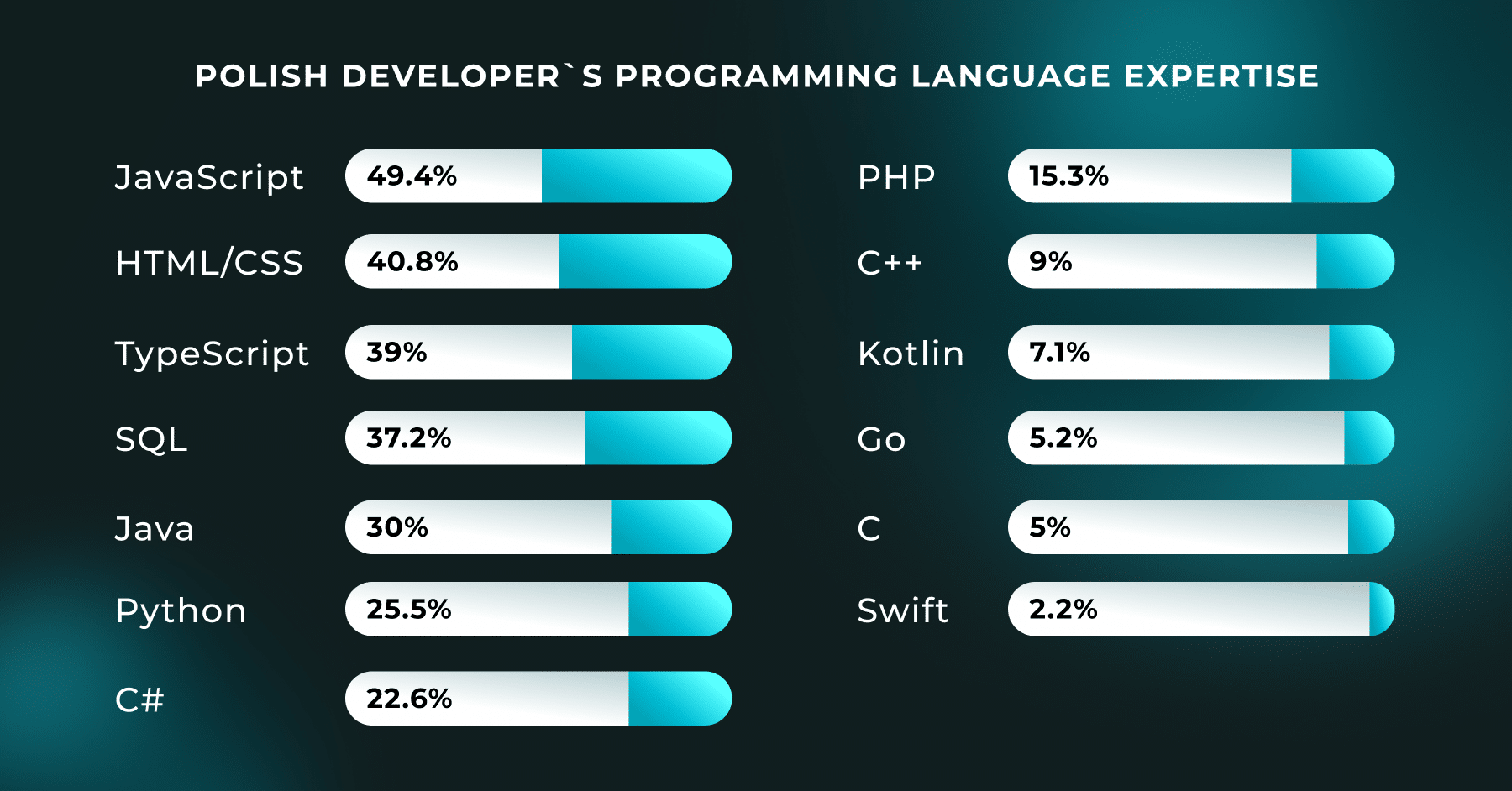
Polish developers work across a range of programming languages and technology stacks. The most relevant skills depend on the product’s architecture, performance requirements, existing codebase, and future roadmap.
Programming-language popularity does not establish an individual developer’s proficiency. Evaluate candidates against the project’s actual requirements, including relevant production experience, architecture decisions, code quality, testing practices, and the ability to maintain existing systems.
When evaluating developers in Poland, focus on verifiable professional capabilities and the conditions that support successful collaboration. Technical experience, communication, reliability, and delivery practices should be assessed individually rather than assumed from nationality.
Assess reliability through evidence: delivery against agreed milestones, code review quality, ownership of technical issues, responsiveness, and how candidates communicate risks or blockers. Structured interviews, reference checks, and practical assessments can help establish whether a developer’s working style matches your team’s expectations.
Poland’s position within the European Union provides a familiar regulatory and commercial environment for many international businesses. Nevertheless, companies should assess current labour costs, tax and employment requirements, currency exposure, and other operational factors when planning a long-term engineering team. Economic stability alone does not guarantee project continuity or individual performance.
Poland has a substantial higher education system, but the number of IT students should not be confused with the number of annual graduates or immediately available software developers.
Statistics Poland reported 1.28 million students across all higher education institutions in the 2024/25 academic year and approximately 292,000 graduates across all fields in 2023/24. These are national higher education totals, not IT-specific figures.
For an accurate assessment of the future developer pipeline, use a dated breakdown of students and graduates in information and communication technologies or relevant STEM disciplines. Avoid presenting the previously cited 86,000 students and 11,000 annual IT graduates as current figures until their definitions and primary sources have been verified.
English proficiency can support collaboration with international product teams, but language ability varies by individual. In the EF English Proficiency Index 2025, Poland ranked 15th globally among 123 countries and regions, with a score of 600. This is a country-level indicator based on test results, not a guarantee of fluency among software developers.
For distributed teams, assess candidates’ ability to discuss technical trade-offs, document decisions, explain blockers, and communicate effectively in meetings and asynchronous channels.
One great thing about hiring software developers from Poland is their versatility across different industries. They’re skilled at crafting custom software solutions tailored to both businesses and users. Some of the industries they specialize in are:
Poland’s developers excel in the finance and banking sector, fueled by the country’s fast growing fintech market. Between 2018 and 2022, the number of fintech companies in Poland increased to 299 from 167. These companies span 15 sectors, with nearly half focusing on payments, financial management, and software delivery. This focus on software delivery has given Polish developers extensive experience in creating complex financial software, managing transaction systems, and ensuring regulatory compliance.
Cybersecurity is another field where Polish software developers stand out. Poland’s focus on cybersecurity education, combined with the growing global need for secure software, has driven this expertise. Polish developers excel in creating secure applications, conducting vulnerability assessments, and implementing strong encryption methods. This expertise is reflected in Poland’s 6th place ranking in the Global Cybersecurity Ranking by MIT Technology Review.
Polish developers excel in creating cutting-edge educational technologies, such as e-learning platforms, virtual classrooms, and educational games. Their expertise, honed through significant contributions to Poland’s EdTech sector, is exemplified by successes like Brainly, LiveKid, and HCM Deck. This background equips them to enhance digital learning experiences and streamline administrative processes in educational institutions.
Poland boasts a robust automotive industry, particularly in automotive software development. Key areas of focus include autonomous driving systems, vehicle diagnostics, and infotainment systems.
As one of Europe’s top 10 largest automobile producers, with a production volume of 451,000 units in 2022, Poland significantly supports the software needs of the industry. This high production level provides developers with valuable experience, enabling them to serve clients globally.
Poland aimed to reach 21% of energy from renewable sources by 2030. Surprisingly, the country achieved 27% in 2023, indicating faster progress than expected. This early success signals positive momentum and sets the stage for Poland to pursue even more ambitious renewable energy goals. It also highlights significant advancements by Polish developers in areas such as renewable energy management, smart grid technology, and energy efficiency solutions. Such expertise could benefit industry clients globally.
The cost to hire Polish programmers depends on seniority, specialization, contract type, location, and the scope of responsibility. A junior developer working on a clearly defined task will have different compensation expectations from a senior engineer responsible for architecture, mentoring, and production systems.
When planning a budget, compare equivalent roles and distinguish employee salaries from contractor invoices and development vendor rates. These figures represent different costs and should not be compared directly without accounting for taxes, benefits, and service fees.
Three cost categories are particularly important when hiring in Poland:
As a reference point, Just Join IT’s 2025 job-offer data reported median monthly rates of PLN 8,000 gross under employment contracts and PLN 9,020 net on B2B invoices for junior roles; PLN 15,000 and PLN 18,900 for mid-level roles; and PLN 21,573 and PLN 24,780 for senior roles, respectively. These are market-wide benchmarks, not guaranteed offers or vendor prices.
Use current salary reports and comparable job postings to establish a realistic range for your specific role. Then assess the total cost of engagement before choosing an employment or outsourcing model.
The advertised salary or hourly rate is only one part of the hiring budget. Businesses should account for the full cost of sourcing, selecting, onboarding, and retaining a developer.
Include these items in your estimate:
The final budget should reflect the chosen hiring model. For example, a dedicated team provider may consolidate several operational costs into a recurring service fee, while direct employment requires the company to manage those costs separately.
Businesses looking to hire Polish programmers can use several sourcing channels, from public job boards to direct outreach and professional referrals. The best approach depends on the seniority of the role, how specialised the required skills are, and how quickly the company needs to fill the position.
Local job boards help employers reach active job seekers and benchmark salary expectations. Polish IT job platforms such as No Fluff Jobs and Just Join IT can help identify candidates, review advertised compensation, and understand demand for particular technologies.
Direct outreach is useful when a role requires specific production experience or a seniority level that is difficult to source through applications alone. Recruiters can identify relevant profiles, review project backgrounds, and contact developers whose experience matches the role.
Referrals can introduce candidates through existing employees and professional networks. They can be a useful additional sourcing channel, but referred candidates should complete the same structured screening and assessment process as other applicants.
Combine these channels rather than relying on a single source. Track candidate quality, response rates, interview conversion, time to hire, and eventual retention to understand which recruitment activities produce the best results.
An external recruitment partner can be useful when your internal team lacks local sourcing capacity, needs access to a specialised candidate pool, or must hire several developers within a defined timeframe.
A dedicated team partner is more appropriate when the requirement extends beyond recruitment to team formation and ongoing operational support. Depending on the agreement, the provider may help source developers, coordinate contracts, handle payroll and benefits, arrange equipment, and support onboarding.
Before engaging a partner, clarify who manages technical screening, who makes the final hiring decision, how replacement requests work, what the commercial terms include, and which party is responsible for employment and contractual obligations.
For businesses that want to hire a Polish developer without building every local process internally, the right partner can reduce administrative work and make scaling more manageable.
A structured hiring process helps companies evaluate candidates consistently and avoid unnecessary delays. Whether you are hiring one engineer or building a larger team, define the requirements first and align technical assessment, communication expectations, and contract terms before making an offer.
Start by documenting the role’s responsibilities and the outcomes the developer is expected to deliver.
Specify the required technology stack, relevant production experience, seniority, and level of ownership. A senior developer may need to make architecture decisions, mentor colleagues, and manage technical risk, while a junior developer may need more guidance and a clearly defined scope.
Also establish the working arrangement, time-zone overlap, language requirements, reporting line, and expectations for documentation and collaboration. Clear criteria help recruiters source relevant candidates and reduce mismatches later in the process.
Review candidates against the role requirements rather than relying on job titles, years of experience, or lists of technologies alone.
Look for evidence of comparable work: systems built, technical challenges resolved, production environments supported, and contributions to team delivery. For senior roles, assess architecture ownership, decision-making, mentoring, and the ability to explain trade-offs.
A structured screening process should also verify essential qualifications and clarify any gaps in a candidate’s experience before technical interviews begin.
Use a technical assessment that reflects the work the developer will actually perform. Depending on the role, this may include a code review, a focused programming exercise, a system-design discussion, or a review of a relevant past project.
Evaluate code quality, testing practices, debugging, security awareness, and the ability to explain technical decisions. For senior candidates, explore how they handle ambiguity, prioritise trade-offs, and support other engineers.
Assess communication separately. Developers working in international teams should be able to explain progress, document decisions, raise risks early, and discuss disagreements constructively. Keep assessments consistent across candidates and avoid unnecessary unpaid assignments.
Once the preferred candidate has passed the assessments, agree on compensation, contract type, responsibilities, working hours, start date, benefits, and any probation or termination provisions that apply.
Confirm intellectual property ownership, confidentiality, data protection, equipment, and access requirements in the appropriate agreements. Have qualified local advisers review arrangements where necessary.
Prepare onboarding before the developer starts. Arrange accounts, hardware, repository access, security training, documentation, and introductions to the team. Set clear initial goals and identify a technical contact who can help the new hire become productive.
A well-planned onboarding process helps turn a successful recruitment decision into an effective long-term working relationship.
The time required to hire a developer in Poland depends on candidate availability, role complexity, seniority, interview stages, compensation, and the selected engagement model.
A straightforward search for a widely available skill set may move faster than a search for a senior engineer with specialised domain knowledge or experience in a regulated industry. Internal decision-making and contract approvals can also extend the process.
The recruitment timeline should distinguish between finding a suitable candidate, completing the interview process, agreeing on terms, and the candidate’s actual start date.
For planning purposes, allow time for:
Do not promise a fixed start date based solely on the time needed to produce a shortlist. Candidates may have existing commitments, and specialist roles can require a longer search.
If speed is critical, agree on the essential requirements in advance, consolidate interviews where possible, and establish who can approve the offer. A recruitment or dedicated team partner may also help coordinate sourcing and administrative steps.
Hiring successfully requires more than competitive compensation and access to a large talent pool. Unclear expectations, weak screening, incomplete contracts, and unrealistic start dates can undermine the process even when suitable candidates are available.
Market reports and technology surveys can help employers understand the broader talent landscape, but they cannot establish an individual developer’s ability.
Assess each candidate’s relevant experience, technical judgment, code quality, communication, and approach to problem-solving. Match the assessment to the role’s actual responsibilities and seniority rather than treating a particular nationality, university, or technology ranking as proof of performance.
Before work begins, establish who owns the code and other deliverables, how confidential information is protected, and which party is responsible for security, data handling, and compliance.
Review intellectual property assignment, confidentiality obligations, termination provisions, and any relevant subcontracting restrictions. Make sure the contractual structure reflects the actual working arrangement and applicable Polish law.
For direct employees, B2B contractors, and outsourced teams, responsibilities may differ. Obtain appropriate legal advice rather than assuming the same contract terms will work for every model.
Poland’s Central European working hours can support collaboration with teams across Europe and provide some overlap with North American teams. The actual overlap depends on where colleagues are located, their working schedules, and seasonal daylight-saving changes.
Agree on core collaboration hours, meeting expectations, asynchronous communication, and response times before the developer starts. Avoid requiring unnecessary real-time availability across every time zone.
Retention also deserves attention. Competitive compensation matters, but so do clear responsibilities, supportive technical leadership, meaningful work, professional development, and manageable workloads.
Monitor retention through regular feedback, career conversations, and team health checks. A hiring decision should support not only a successful start date but also a sustainable working relationship.
Hiring developers in Poland requires more than finding candidates with the right technical skills. Businesses also need a reliable recruitment process, clear employment arrangements, and the operational support to onboard and retain talent.
Whether you’re looking to hire a full-stack developer, assemble IT augmentation teams, or establish dedicated development teams in Poland, Newxel, as your trusted IT staffing partner, can streamline your entire process.
We don’t just hire software developers in Poland, we handle recruitment, team formation, and all administrative and legal matters, ensuring a smooth setup process. With our efficient approach, your team can be ready to go in just 3 to 5 weeks, helping you scale up quickly and meet those project deadlines.
Partner with Newxel to tap into a vast talent pool, get cost-effective solutions and ongoing support, and set your company up for success in the global market. Contact us!
Poland’s robust IT landscape, thriving economy, government support, and skilled workforce make hiring software developers there a big win for businesses looking to bridge internal skills gaps and access top-tier talent for their development projects. Remember, however, working with the right staffing partner, like Newxel, is a key ingredient for success.